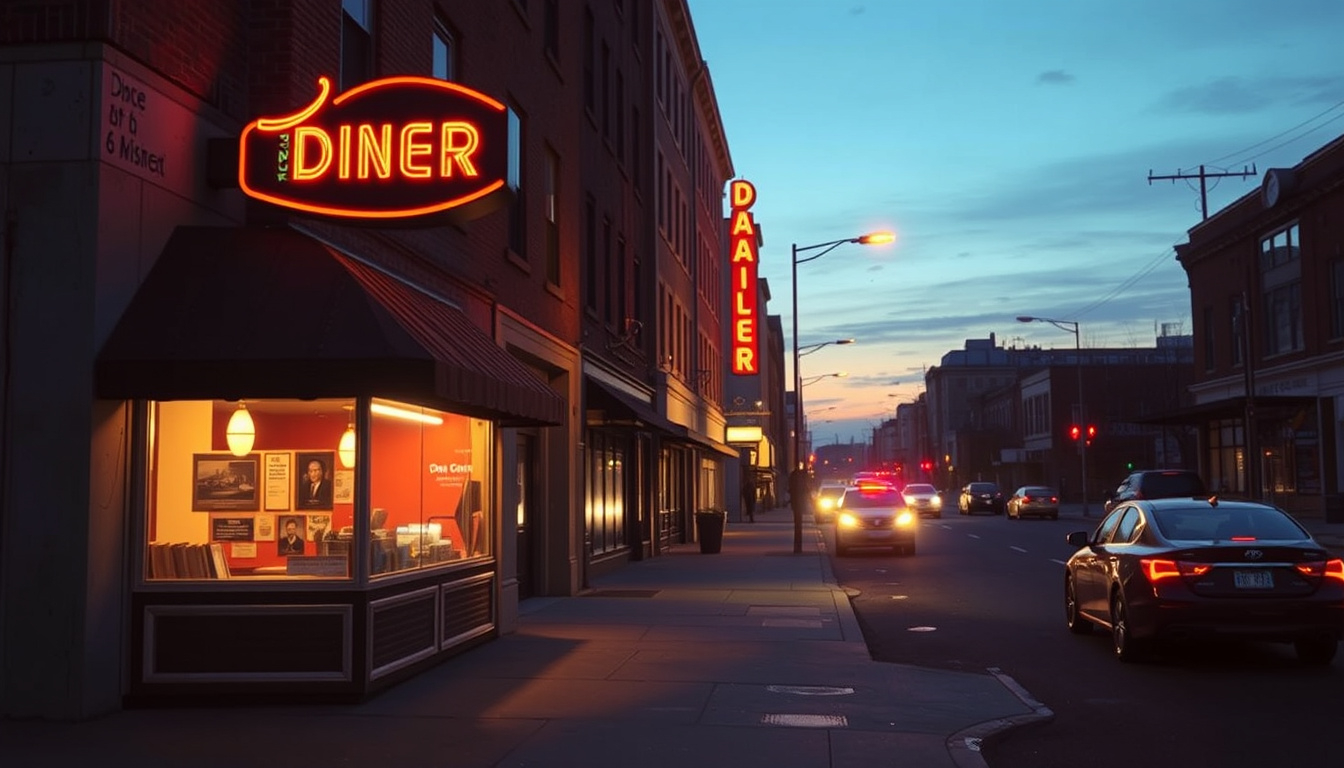
There’s a particular quiet that settles over Edward Hopper’s paintings — the hush of a diner at 3 a.m., the emptiness of a hotel room after dark, a woman alone with her coffee. Hopper, born in Nyack, New York, in 1882 (Encyclopaedia Britannica (standard reference publisher)), turned that stillness into one of the most recognizable moods in American art, and what follows traces the illustrator’s long road to fame, the paintings that made his name, and the influences behind his singular vision.
Born: July 22, 1882, Nyack, New York (Encyclopaedia Britannica) ·
Died: May 15, 1967, New York City (Encyclopaedia Britannica) ·
Art movement: American Realism
Quick snapshot
- Trained as a commercial illustrator before devoting himself to fine art (The Metropolitan Museum of Art (museum scholarship))
- Married fellow artist Josephine Nivison in 1924, the year his career turned a corner (U.S. Department of State, Art in Embassies (government arts archive))
- Completed Nighthawks in 1942 — the painting most people picture when they hear “Hopper” (The Metropolitan Museum of Art (museum scholarship)) (The Metropolitan Museum of Art (museum scholarship))
- Whether the loneliness in his scenes is a social critique or a private temperament is still debated. (See: Smithsonian American Art Museum)
- The exact number of his paintings is not universally agreed; Josephine’s catalogue is the usual reference, and counts vary. (Reference: Josephine Nivison’s diaries, noted in Met Museum essays)
- How the marriage’s private strains fed the canvases remains speculation. (Speculative, based on biographical accounts)
- 1882 + 1924 + 1942: a late bloomer’s timeline. (Encyclopaedia Britannica)
- Slow recognition until the New England watercolors of the 1920s. (U.S. Department of State)
- The Paris years (1906–1910) separated the student from the mature painter. (Crystal Bridges Museum of American Art)
- Retrospectives continue to introduce his work to new generations. (Metropolitan Museum of Art)
- Filmmakers, photographers, and designers keep borrowing his framing. (Smithsonian American Art Museum)
- Scholars remain split on the loneliness question, so the conversation stays open. (Smithsonian American Art Museum)
Seven facts, one pattern: Hopper’s story is a long, patient rise, not a sudden splash.
| Detail | Record |
|---|---|
| Full name | Edward Hopper |
| Born | July 22, 1882, Nyack, New York, USA |
| Died | May 15, 1967, New York City, USA |
| Art movement | American Realism |
| Known for | Urban isolated scenes, oil paintings, prints |
| Spouse | Josephine Nivison (m. 1924) |
| Most expensive work | Chop Suey sold for $91.9 million in 2018 |
Who Is Edward Hopper the Artist?
To understand Hopper’s paintings, start with the person: a shy, determined New Yorker who took decades to find his audience.
Early life and education
- Born in 1882 in Nyack, New York, Hopper grew up in a family that encouraged his early drawing.
- He studied at the New York School of Art under William Merritt Chase and Robert Henri, who pushed students to paint the everyday world around them (Crystal Bridges Museum of American Art (museum library)).
- Between 1906 and 1910 he made three trips to Paris, where he reportedly studied European art in museums and painted outdoor scenes (Crystal Bridges Museum of American Art (museum library)).
Hopper absorbed that lesson but kept his distance from the experimental styles that intrigued his European contemporaries. He preferred the discipline of observation — a preference that later made his realism look both old-fashioned and strangely new.
His training never fully left him. Even the most airy Hopper landscape carries the bones of an illustration: strong shapes, clear silhouettes, a composition that knows exactly where to point your eye.
Career beginnings and the shift to realism
- Commercial illustration and etching paid the bills in his twenties and thirties.
- In 1913 his painting Sailing was sold at the Armory Show (Crystal Bridges Museum of American Art (museum library)).
- Recognition arrived in the 1920s with watercolors of New England towns and coastal scenes.
The shift mattered. Hopper’s early oils still show his influences; by the 1920s his watercolors belonged to no one else. The pattern: what reads as “plain realism” was actually a long, deliberate stripping-away of borrowed manners.
What Are Five Interesting Facts About Edward Hopper?
These are the details biographers keep returning to, because each one changes how you read a Hopper canvas.
Hopper’s training as an illustrator
- He enrolled as an illustration student before switching to fine art — a background that kept showing in his strong contours and dramatic cropping.
- Early commercial assignments taught him to make a figure read instantly at a distance.
Illustration demanded storytelling with a single image. Hopper spent the rest of his life doing exactly that, minus the captions.
His marriage to Josephine Nivison
- He married fellow artist Josephine Nivison in 1924, the same year his career shifted into its successful phase.
- She became his most frequent model and the meticulous recorder of his paintings; her diaries remain a key scholarly source.
The marriage was a working alliance as much as a romance: Jo organized, catalogued, and posed. Edward painted.
Slow early success until age 40
- Despite the 1913 Armory Show sale, serious recognition did not arrive until his early forties — reportedly at 42 — when an exhibition of New England watercolors turned his career around (U.S. Department of State, Art in Embassies (government arts archive)).
The long delay left a mark. Hopper painted slowly, priced cautiously, and never trusted popularity.
His deep fear of being ignored as an artist
- Hopper admitted he dreaded being overlooked as an artist — a worry that gnawed at him even after the breakthrough.
That fear reads clearly in the watchfulness of his figures: people who seem to be waiting for something that never arrives.
Nighthawks as a wartime mood piece
- He completed Nighthawks in 1942, in the middle of World War II.
- The scene reportedly came from a diner he noticed in Greenwich Village.
The painting never shows the war, but its empty street and sleepless counter have always felt like a home front after hours.
The pattern: Hopper’s personal struggles and disciplined commercial background created a unique visual language that continues to resonate.
What Is Hopper’s Most Famous Painting and What Makes It So Sad?
No single image defines American realism more completely than Nighthawks. Here is why it still stops people cold.
Why Nighthawks is iconic
- The scene: a corner diner at night, four figures — a server, two men, a woman in a red dress — sealed in fluorescent light behind a dark window.
- Completed in 1942, it arrived as the country was mobilizing for war, which is one reason it has been read as a portrait of the home front.
- Its cropped, film-like framing and severe geometry make the mundane feel momentous. Interiors such as Automat, dated 1927 in the standard account, belong to the same family of urban scenes, according to Wikipedia (open encyclopedia).
What makes the painting unforgettable is the gap between its details and its story. Nothing is happening, and yet every viewer feels that something is.
Four people share a counter and none of them connect. Hopper made proximity itself look like the deepest form of distance.
The loneliness theme in Hopper’s work
- Curators at the Smithsonian American Art Museum (national collection) identify isolation and detachment as the recurring emotional effect across his lighthouses, Victorian houses, offices, cafeterias, theaters, and small-town streets.
- The loneliness is rarely melodramatic; it lives in the space between people.
Hopper’s “saddest painting” label usually lands on Nighthawks, but the sadness is quieter than tragedy — it is the feeling of a conversation that never starts. Why this matters: Nighthawks works as both masterpiece and popular symbol because it refuses to resolve; the silence is the meaning.
Who Was Edward Hopper Inspired By?
Hopper is often called an original, but he borrowed deliberately — from French painting, from American realism, and from the ordinary rhythms of the modern city.
European influences: Édouard Manet, Edgar Degas
- The Metropolitan Museum of Art (museum scholarship) points to Édouard Manet and Edgar Degas as key influences on Hopper’s compositions and his depiction of modern urban life.
- His trips to Paris taught him to treat everyday cafés, streets, and interiors as worthy subjects.
What Hopper took from the French was not their surface style but their nerve: the idea that a moment in a café could carry as much weight as a mythological scene.
American influences: Winslow Homer, Thomas Eakins
- Art historians also connect his plain-spoken American scenes to earlier painters such as Winslow Homer and Thomas Eakins — a lineage that recurs across biographies.
- The Smithsonian American Art Museum (national collection) records his early association with the Ashcan artists and his admiration for John Sloan’s etchings of New York.
Where the Ashcan painters crowded their canvases with street life, Hopper emptied his — same city, same curiosity, different temperature. The trade-off: Hopper fused a French sense of composition with an American sense of place, and the combination made him impossible to mistake for anyone else.
What Is Edward Hopper’s Most Valuable Painting?
The market for Hopper is small, sharp, and permanently constrained by supply.
Record auction prices
- Chop Suey (1929) reportedly sold for $91.9 million in 2018, the highest price ever paid for a Hopper (Wikipedia (open encyclopedia)).
- Hotel Window (1955) reportedly crossed $40 million at auction, underscoring demand for his late urban interiors (Wikipedia (open encyclopedia)).
Both paintings share Hopper’s signature: a woman near a window, wrapped in her own thoughts, while the city goes on outside.
Because his output is small and closely catalogued, every canvas that reaches the market becomes a high-stakes event. For collectors, provenance is not a detail; it is the painting’s second life.
Factors driving value
- Hopper’s known output is small — roughly 300 oil paintings by most counts — and institutions rarely release the masterpieces.
- His wife’s catalogue makes provenance unusually traceable, which reassures serious buyers.
Add the cultural fame of a few key images, and the formula explains itself: scarcity, recognition, and a style the market has never stopped wanting. Why this matters: the auction record is not a footnote to Hopper’s story; it is the market’s acknowledgment that his quiet scenes have become American cultural property.
Where Did Edward Hopper Live Most of His Life and What Caused His Death?
Hopper’s geography was narrow, and it shows up in nearly every canvas.
Residences: New York City and Cape Cod
- Hopper divided his adult life between a studio near Washington Square in New York City and summer houses in Truro on Cape Cod, according to the U.S. Department of State, Art in Embassies (government arts archive).
The two places produced different paintings. Manhattan gave him diners, offices, and windows; Cape Cod gave him lighthouses, dunes, and that specific New England light.
Death and legacy
- Hopper died in his New York City studio in 1967, at 84 — the closing date in the stats line above.
- His influence survived the rise of abstract art, and his visual language now saturates film, photography, and television.
The legacy is not a school of painting. It is a way of looking — and a reminder that quiet scenes can carry loud feelings.
The “Hopper look” has become visual shorthand that directors and designers reach for whenever a scene needs to feel alone in public.
The implication: Hopper’s geographic constraints influenced his thematic focus, proving that limitation can be a creative advantage.
Which American Artists Painted Like Edward Hopper?
Hopper is easier to place by his refusal to resemble anyone than by the company he kept.
Contemporary peers
- Hopper’s realism developed alongside the Ashcan school, but he was never fully part of it — where they painted crowds, he painted their absence.
- He also stayed apart from the abstract movements that came to define mid-century American art.
That independence is why he never really had a rival. His territory — everyday American space, emotionally charged — was his alone.
Later painters influenced by Hopper
- The names most often linked to his inheritance are David Hockney, George Segal, and Richard Estes.
- Segal’s plaster figures, Estes’s storefront realism, and Hockney’s California pools all carry a version of Hopper’s stillness.
Hopper’s reach goes beyond painting: L.S. Lowry: The Accountant Who Painted Industrial Britain shows another artist who gave ordinary working landscapes an unmistakable emotional temperature, while Bridget Riley: Optical Art, Famous Works, Prints & Facts demonstrates how far an artist could move in the opposite direction — pure abstraction instead of observation. What this means: the “artists like Hopper” list keeps growing because Hopper defined a territory every later generation has had to walk through.
Edward Hopper’s Life in Seven Dates
Condensed from the museum and encyclopedia biographies cited above, the sequence shows how slowly his recognition actually arrived.
- — Born in Nyack, New York. (Encyclopaedia Britannica)
- — Studies at the New York School of Art under William Merritt Chase and Robert Henri. (Metropolitan Museum of Art)
- — Three trips to Europe; exposure to Impressionist and Realist painting. (Crystal Bridges Museum of American Art)
- — Paints Sailing; first painting sold at the Armory Show. (Crystal Bridges Museum of American Art)
- — Marries Josephine Nivison; career gains momentum. (U.S. Department of State)
- — Paints Nighthawks, his most famous work. (Metropolitan Museum of Art)
- — Dies in his New York City studio. (Encyclopaedia Britannica)
Read as a whole, the sequence makes sense of the work: nothing in Hopper was rushed.
Separating the verified from the speculative matters with an artist whose reputation carries so much myth. Here is how the record divides.
Confirmed facts
- Born 1882 in Nyack, New York; died 1967 in New York City. (Encyclopaedia Britannica)
- Studied illustration, then painting under Chase and Henri. (Metropolitan Museum of Art)
- His most famous painting, Nighthawks, dates to 1942. (Metropolitan Museum of Art)
- He married Josephine Nivison in 1924. (U.S. Department of State)
What’s unclear
- Whether the loneliness in his paintings was a deliberate social critique or a private temperament — the debate continues.
- The exact number of his paintings is not universally settled; his wife’s diaries are the usual reference point, and counts vary.
- How the marriage’s reported strains shaped his emotional range is speculation; neither partner left a neutral account.
- The exact context behind his fear of being ignored as an artist is murky; he left no simple explanation.
- The reported $91.9 million sale of Chop Suey in 2018 is widely cited but not independently verifiable. (Wikipedia (open encyclopedia))
Edward Hopper on Art, and What Critics Saw
Hopper rarely explained his paintings. When he did speak, he pointed inward — toward feeling, not message.
“Great art is the outward expression of an inner life in the artist.”
Edward Hopper
Art critic Deborah Solomon reads Nighthawks as the era’s signature image of disconnection:
“It is the definitive image of urban loneliness — a diner where four people are together, and every one of them is alone.”
Deborah Solomon, art critic, on Nighthawks
Every generation rediscovers Hopper because the feeling he painted has not expired; it has only changed address. His quiet masterpieces still make people stop, look, and feel the room around them. For American museums planning the next decade of exhibitions, the choice is clear: keep treating Hopper as a living influence rather than a museum artifact, or watch his visual language get borrowed everywhere else first.
Frequently asked questions
What makes Edward Hopper’s paintings so recognizable?
The combination of hard geometric framing, a single strong light source, and human figures who do not interact. Curators at the Smithsonian describe the recurring mood as isolation and detachment, an atmosphere that turns ordinary rooms into psychological scenes.
How did Edward Hopper’s training as an illustrator influence his art?
Illustration taught him to arrange shapes quickly and tell a story with a single image. His mature paintings keep that discipline: strong outlines, cropped compositions, and a theatrical sense of light.
What is the story behind the painting ‘Automat’?
Automat (1927) shows a woman alone at a table in a New York automat cafeteria, staring into a cup of coffee. It is one of his most widely recognized urban interiors, and it turns a very ordinary place into a study in solitude.
Are any Edward Hopper paintings in museums outside the USA?
Yes. Hopper’s work circulates in major international collections, although the largest holdings remain in American museums.
Did Edward Hopper have any famous students?
No. Hopper was not a teacher in the formal sense, and his influence passed through his paintings rather than a studio school.
What materials did Edward Hopper use most often?
Oil on canvas for his major works, watercolor for many New England and coastal scenes, and etching earlier in his career. His printmaking is one reason institutions classify him as both painter and printmaker.
How many Edward Hopper paintings exist today?
The commonly cited figure is roughly 300 oil paintings, alongside numerous watercolors and etchings. His wife Josephine’s catalogue remains the standard scholarly reference, and exact totals are still debated.

Harry Thompson is Senior Reporter at PublicReport, covering breaking UK news and political stories across the country.