
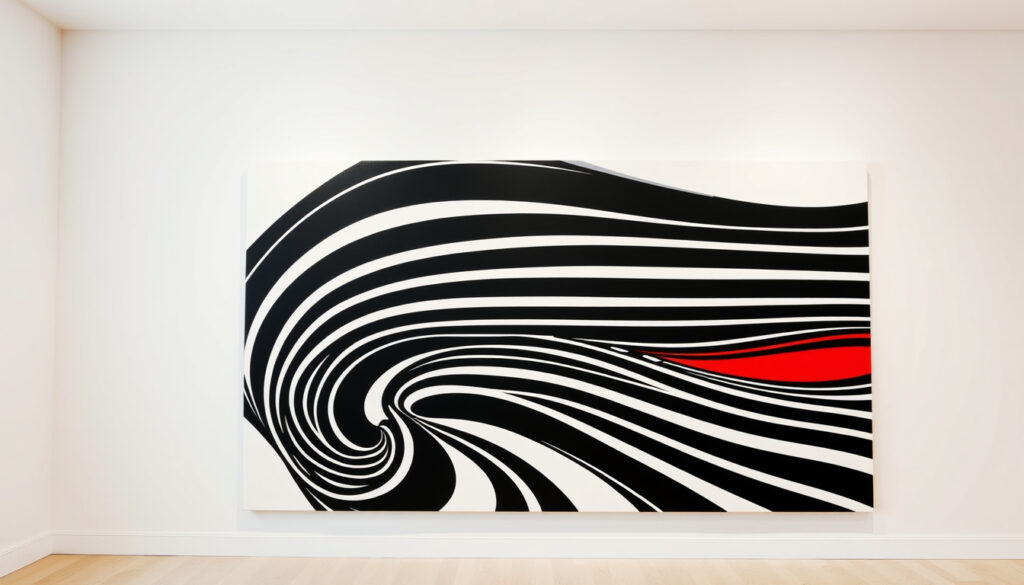
You’ve probably seen a Bridget Riley painting even if you didn’t catch the name beside it — the kind of canvas that seems to ripple and flicker the longer you look (Tate (museum artist biography)), and Riley has been refining that optical effect for most of her working life, with geometric canvases that now anchor major museum collections from London to New York. This guide separates the documented facts of her career from the search questions that keep circling her — from frottage to signed print values — so you can tell what’s established, what’s still uncertain, and what actually matters next.
Born: 24 April 1931, Norwood, London · Movement: Op Art, 1960s · Education: Goldsmiths College (1949–52); Royal College of Art · Signature National Gallery work: Messengers wall painting · Practice: Painting and printmaking
Quick snapshot
- Born 24 April 1931 in Norwood, London (Encyclopaedia Britannica (reference publisher))
- Studied at Goldsmiths College and the Royal College of Art (National Museum of Women in the Arts (museum biography))
- A leading figure in 1960s Op Art (Art UK (arts charity))
- Whether any single artwork can officially be called her “most famous” piece
- The National Gallery’s complete 2026 exhibition programme
- Current market values for individual signed prints
- 1931: born in Norwood, London (Encyclopaedia Britannica)
- 1960: decisive turn toward optical abstraction (Tate)
- 1965: included in The Responsive Eye at MoMA (Museum of Modern Art)
- National Gallery 2026 programming: watch official channels
- Signed-print buyers: verify edition, condition, and provenance first
- Museum retrospectives continue to document her legacy
Six rows, one pattern: every major turn in Riley’s career happened in public — in art schools, galleries, and museums — which is why the paper trail stays so consistent.
| Attribute | Detail | Source |
|---|---|---|
| Born | 24 April 1931, Norwood, London | Encyclopaedia Britannica (reference publisher) |
| Training | Goldsmiths College (1949–52); Royal College of Art (1952–55) | National Museum of Women in the Arts (museum biography) |
| Movement | Op Art, with 1960s prominence | Museum of Modern Art (exhibition organiser) |
| First solo exhibition | Gallery One, London, 1962 | Princeton University Art Museum (museum account) |
| MoMA breakthrough | Two works in The Responsive Eye, 1965 | Princeton University Art Museum (museum account) |
| Technique | Black-and-white geometric forms at the start; colour enters the stripe paintings later | Op-Art.co.uk (Op Art reference site) |
What is Bridget Riley’s most famous piece of art?
There’s no official registry that crowns a single Riley canvas, and museums tend to treat “most famous” as a moving target. But one work keeps surfacing in that conversation, and a 1965 exhibition explains why the question exists at all.
Which works feature in Bridget Riley’s landmark Op Art period?
- Movement in Squares — frequently cited as a landmark Op Art work by Riley (Art UK, arts charity).
- Black-and-white geometric paintings — lines, squares, ovals, and repeated patterns dominated her early Op Art period (see the technique row in the table above).
- Stripe paintings — the undulating black-and-white stripes that became shorthand for Op Art after The Responsive Eye (see the institutional quotes below).
The 1965 Museum of Modern Art exhibition The Responsive Eye is the moment most often tied to Riley’s breakout. The show reportedly brought international attention to her and the other Op artists on display (Museum of Modern Art (exhibition organiser)).
Then there’s the institutional move. The National Gallery in London presents Messengers, a large-scale wall painting by Riley, and its artist page for her keeps the work visible in a collection better known for older masters. That curatorial decision says a lot about where “most famous” now points: not at a single canvas, but at a living artist being folded into art history in real time.
What is the significance of the National Gallery’s ‘Messengers’ wall painting?
Messengers matters because it turns Riley from an artist you visit in a modern wing into an artist the National Gallery treats as part of the permanent story. The painting gives her a fixed address in British art history.
The pattern: fame in Op Art isn’t one canvas — it’s a set of images that moved through one 1960s moment and never left the cultural frame. Messengers simply gave that moment a permanent wall.
The pattern: the “most famous” question is answered differently by the market, the museum, and the history books.
What is frottage in art?
Frottage is a technique that creates images by rubbing over a textured surface — paper laid against wood grain, stone, or fabric and shaded with a soft pencil until the pattern transfers. It’s a real method. It’s just not Bridget Riley’s method.
How does frottage relate to Bridget Riley’s working methods?
Frottage belongs to a different artistic lineage. Riley’s mature optical style is geometric abstraction built from controlled patterns — not rubbing-based imagery.
The technique that actually shaped her early development was pointillism. Around 1958, Riley moved from semi-Impressionist figure painting to pointillist landscapes (Tate, museum artist biography), drawn to the way Georges Seurat’s juxtaposed colour dots activated optical perception (National Museum of Women in the Arts, museum biography).
So when a search engine pairs “frottage” with “Bridget Riley,” the connection is mostly a mismatch of labels — a texture-based drawing technique grafted onto an artist whose textures are optical, not physical.
What other techniques did Bridget Riley use before Op Art?
- Life drawing — her early training was grounded in the figure, as discussed in the biography section below.
- Figurative painting — semi-Impressionist subjects before the turn to abstraction (covered above).
- Pointillism — Seurat-inspired colour juxtaposition (covered above).
The implication: Riley’s innovation wasn’t a novel surface trick. It was a systematic study of how the eye handles repetition, contrast, and colour.
What are the five techniques of art?
There’s no single fixed canon. Different art curricula group techniques differently, and the “five techniques” label shifts depending on who’s teaching. A common introductory list, though, runs through drawing, painting, printmaking, sculpture, and photography.
What visual art techniques are most often taught in introductory art education?
- Drawing — line, tone, and composition on a flat surface.
- Painting — pigment applied to canvas, panel, or paper.
- Printmaking — transferring images from a matrix to paper.
- Sculpture — three-dimensional form in materials like clay, stone, or metal.
- Photography — image-making through light-sensitive capture.
Swap any one entry and you’ll find a school that teaches it that way. The list is a teaching convenience, not a law of art.
Which techniques are visible in Bridget Riley’s prints and paintings?
- Optical illusion — the repeated black-and-white forms documented in the key facts table above.
- Geometric patterning — lines, squares, and ovals arranged in strict repetitions.
- Colour relationships — later stripe paintings introduced carefully controlled colour into the same perceptual system.
Put together, Riley’s technique stack runs: traditional drawing early, pointillism as a bridge, then hard-edge geometric abstraction with colour layered in later. Frottage isn’t in the stack.
The trade-off: students asked to name “five techniques” get a tidy list; artists like Riley win by crossing between them, which is why her work resists being filed under a single method.
Are artist-signed prints worth anything?
Yes — but “worth anything” is the wrong question. A signed print is worth a lot when its edition, condition, provenance, and authenticity line up, and a fraction of that when any one of the four is shaky.
What determines the value of a signed Bridget Riley print?
- Edition — documented edition sizes give buyers a reference point.
- Condition — fading, creases, and frame burn cut value sharply.
- Provenance — a clean chain of ownership adds confidence and value.
- Authenticity — a signature alone isn’t proof; documentation and recognised editions are.
Riley is both a painter and a printmaker, so signed prints exist across her career (Art UK, arts charity). That breadth is the opportunity — and the risk: a “signed Riley print” from an online marketplace is not the same asset as a documented edition from a recognised gallery.
How should a buyer verify a signed print before purchase?
- Ask for provenance — the seller should name previous owners.
- Check the edition — edition number, signature, and any blind stamps.
- Compare auction records — specialist dealers and auction archives are the standard sources for print valuation.
- Get independent authentication — for high-value pieces, an expert opinion is cheap insurance.
A signature alone doesn’t make a print a Riley. The price is set by the edition, the paper’s condition, and the paper trail — not by the squiggle in the corner.
Why this matters: Riley is a rare living artist with an established print market, which means buyers can still verify work directly — an advantage that disappears once an artist’s estate takes over.
What this means for the market: documentation is the difference between a decorative print and a collectable one.
What exhibitions are on at the National Gallery in 2026?
As of the latest records available to this guide, the National Gallery’s full 2026 exhibition programme has not been confirmed. That makes the honest answer short: check the official schedule, and treat anything else as speculation.
Does Bridget Riley appear in the National Gallery’s 2026 exhibition plans?
The National Gallery already has a Bridget Riley connection: its artist page presents the large-scale wall painting Messengers as part of the collection. Whether that becomes a temporary exhibition in 2026 is a different question, and it’s unconfirmed.
Permanent presence and temporary exhibition are different things. Riley’s wall painting gives her a fixed place at the Gallery, but an exhibition slot depends on the programming cycle, loans, and curatorial priorities that haven’t been published yet.
Where should readers check the official National Gallery exhibition schedule?
- Official website — exhibition pages and press releases are the authoritative source.
- Press office — formal announcements reach accredited media first.
- On-site listings — the gallery’s own What’s On boards confirm what’s actually hanging.
If it isn’t on the National Gallery’s own channels, treat third-party rumours as unconfirmed — especially when the claim is built around a single artist’s name.
What to watch: the 2026 announcements themselves. If Messengers is joined by a temporary Riley show, the “most famous work” conversation will shift again.
Is Bridget Riley still alive?
Yes. Bridget Riley is alive, and she continues to be treated as a working artist rather than a historical one. Her birth on 24 April 1931 in Norwood, London, is one of the most consistently confirmed facts in her biography.
When was Bridget Riley born?
- Date: 24 April 1931.
- Place: Norwood, London, England.
- Early years: Riley spent part of her childhood in Cornwall and Lincolnshire (University of Warwick Art Collection (university collection)).
The date itself is confirmed by her institutional biographies, including the ones cited in the quick snapshot above.
Where is Bridget Riley based?
- Base: London — galleries including Sprüth Magers describe her as a London-based artist and one of the most influential painters of our time.
- Training: her early work ran from life drawing to figurative painting before the turn to abstraction, according to Op-Art.co.uk (Op Art reference site).
That London base matters for buyers: it means authentication and archival questions can be routed to a living artist’s own studio network, not just to auction houses.
A living artist can still authenticate a print, approve an edition, and shape her own catalogue. That’s rare in the art market, and it changes the risk calculus for buyers.
The implication: “alive” isn’t a trivia answer here. It’s a market fact — it affects what can be verified, and by whom.
The practical trade-off: buying a signed Riley print
If the print question has you thinking about buying, here’s the trade-off in plain terms.
Upsides
- Established print market with auction records to benchmark against.
- The artist is alive and can confirm authenticity directly.
- Riley’s printmaking is documented across her career.
Downsides
- Provenance gaps are common and can cut value sharply.
- Condition problems — fading, creases, frame burn — are easy to miss.
- Online listings blur the line between genuine editions and decorative copies.
The trade-off: buying a signed Riley print is a documentation game, not a signature game.
Bridget Riley’s career at a glance
Seven markers capture the arc from a London childhood to a National Gallery wall.
- — Born 24 April in Norwood, London (Encyclopaedia Britannica, reference publisher).
- — Studies at Goldsmiths College and the Royal College of Art (see the training row in the table above).
- — Moves from semi-Impressionist figure painting to pointillist landscapes (covered in the frottage section above).
- — Decisive turn toward optical abstraction (the turning point documented by Tate’s artist biography, quoted below).
- — First solo exhibition at Gallery One, London (see the table above).
- — The Responsive Eye at MoMA reportedly brings her to international attention (Museum of Modern Art, exhibition organiser).
- — The National Gallery presents the large-scale wall painting Messengers.
The pattern: her career moved in clear phases — training, technique shift, breakthrough, institutional recognition — and each phase is documented by a different organisation. That’s why the record holds up.
Confirmed facts vs. what’s still unclear
Some parts of the Riley story are nailed down by institutional records. Other parts — the “most famous work” question, the National Gallery’s 2026 calendar, the value of a specific signed print — are not.
Confirmed facts
- Born 24 April 1931 in Norwood, London (Encyclopaedia Britannica).
- Studied at Goldsmiths College and the Royal College of Art (National Museum of Women in the Arts).
- A leading figure in 1960s Op Art (Art UK).
- First solo exhibition at Gallery One in 1962 (Princeton University Art Museum).
What’s unclear
- Which single artwork is officially her “most famous” piece.
- The National Gallery’s complete 2026 exhibition programme.
- Current market values for individual signed prints.
- Whether frottage played any role in her working method — evidence says no, but the question persists online.
- How much of the online “signed Riley print” market is authentic.
The split is normal for a living artist: the archive is settled, but the commentary around it is still being written.
What the institutions say
Two different institutions describe the same mechanism — a deliberate, systematic manipulation of visual perception — which is why Riley’s reputation outlived the 1960s hype.
“Riley’s patterns were designed to create sensations such as movement, vibration, depth, falling, or undulation in the viewer’s visual field.”
— Tate (museum artist biography)
“Riley’s undulating black-and-white stripes became strongly associated with the public image of Op Art after The Responsive Eye.”
— Princeton University Art Museum (museum account)
The common thread: the movement, the vibration, the depth — they’re engineered. The illusion is the content.
Riley’s story is a reminder that “famous” and “understood” are different things. The institutions that shaped her reputation — Tate, the National Gallery, the Museum of Modern Art — kept the records, and those records are the best guide for buyers and viewers alike. For collectors drawn to Op Art’s most recognisable name, the choice is clear: buy the documented edition with clean provenance and verifiable condition, or enjoy the work at a museum and skip the speculation entirely.
Frequently asked questions
What is Op Art?
Op Art — short for optical art — uses geometric patterns and colour relationships to create optical illusions of movement, vibration, and depth. Riley became one of its best-known figures in the 1960s, a period documented by Op Art reference sources (Op-Art.co.uk, Op Art reference site).
Where can I see Bridget Riley’s work in London?
The National Gallery presents Messengers, her large-scale wall painting. For temporary exhibitions and loans, check the National Gallery’s official website and major London museum listings, since schedules change and not every Riley work is on permanent view.
How do I authenticate a Bridget Riley print?
Start with the edition: ask for the edition number, any signature or blind stamp, and the chain of ownership. Then compare the piece against auction records through specialist dealers. For a high-value purchase, independent authentication is worth the cost.
What materials did Bridget Riley use in her paintings?
Her early Op Art paintings used black-and-white geometric forms — lines, squares, ovals, and repeated patterns, as covered in the key facts table. Later works introduced carefully controlled colour into the same perceptual system.
Why do Bridget Riley paintings appear to move?
The illusion is built in. Her patterns were designed to create sensations such as movement, vibration, depth, falling, or undulation in the viewer’s visual field — a point made in Tate’s artist biography cited above.
What is the difference between Op Art and kinetic art?
Op Art suggests motion: the image stays physically still while the eye generates the flicker. Kinetic art actually moves, using motors, wind, or gravity. The two overlap historically, but Riley’s work belongs to the optical side of the line.
Related reading

Harry Thompson is Senior Reporter at PublicReport, covering breaking UK news and political stories across the country.