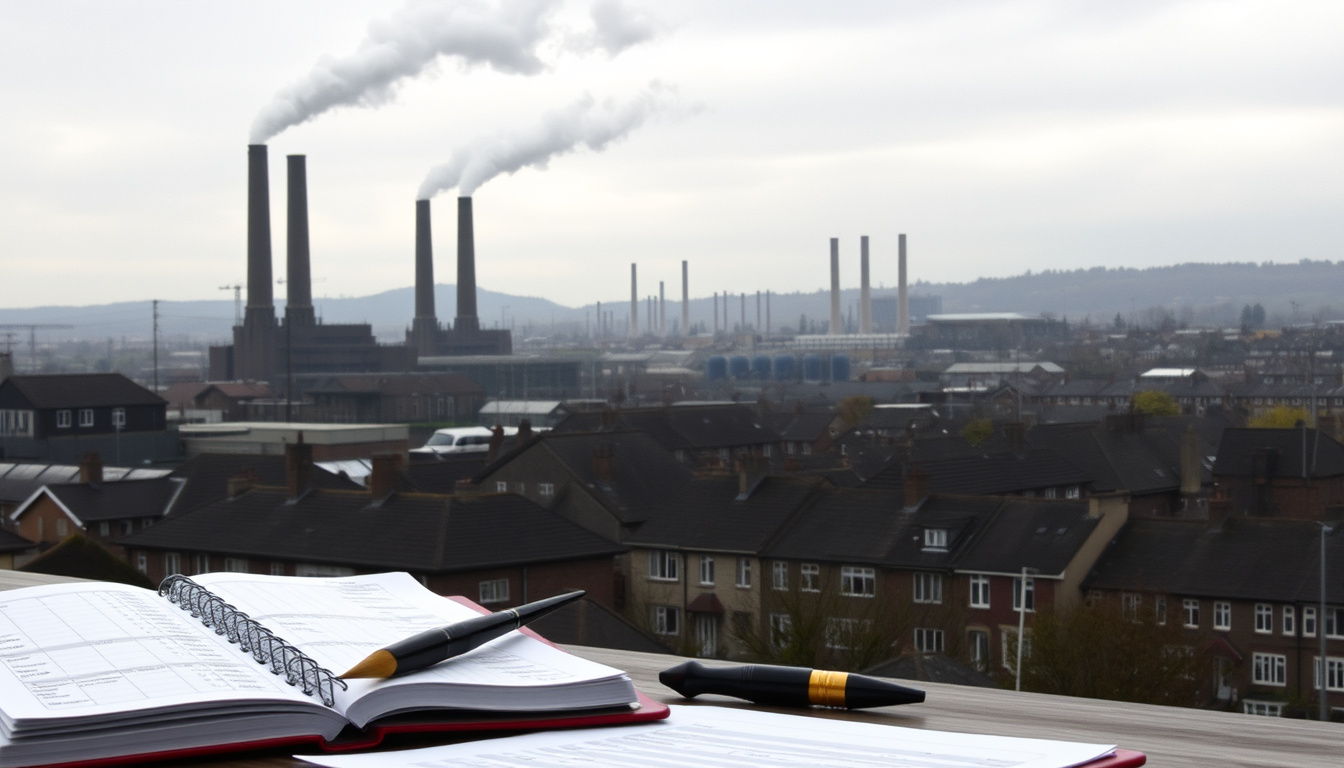

You’ve probably seen his stick-thin figures before — crowds of matchstick people trudging past mills and terraced houses under a grey northern sky; they’re the work of L.S. Lowry, born in 1887, who spent his days collecting rents and his evenings painting industrial Salford (The Lowry, official Salford gallery). More than 400 of his works now hang in that gallery, yet most people know only the matchstick figures.
Born: 1887 ·
Died: 1976 ·
Occupation: Rent collector and clerk; painter ·
Works in The Lowry collection: over 400 ·
Known for: Matchstick men industrial landscapes
Quick snapshot
- More than 400 of his works are held at The Lowry in Salford (The Lowry, official Salford gallery)
- He died on 23 February 1976, aged 88 (Masterworks Academy, art investment platform)
- He earned his living as a rent collector and clerk (per The Lowry, official Salford gallery) (The Lowry, official Salford gallery)
- No authoritative count of his total output across all collections
- Whether he ever intended to marry
- First London solo show: 1938 (Warwick) or 1939 (The Lowry)
- 1916: reported turning point after watching workers leave Acme Spinning Company mill (L.S. Lowry biography site, artist biography resource)
- 2013: Tate Britain staged a major Lowry survey (Tate, UK national art museum)
- The Lowry, which opened in Salford in 2000, holds the largest public collection of his work (The Lowry, official Salford gallery)
Seven facts, one pattern: Lowry’s career moved at walking pace — training for two decades, painting for four, famous only near the end.
| Field | Value | Source |
|---|---|---|
| Full name | Laurence Stephen Lowry | — |
| Born | 1 November 1887, Stretford, Lancashire | — |
| Died | 23 February 1976, Glossop, Derbyshire | Masterworks Academy, art investment platform |
| Nationality | British | — |
| Occupation | Rent collector and clerk; painter | — |
| Known for | Industrial landscapes, matchstick men | — |
| Art training | Manchester Municipal College of Art (c.1905–1915); Salford School of Art (c.1915–1925) | University of Warwick Art Collection, academic gallery |
What happened to LS Lowry?
Early life and career
- 1905–1915: evening classes at Manchester Municipal College of Art while working by day (Tate, UK national art museum)
- 1916: reported turning point after watching workers leave the Acme Spinning Company mill near Pendlebury (L.S. Lowry biography site, artist biography resource)
- 1919: first public exhibition at the Manchester Academy of Fine Arts (University of Warwick Art Collection, academic gallery)
Lowry is often called the accountant-artist, but the job itself was earthier: he worked as a rent collector and clerk for a property company, a routine that lasted decades. The daily round from door to door gave him the streets, the mills and the crowds he would later paint.
He trained the slow way, in evening classes at Manchester Municipal College of Art and then at Salford School of Art — roughly two decades of study squeezed around a full-time job. The popular shorthand makes him sound like an untrained visionary; actually, he was one of the most patient students British art has produced.
Lowry’s “matchstick men” label made him famous, then trapped him: for years, the art establishment treated him as a folk painter rather than a serious modern artist. Tate’s 2013 survey was, in part, an attempt to correct that.
The public debut came in 1919 at the Manchester Academy of Fine Arts; Manchester City Art Gallery acquired a Lowry in 1930; and the Royal Academy showed his work in 1932 — a breakthrough arc documented in the University of Warwick Art Collection’s artist biography.
Later years and death
- 1938 or 1939: first London solo exhibition — sources disagree on the year
- Later life: increasingly private, rarely leaving his base in the north-west
- 1976: Royal Academy retrospective shortly after his death (Tate, UK national art museum)
Lowry died on 23 February 1976 in Glossop, Derbyshire, at 88. He had never married, and in later years he grew increasingly private — a turn that fixed his reputation as a reclusive genius. A Royal Academy retrospective followed that same year.
What are 5 interesting facts about L.S. Lowry?
Fact 1: He was a chartered accountant
- The day job: rent collector and clerk for a property company, a career that spanned decades
Sort of. The label stuck because it’s memorable, but the reality is more ordinary: Lowry collected rents and kept ledgers. Far from being a distraction, the job put him inside the industrial landscape he painted — walking the streets, watching the same working lives repeat themselves daily.
Fact 2: He started painting late in life
- The timing: he was nearly 30 when he found his signature subject, and past 30 at his first public exhibition
By 1916, after watching workers stream out of the Acme Spinning Company mill, the classic Lowry elements — pale sky, dark mills, thin figures — started coming together. The famous “matchstick” style was not an overnight flash; it emerged after years of evening classes and patient reworking.
Fact 3: His figures are nicknamed matchstick men
- The nickname: the popular name for his simplified, stick-thin figures (Lowry.co.uk, specialist Lowry resource)
The name is descriptive, not literal. As Tate points out, Lowry did not build his figures out of actual matchsticks — the term simply captures how thin and schematic they look.
Fact 4: He painted the same scenes repeatedly
- Recurring subjects: mills, streets, parks, crowds, seascapes — the same north-of-England territory, revisited for decades
Lowry wasn’t repeating himself out of laziness. The repetition reads as commitment: by returning to the same streets and shapes, he refined a strange, private vision of industrial life until every figure felt inevitable.
Fact 5: He refused an OBE
- Honours declined: Lowry turned down the Order of the British Empire, according to his biographies
A man who spent decades collecting rents was not interested in collecting titles. The refusal fits the rest of the story: recognition came late, and Lowry never seemed comfortable with what it asked of him.
The takeaway: the myths around Lowry — the eccentric accountant, the late starter — are shortcuts to a stranger truth. He was a disciplined, trained painter who chose the industrial north on purpose and stayed with it for decade after decade.
The pattern: the late start, the day job and the refused honour all point to the same temperament — Lowry painted because he had to, not because he needed the applause.
Which painting took 16 years to make?
The Procession
- Title: The Procession
- Period: 1924–1940
- Subject: a funeral procession
Lowry worked on The Procession from 1924 to 1940, according to the L.S. Lowry biography site, artist biography resource. It depicts one of those pale, silent crowds that became his signature — but this time the crowd is walking behind a hearse.
Why it took so long
- Sixteen years on one canvas: Lowry returned to the painting repeatedly rather than finishing it in a single sitting
The long gestation fits the method. Lowry painted the way he worked — steadily, without drama — and The Procession shows what that patience could produce.
Where to see it
- Today: The Procession hangs at The Lowry in Salford
The Lowry’s collection is also where the full range of his work becomes visible: not just matchstick crowds, but portraits and eerily quiet seascapes that rarely make the postcards.
The Procession matters because it shows Lowry’s patience wasn’t a gimmick: he treated a single painting the way he treated a twenty-year day job — without shortcuts.
What this means: a 16-year painting is the perfect biographical detail. Lowry could carry a canvas in his head for a decade and a half, just as he carried the same streets in his memory for a lifetime.
Who is a painter similar to Lowry?
Stanley Spencer
- Shared ground: both turned everyday British life into serious painting
- Key difference: Lowry’s figures are stylised and anonymous; Spencer’s are more detailed and individual
Stanley Spencer is the name that comes up most often when critics look for a British painter alongside Lowry. Both ignored grand historical subjects in favour of ordinary people — though they painted those people in very different ways.
Lowry’s own subject matter stayed rooted in the industrial districts of Lancashire and Greater Manchester, as the University of Warwick Art Collection’s artist biography stresses. That anchoring is why he gets grouped with painters of everyday British life rather than with landscape romantics.
Other British figurative painters
- Modern-life framing: Tate’s 2013 exhibition presented Lowry as a painter of modern industrial life, a context that links him to a wider figurative tradition (Tate, UK national art museum)
Comparisons are useful but imperfect. Lowry’s crowds are deliberately anonymous — people reduced to shapes — which is what separates him from the more personalised figures of Spencer and many of his contemporaries.
Three differences, one reason they get grouped: both painters treated ordinary British life as a subject worth serious art.
| Comparison point | L.S. Lowry | Stanley Spencer |
|---|---|---|
| Focus | Industrial life in northern England | Everyday British life and community |
| Figures | Simplified, anonymous “matchstick” figures | More detailed, individualised figures |
| Framing today | Painter of modern life (Tate, 2013) | Chronicler of ordinary British life |
The trade-off: Lowry’s anonymous crowds make him instantly recognisable, but they also made it easy to underestimate him — the exact problem Tate’s survey set out to correct.
What is L. S. Lowry’s most famous painting?
The Football Match
- The painting: The Football Match (1928)
- Why it’s famous: a crowd of matchstick figures turned into pure, tense composition
The Football Match is the work most often singled out as Lowry’s signature canvas (Lowry.co.uk, specialist Lowry resource). It has the classic ingredients: pale sky, packed street, tiny repeated figures — everything the “matchstick men” label describes.
Coming from the Mill
- The painting: Coming from the Mill
- The image: workers streaming out of a factory at the end of a shift
If The Football Match shows Lowry at his most composed, Coming from the Mill shows him at his most social: a crowd leaving work, heads down, moving as one body. It is the painting that turns a daily routine into a quiet monument.
Sunday Afternoon
- The painting: Sunday Afternoon (1957)
Sunday Afternoon is one of his best-loved later works (Lowry.co.uk, specialist Lowry resource). It is quieter than the football crowds — proof that his real subject was the ritual of ordinary life, not just the drama of industry.
Lowry’s most famous paintings all do the same thing: they turn an ordinary moment in a northern industrial town into something monumental. That is why “matchstick men” undersells him — the figures are small, but the subject was nothing less than modern British life.
Why this matters: the paintings that made Lowry famous are the ones that made an entire working city look worth staring at — crowds, mills and all.
Key dates in Lowry’s life
The timeline below condenses the gallery and university biographies already cited above.
- — born in Stretford, Lancashire (The Lowry, official Salford gallery)
- 1905–1915 — evening classes at Manchester Municipal College of Art (Tate, UK national art museum)
- 1915–1925 — evening classes at Salford School of Art (University of Warwick Art Collection, academic gallery)
- 1924–1940 — works on The Procession (L.S. Lowry biography site, artist biography resource)
- — paints Sunday Afternoon (Lowry.co.uk, specialist Lowry resource)
- — dies in Glossop, Derbyshire, aged 88 (Masterworks Academy, art investment platform)
- — The Lowry opens in Salford, housing more than 400 of his works (The Lowry, official Salford gallery)
Read together, the dates show a painter who never rushed — even as the world around him speeded up.
What’s confirmed and what’s still unclear
Confirmed facts
- Born 1887 in Stretford, Lancashire (The Lowry, official Salford gallery)
- Died 1976 in Glossop, aged 88 (Masterworks Academy, art investment platform)
- Worked as a rent collector and clerk (The Lowry, official Salford gallery)
- More than 400 works at The Lowry, Salford (The Lowry, official Salford gallery)
What’s unclear
- Exact number of paintings across all collections
- Exact birthplace: sources differ between Rusholme and Stretford
- Whether Lowry ever intended to marry
- First London solo exhibition: 1938 (Warwick’s biography) or 1939 (The Lowry’s biography)
The open questions don’t undermine the biography — they just mark where the record of a deliberately private man runs quiet.
Lowry’s voice — and how the record sees him
“I am a person who is constantly seeking something that I can’t find. I am a person who is never satisfied.”
L.S. Lowry, quoted in the L.S. Lowry biography site, artist biography resource
“The industrial districts of Lancashire and Greater Manchester were central to Lowry’s subject matter.”
University of Warwick Art Collection, academic artist biography
The implication: Lowry’s own restlessness — that “never satisfied” — was the engine behind all those repeated scenes, painted over and over until they felt right.
Lowry’s career is easy to boil down to matchstick men and grey mills, and that shorthand has done him few favours. What the full picture shows is a trained, disciplined painter who chose the industrial north on purpose and kept choosing it for decades. For anyone heading to Salford, the choice is clear: spend an hour with The Football Match and The Procession in person — or keep seeing Lowry the way the art world once did, as a charming amateur who got lucky.
Related reading
- Grayson Perry: Identity, Wife, Knighthood, and More
- Charlotte Brontë: Biography, Books & Fascinating Facts
These adjacent biographies circle the same question Lowry’s life raises: how far does public recognition match private intention?
Frequently asked questions
How many paintings did Lowry create?
No exact count is established. The Lowry in Salford alone holds more than 400 of his works, so the lifetime total is certainly higher.
Did Lowry ever marry?
No. Lowry never married, and whether he ever intended to is one of the open questions in his biography.
Why are his figures called matchstick men?
The name reflects their thin, simplified shapes. Tate notes it is a popular descriptive label rather than evidence that Lowry used actual matchsticks.
What was Lowry’s style called?
He is usually described as an industrial landscape painter. His subject matter was rooted in the mills, streets and crowds of Lancashire and Greater Manchester.
Where can I see Lowry’s paintings?
The largest public collection is at The Lowry in Salford. Tate Britain and other UK museums also hold significant works.
What awards did Lowry receive?
He declined the Order of the British Empire, and a major Royal Academy retrospective followed shortly after his death in 1976.
How much is a Lowry painting worth?
Significant works regularly appear in specialist sales at Christie’s and Sotheby’s, where his paintings have reached strong prices. Specific values depend on the work and market conditions.
The questions people ask about Lowry tend to circle the same tension: the man was private, but his work is public property.

Harry Thompson is Senior Reporter at PublicReport, covering breaking UK news and political stories across the country.