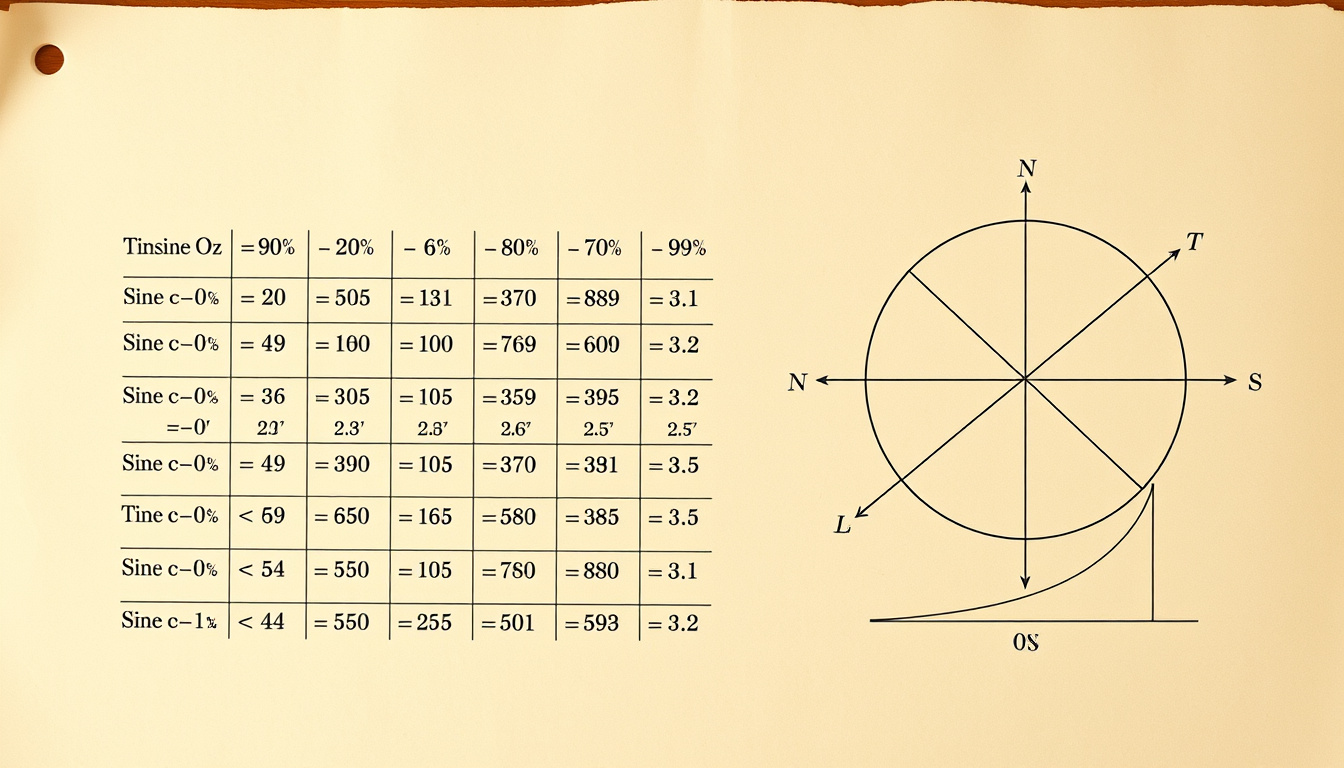

Sin Cos Tan Table: Essential Trigonometric Values (0°-90°)
A sin cos tan table provides the exact values of the three primary trigonometric functions for standard angles. These tables have been fundamental tools in mathematics education for centuries, enabling students and professionals to quickly reference sine, cosine, and tangent values without performing calculations. The most commonly used tables cover angles from 0° to 90°, representing the first quadrant where all trigonometric functions maintain positive values.
The values in these tables derive from two fundamental right triangles: the 30-60-90 triangle with side ratios of 1 : √3 : 2, and the 45-45-90 triangle with side ratios of 1 : 1 : √2. Understanding these geometric foundations helps learners appreciate why certain angles produce specific exact values rather than arbitrary decimals. Modern trigonometry tables remain essential references for geometry, physics, engineering, and various applied sciences.
Sin Cos Tan Values from 0° to 90°
The following table presents the primary trigonometric values for standard angles from 0° to 90°. These exact values appear consistently across mathematical textbooks and reference materials. The first quadrant contains all positive values, making these angles particularly useful for introductory trigonometry studies.
Key Insights
- Sin values increase from 0 to 1 as angles progress from 0° to 90°
- Cosine values decrease from 1 to 0 over the same range
- Tangent equals 1 at 45° where sine and cosine are equal
- At 90°, tangent becomes undefined because cosine equals zero
- The values at 30°, 45°, and 60° form the foundation of trigonometry
- Decimal approximations allow for practical calculations when exact values are unnecessary
| Angle (degrees) | Radians | sin | cos | tan |
|---|---|---|---|---|
| 0° | 0 | 0 | 1 | 0 |
| 30° | π/6 | 1/2 | √3/2 | √3/3 |
| 45° | π/4 | √2/2 | √2/2 | 1 |
| 60° | π/3 | √3/2 | 1/2 | √3 |
| 90° | π/2 | 1 | 0 | undefined |
The reciprocal functions appear in extended tables: cosecant (csc = 1/sin), secant (sec = 1/cos), and cotangent (cot = 1/tan). For 45°, all three reciprocals equal √2, while 30° and 60° produce values like csc 30° = 2 and sec 60° = 2.
How to Read and Use a Sin Cos Tan Table
Reading a trigonometric table requires understanding its basic structure. The leftmost column typically displays angles in either degrees or radians, while subsequent columns show corresponding function values. For any given angle, you can locate its position in the table and read across to find sine, cosine, or tangent values directly.
Finding Values for Calculations
When solving right triangle problems, identify the known angle and side relationships first. If you need the sine of 30°, locate 30° in the angle column and read the value under the sine header. For tan 45°, the table shows 1, indicating that the opposite and adjacent sides are equal in length for that angle.
Scientific calculators require setting the correct mode for angle measurement. Press the MODE button and select DEG for degrees or RAD for radians before performing trigonometric calculations. Incorrect mode settings produce erroneous results.
Working with Non-Special Angles
Angles not appearing in standard reference tables, such as 22° or 67°, require decimal approximations from extended tables. For instance, sin 20° equals approximately 0.342 while cos 20° equals approximately 0.940. These decimal values, typically rounded to three or four decimal places, provide sufficient accuracy for most practical applications.
Common Applications
Architects use trigonometric tables when calculating roof pitches and structural loads. Surveyors apply these values to determine distances and elevations. Engineers rely on precise trigonometric values when designing mechanical systems and electrical circuits. Navigation professionals historically used these tables for celestial positioning and course plotting.
What Is a Sin Cos Tan Table?
A sin cos tan table is a mathematical reference that lists the values of the three primary trigonometric functions for specific angles. The functions themselves represent ratios between the sides of right triangles: sine relates the opposite side to the hypotenuse, cosine relates the adjacent side to the hypotenuse, and tangent relates the opposite side to the adjacent side.
Origin and Historical Development
Astronomers in ancient Greece first developed trigonometric tables around 150 BCE. The mathematician Hipparchus compiled one of the earliest known tables, relating chord lengths to arc measurements. Indian and Islamic scholars later refined these tables, adding greater precision and expanded angle coverage. By the sixteenth century, printed trigonometric tables had become standard tools in European mathematics and navigation.
Connection to the Unit Circle
The unit circle provides a geometric foundation for understanding trigonometric values. On a unit circle with radius 1, the x-coordinate at any angle represents the cosine value while the y-coordinate represents the sine value. This visualization explains why sine values rise from 0 to 1 while cosine values fall from 1 to 0 as angles progress through the first quadrant.
The mnemonic “Funny Things Are Sinful In Catholic Theology” helps recall the rising sine values for 0°, 30°, 45°, 60°, and 90°. The first letters correspond to increasing values from 0 to 1/2 to √2/2 to √3/2 to 1.
Sin Cos Tan Table in Degrees vs Radians
Mathematics employs two primary units for measuring angles: degrees and radians. Degrees divide a circle into 360 equal parts, with each right angle measuring 90°. Radians measure angles based on arc length, where a full circle equals 2π radians (approximately 6.2832 radians). Understanding both systems proves essential for comprehensive trigonometry proficiency.
Conversion Between Systems
Converting between degrees and radians requires simple formulas. Multiply degrees by π/180 to obtain radians, or multiply radians by 180/π to obtain degrees. For example, 45° equals 45 × π/180 = π/4 radians, and π/3 radians equals π/3 × 180/π = 60°.
| Degrees | Radians |
|---|---|
| 30° | π/6 |
| 45° | π/4 |
| 90° | π/2 |
| 180° | π |
| 360° | 2π |
When to Use Each System
Degrees remain preferred for geometric constructions and everyday applications involving angles. Radians become essential in calculus and advanced mathematical analysis, particularly when working with derivatives and integrals of trigonometric functions. Scientific calculators typically offer mode switching between these systems, allowing users to select the appropriate unit for their current task.
Tables covering the full 360° extend values into all four quadrants. In quadrant II (90°-180°), sine and cosecant remain positive while other functions turn negative. Quadrant III (180°-270°) shows tangent and cotangent positive with sine and cosine negative. Quadrant IV (270°-360°) keeps cosine and secant positive while the other functions become negative.
Downloadable Reference Materials
Students and professionals benefit from having printed or digital trigonometric references readily available. Several educational institutions provide free downloadable charts and tables that cover various ranges and include supplementary information.
- A comprehensive trigonometric cheat sheet combines formulas with conversion tables
- The special angles chart focuses on 0°-90° with exact values
- A detailed decimal table provides 1° increments from 0° to 90°
- The unit circle reference displays coordinates for key angles
- A full 0°-360° table includes reciprocal functions
Precision and Accuracy in Trigonometric Tables
All values in standard trigonometric tables represent mathematically precise quantities. When decimal approximations appear, they typically extend to three or four decimal places, providing sufficient accuracy for most practical calculations. More precise applications may require extended decimal tables or computational tools.
Certain angle-function combinations produce undefined results. Tangent becomes undefined at 90° and 270° because these angles have cosine values of zero, creating division by zero in the tan = sin/cos formula. Similarly, sine and cosine become undefined at certain angles for their reciprocal functions.
Background and Context
Trigonometry emerged from practical needs in ancient civilizations. Babylonian astronomers required precise angle measurements for tracking celestial movements. Greek mathematicians formalized relationships between angles and side ratios in triangles. Islamic scholars preserved and expanded this knowledge during the European Dark Ages, eventually passing it to Renaissance mathematicians who developed the trigonometric functions as we know them today.
The three primary functions—sine, cosine, and tangent—each serve distinct purposes in mathematical and scientific applications. Sine describes oscillatory behavior in waves and alternating currents. Cosine appears in architecture for calculating structural loads and in physics for analyzing forces. Tangent proves useful in determining slopes and angles of elevation across numerous fields.
Sources and References
The trigonometric values presented in standard tables derive from well-established mathematical principles documented in educational materials and reference publications. These values have been verified through centuries of mathematical practice and remain consistent across reputable sources.
Paul’s Online Math Notes provides comprehensive coverage of trigonometric functions, including formulas, identities, and conversion tables.
Community college tutoring resources offer practical charts designed for introductory trigonometry students, focusing on special angles and their exact values.
Summary
The sin cos tan table remains an indispensable tool for anyone studying or working with trigonometry. Understanding how to read these tables, knowing where to find accurate values, and recognizing the relationship between degrees and radians form the foundation for successful trigonometric applications. Whether for academic study, professional work, or practical problem-solving, these reference tables provide the quick-access values needed for efficient and accurate calculations.
For related mathematical concepts, explore the Books of the Bible – Complete List in Order or learn about Soluble Salts From Mixing Acids and Alkalis – What Reaction Name?
Frequently Asked Questions
Where can I download a sin cos tan table PDF?
Several educational institutions offer free downloadable PDF tables. The University of Texas provides a comprehensive trig cheat sheet, while community colleges offer special angles charts and complete 0°-90° tables with decimal values.
How do I memorize sin cos tan values quickly?
Use the 30-60-90 and 45-45-90 triangle ratios. The mnemonic “Funny Things Are Sinful In Catholic Theology” helps recall sine values for 0°, 30°, 45°, 60°, 90°. Practice filling blank tables repeatedly until recall becomes automatic.
What is sin 30°, cos 30°, and tan 30°?
For 30°, the values are: sin 30° = 1/2, cos 30° = √3/2, and tan 30° = √3/3. These exact values derive from the 30-60-90 right triangle with sides in ratio 1 : √3 : 2.
How do you convert degrees to radians in a trig table?
Multiply degrees by π/180 to get radians. For example, 60° × π/180 = π/3 radians. Conversely, multiply radians by 180/π to convert to degrees.
Why does tan 90° equal undefined?
Tangent equals sine divided by cosine. At 90°, cosine equals zero while sine equals one, creating division by zero. This mathematical undefined state means no finite tangent value exists for a 90° angle.
What are the exact values for 45°?
At 45°, both sine and cosine equal √2/2 (approximately 0.707). Since they are equal, tangent 45° equals 1. The reciprocal functions—cosecant, secant, and cotangent—all equal √2 at this angle.
Can trig tables show values beyond 90°?
Extended tables cover full 360° circles using quadrant rules. Quadrant II keeps sine positive, Quadrant III keeps tangent positive, and Quadrant IV keeps cosine positive. Signs change based on which function is being evaluated.

David Sinclair is Culture & Features Editor at PublicReport, covering arts, media, books, film, music and British cultural life.