The Hanging Gardens of Babylon rank among the most enduring mysteries of the ancient world. Although celebrated as one of the Seven Wonders, scholars continue to debate whether these legendary terraced gardens ever existed—and if they did, where they truly stood. Ancient sources describe lush, multi-level plantings rising above the Mesopotamian plains, yet no definitive archaeological remains have confirmed their location.
Classical writers attributed these gardens to Babylonian king Nebuchadnezzar II, who supposedly built them for his Median wife. Later generations imagined cascading green terraces irrigated by some of the ancient world’s most sophisticated engineering. Today, a growing body of research suggests the gardens may have been constructed not in Babylon at all, but rather in the Assyrian capital of Nineveh.
Were the Hanging Gardens of Babylon Real?
- No physical remains have ever been confirmed at Babylon despite extensive excavations
- Assyriologist Stephanie Dalley proposes Nineveh as the actual location, built by Sennacherib
- Babylonian texts contain no mention of the gardens, while Assyrian records describe advanced irrigation
- Greek writers may have confused Nineveh with Babylon when recording descriptions
- The ruins of Babylon became a UNESCO World Heritage site in 2019
- Some scholars suggest the entire account may be a literary invention rather than historical fact
- Modern reconstructions remain speculative, based entirely on classical descriptions
| Fact | Details | Source |
|---|---|---|
| Wonder status | Listed among Seven Wonders of the Ancient World by Hellenistic writers | Britannica |
| Primary sources | Strabo, Diodorus Siculus, Josephus (citing Berosus) | Biblical Archaeology Review |
| Location theory | Babylon vs. Nineveh debate ongoing among scholars | Biblical Archaeology Review |
| Engineering claim | Advanced irrigation possibly using early Archimedes screw technology | Britannica |
| BUILD date proposed | 605–561 BCE (Nebuchadnezzar) or 704–681 BCE (Sennacherib) | Multiple sources |
| Destruction theories | Earthquake, natural decay, or neglect after Persian conquest | Britannica |
| BABYLON excavations | Robert Koldewey’s digs uncovered palace vaults but no gardens | Biblical Archaeology Review |
| UNESCO status | Babylon ruins designated World Heritage in 2019 | UNESCO |
Where Were the Hanging Gardens of Babylon Located?
The Babylon Theory and Its Limitations
For centuries, historians assumed the gardens stood near the royal palace of Babylon, the capital of Nebuchadnezzar II’s empire. The ancient city sits roughly 50 miles south of modern Baghdad in what is now Iraq. German archaeologist Robert Koldewey led extensive excavations at the site in the early 20th century, uncovering palace vaults and a possible pump well. However, his team found no definitive traces of the terraced gardens described in classical texts.
The Euphrates River, which once flowed through Babylon, shifted course after the Persian conquest of 539 BCE. By the time Greek writers began describing the gardens in detail, the water sources that supposedly irrigated them had already dried. This timeline presents a significant problem for the Babylon hypothesis.
The Nineveh Alternative
Assyriologist Stephanie Dalley has advanced the most compelling alternative theory since the 1990s. Her research places the actual gardens in Nineveh, the capital of the Assyrian Empire, constructed under King Sennacherib between 704 and 681 BCE. Archaeological excavations there have uncovered ruins of sloping, mountain-like gardens that closely match classical descriptions.
Assyrian texts from Sennacherib’s reign explicitly describe sophisticated garden construction and advanced irrigation systems. Dalley argues that Greek writers, writing centuries after the events and perhaps unfamiliar with Mesopotamian geography, confused Nineveh with Babylon. The misattribution to Nebuchadnezzar II may have resulted from this geographic confusion.
Nineveh lies approximately 250 miles north of Babylon, near modern Mosul. The Assyrian capital flourished as an administrative center with extensive palace complexes before its destruction in 612 BCE. The region’s topography includes hills and elevated terrain that better accommodate the terraced structure described in ancient accounts.
Who Built the Hanging Gardens of Babylon?
The Traditional Attribution to Nebuchadnezzar II
Classical sources most frequently credit Babylonian king Nebuchadnezzar II with constructing the gardens. According to these accounts, he built them as a gift for his Median wife Amytis, who allegedly missed the mountains and greenery of her homeland. Nebuchadnezzar ruled from 605 to 561 BCE, a period of Babylonian imperial power and architectural achievement.
The narrative appears in several ancient sources, including Josephus’s account of the historian Berosus. However, this attribution poses problems: no Babylonian texts from Nebuchadnezzar’s reign mention any such garden construction, despite extensive record-keeping from this period.
The Semiramis Legend
Some ancient writers attributed the gardens to an earlier ruler: Queen Semiramis, identified as Sammu-ramat, who may have ruled Assyria around the 9th century BCE. This version appears in writings by Ctesias and Diodorus Siculus. The Semiramis connection, like the Nebuchadnezzar story, lacks supporting evidence from contemporary inscriptions or records.
The Sennacherib Hypothesis
Dalley’s research points to Assyrian king Sennacherib as the actual builder. Assyrian royal records from his reign describe ambitious construction projects at Nineveh, including what appears to be an elaborate garden complex. Sennacherib’s inscriptions boast of bringing water to the city through advanced engineering methods, including machinery that may represent an early version of the Archimedes screw.
The attribution remains contested. While popular sources continue to credit Nebuchadnezzar, a growing number of specialists in ancient Near Eastern studies find Dalley’s Sennacherib hypothesis more consistent with available evidence.
What Happened to the Hanging Gardens of Babylon?
Theories of Destruction
Ancient sources offer no precise record of when or how the gardens disappeared. Several theories attempt to explain their fate. Natural decay over centuries likely played a significant role, as the structures required constant maintenance to survive Mesopotamia’s harsh climate. Once abandoned, the timber, reeds, and soil that comprised the terraces would deteriorate rapidly.
Some researchers propose that earthquakes, which frequently strike Mesopotamia, destroyed the gardens during the second century BCE. This theory accounts for a relatively sudden disappearance rather than gradual decay. However, no specific seismic event is documented in connection with the gardens.
Political and Military Factors
The Persian conquest of Babylon in 539 BCE under Cyrus the Great marked a turning point in the region’s history. The diversion of the Euphrates River from Babylon weakened the water supply that would have sustained any garden complex. The subsequent decline of Babylonian power under Persian rule may have led to neglect of royal constructions.
Nineveh itself fell to a coalition of Babylonians and Medes in 612 BCE, decades before the traditional construction date attributed to Nebuchadnezzar. This chronological problem further complicates the Nineveh theory, as Sennacherib’s gardens would have been destroyed before Greek writers began describing them as existing Wonders.
The Timing Problem
Perhaps the most puzzling aspect of the gardens’ history is timing. Greek writers describe the gardens as existing Wonders during the Hellenistic period, yet the accounts postdate the events they describe by centuries. By this point, any original structures would have already vanished, meaning Greek authors relied on secondhand information or earlier Greek sources rather than direct observation.
What Do We Know About the Hanging Gardens’ Appearance?
Classical Descriptions
Ancient authors provide our most detailed accounts of the gardens’ appearance. Strabo described terraces built in stages, with plants growing in soil deposited on vaulted structures. The terraces were reportedly covered with reeds, bitumen, and lead to prevent water leakage. An irrigation system allegedly pumped water from the Euphrates River to the highest levels.
Diodorus Siculus characterized the gardens as having trees of various types, with the entire structure rising to a considerable height above the city below. The image that emerges from these accounts resembles an artificial mountain covered in vegetation, supported by vaulted chambers at multiple levels.
Modern Reconstructions and Visual Interpretations
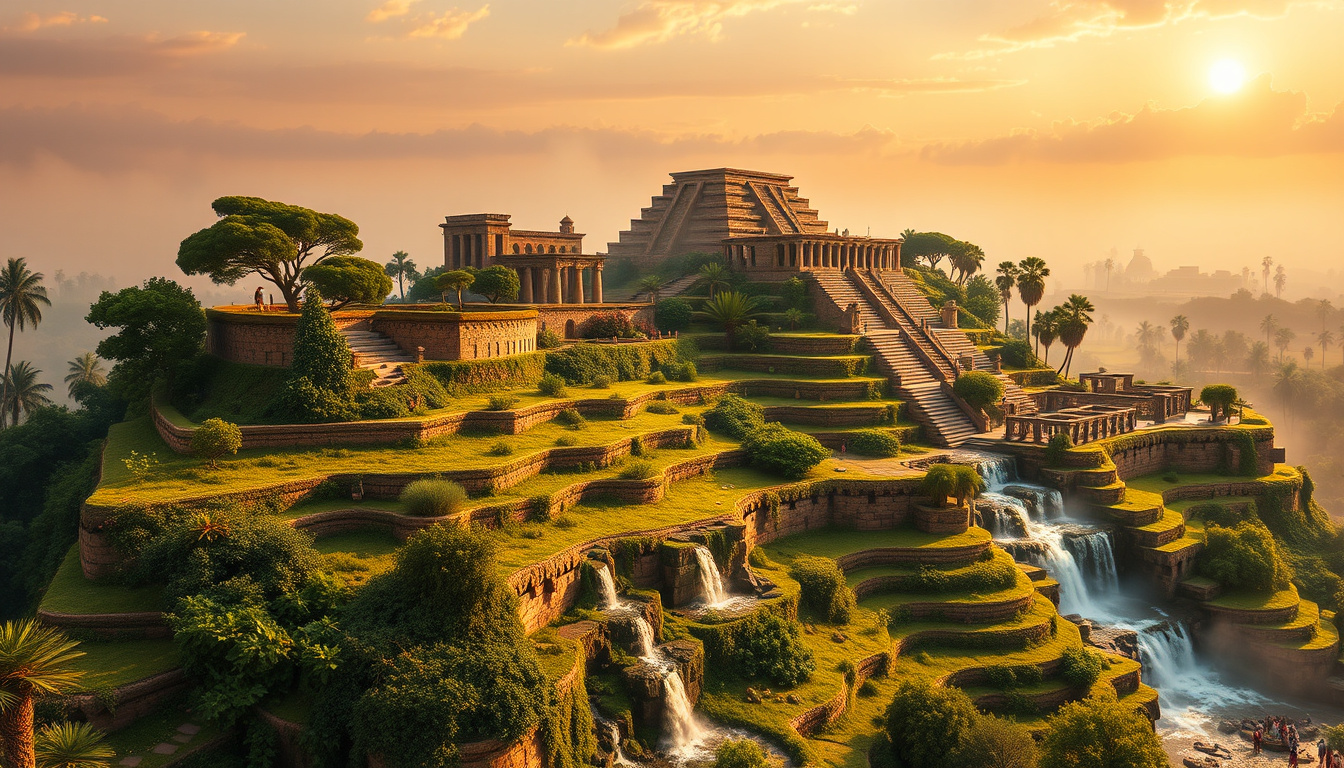
Artists’ reconstructions, based on classical descriptions, depict tiered terraces with aqueducts, cascading plantings, and monumental scale. These visualizations have shaped popular understanding of the gardens, though they remain speculative. No ancient images or sculptures definitively depicting the gardens have survived.
The ruins of Nineveh’s palace complexes have revealed what may be garden foundations—sloping terraces and complex irrigation channels carved into bedrock. These archaeological findings provide the closest physical evidence to the classical descriptions, though they cannot be definitively identified as the celebrated Wonder.
Despite their fame, no contemporary images, plans, or sculptures depicting the gardens have been discovered. All visualizations produced today represent artistic interpretations based on textual descriptions rather than architectural evidence.
A Chronology of the Hanging Gardens
Understanding the sequence of events and accounts helps clarify what we know—and what remains uncertain—about the Hanging Gardens.
- : Sennacherib potentially constructs gardens at Nineveh according to Assyrian records
- : Nebuchadnezzar II rules Babylon; traditional (but unsubstantiated) construction date
- : Nineveh falls to Babylonian-Median coalition
- : Persian conquest of Babylon; Euphrates diverted from the city
- : Alexander the Great visits Mesopotamia; Hellenistic era begins
- : Greek writers including Strabo and Diodorus describe the gardens as Wonders
- : Robert Koldewey excavates Babylon, finding palace ruins but no gardens
- : Stephanie Dalley publishes research supporting the Nineveh theory
- : Babylon ruins designated a UNESCO World Heritage site
What Remains Clear and Uncertain
| Established Information | Unresolved Questions |
|---|---|
| Ancient Greek and Roman writers described the gardens as one of the Seven Wonders | Whether any physical gardens matching these descriptions ever existed |
| No archaeological evidence has confirmed gardens at Babylon despite extensive excavations | The exact location—Babylon, Nineveh, or elsewhere entirely |
| Nebuchadnezzar II ruled Babylon from 605 to 561 BCE | Who actually constructed the gardens, if they were real |
| Sennacherib’s inscriptions describe sophisticated garden construction at Nineveh | Whether the gardens were destroyed by earthquake, decay, or human action |
| The ruins of Babylon are a UNESCO World Heritage site in Iraq | The precise appearance and dimensions of any original structures |
| Assyrian records mention advanced irrigation technology under Sennacherib | Whether Greek writers invented the gardens as a literary construct |
The Gardens in Historical Context
The Hanging Gardens of Babylon hold a unique position among the Seven Wonders of the Ancient World. Unlike the Great Pyramid of Giza, which remains standing, or the Temple of Artemis at Ephesus, which left physical traces, the gardens exist primarily in textual descriptions. This absence of physical evidence has made them perhaps the most enigmatic of the ancient Wonders.
Their inclusion in the canonical list of Wonders, established during the Hellenistic period, reflects Greek cultural values. The gardens symbolized the intersection of nature and human engineering—a theme that resonated with Mediterranean audiences unfamiliar with Mesopotamian landscape irrigation. Whether factual or imagined, they represented an achievement that seemed to surpass ordinary human capability.
The gardens’ association with legendary monarchs and exotic locations added to their appeal. The narrative of a king building paradise for his homesick queen captured imagination across cultures and centuries. This storytelling element may explain why the gardens inspired such persistent fascination even as other Wonders faded from popular consciousness.
Ancient and Modern Sources
“The garden was of a square shape, each side being four hundred feet long, and consisted of stories one above another, each story having a height of fifty feet.”
— Diodorus Siculus, Bibliotheca Historica
“The kings… constructed a park… with all manner of trees… The descent to the garden is by steps… and water is raised by a screw.”
— Strabo, Geographica
“I made a canal… with water flowing abundantly… I had the bank of the city of Nineveh lined with stone.”
— Sennacherib, royal inscriptions
Modern scholarship draws on multiple source traditions: classical Greek and Latin accounts, cuneiform tablets from Mesopotamia, and archaeological evidence from both Babylon and Nineveh. Assyriologists, classical philologists, and archaeologists bring different methodologies to the question, and the debate continues to evolve as new evidence emerges.
Summary and Current Understanding
The Hanging Gardens of Babylon remain one of antiquity’s greatest puzzles. Ancient texts describe a remarkable achievement of engineering and horticulture, yet no physical evidence confirms their existence in Babylon or elsewhere. The most compelling recent scholarship, particularly Dalley’s Nineveh theory, suggests that some form of elaborate garden complex probably existed—but in Assyria rather than Babylonia, built by Sennacherib rather than Nebuchadnezzar.
Visitors to Iraq today can explore the ruins of Babylon and Nineveh, both significant archaeological sites. The Babylon ruins, designated a UNESCO World Heritage site in 2019, offer insights into Mesopotamian civilization regardless of whether the famous gardens ever stood there. For those interested in exploring related topics, the General Knowledge Questions and Answers resource provides context on ancient history and world heritage sites.
Frequently Asked Questions
Were the Hanging Gardens of Babylon actually in Babylon?
The evidence increasingly suggests they were not. While traditionally associated with Babylon, excavations there have found no definitive garden remains. Assyriologist Stephanie Dalley proposes Nineveh as the more likely location.
Who really built the Hanging Gardens?
Ancient sources credit different builders—Nebuchadnezzar II, Queen Semiramis, or King Sennacherib. Modern scholarship favors Sennacherib, based on Assyrian records describing garden construction at Nineveh.
Why do the Hanging Gardens remain so mysterious?
No physical remains have ever been definitively identified, Greek accounts were written centuries after the events, and Mesopotamian sources from the period contain no mention of the gardens.
Can I visit where the Hanging Gardens were located?
The ruins of Babylon are in Iraq and open to visitors as a UNESCO World Heritage site. Nineveh’s remains are near Mosul. Neither location contains identifiable garden structures.
What happened to the Hanging Gardens?
Most scholars believe they were destroyed by earthquake, natural decay, or neglect over centuries. No specific destruction event is recorded in ancient sources.
Are the Hanging Gardens listed among the Seven Wonders?
Yes, they were included in lists of the Seven Wonders of the Ancient World by Hellenistic writers, though their existence was questioned even in antiquity.
How were the Hanging Gardens irrigated?
Classical sources describe pumps and possibly an early Archimedes screw lifting water from the river to the highest terraces. Assyrian records from Sennacherib’s reign mention sophisticated hydraulic engineering.

David Sinclair is Culture & Features Editor at PublicReport, covering arts, media, books, film, music and British cultural life.