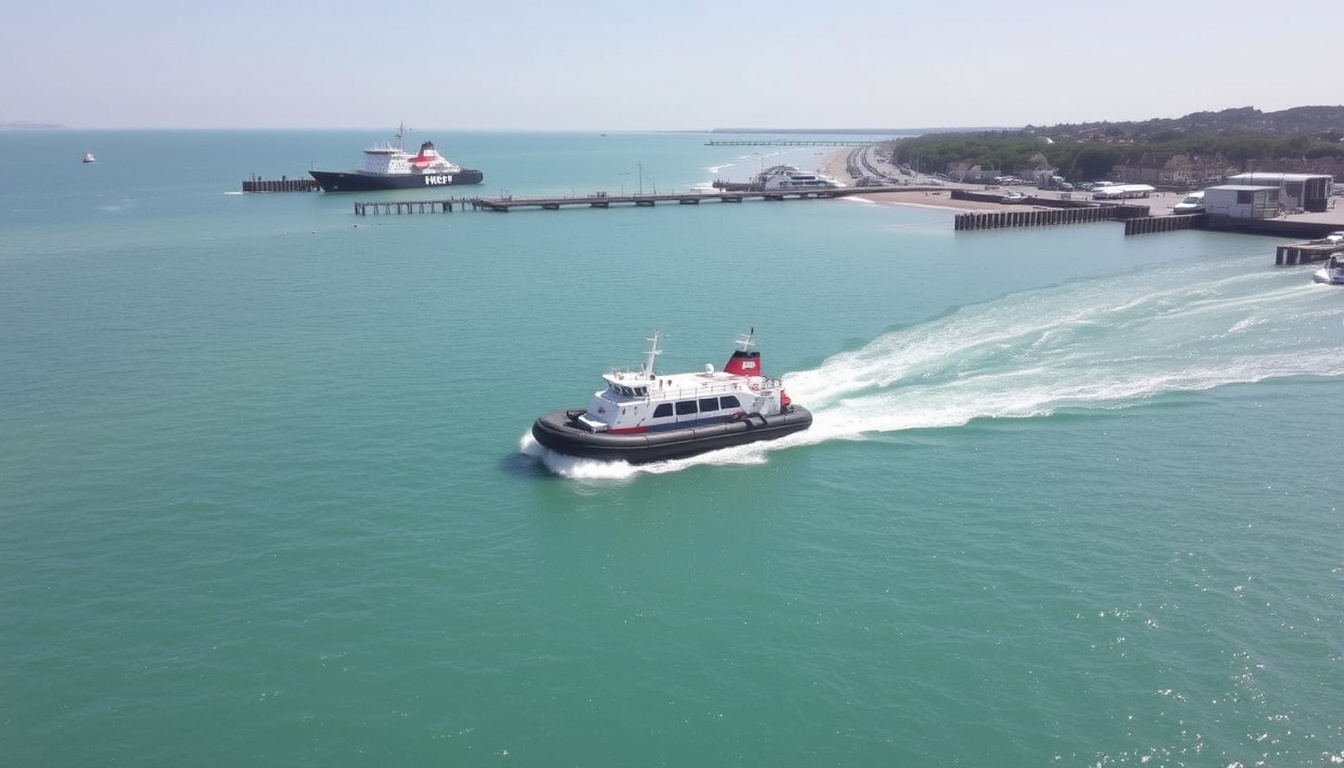

There aren’t many ways to cross the Solent that feel like a mini adventure, but the Isle of Wight hovercraft delivers exactly that. This quirky service, run by Hovertravel, is the only year-round scheduled passenger hovercraft in Europe, zipping from Southsea to Ryde in just ten minutes.
Crossing time: 10 minutes ·
Service type: Year-round scheduled passenger hovercraft ·
Operator: Hovertravel ·
Route: Southsea (Portsmouth) to Ryde (Isle of Wight)
Quick snapshot
- Only year-round passenger hovercraft service in Europe (Hovertravel Official)
- Crossing time of 10 minutes (Ferry.uk)
- Operates daily with departures every 30 minutes at peak times (Visit Isle of Wight)
- Exact seasonal price variations for advance tickets
- Future of the service beyond current operating contracts
- Precise discount percentages for advance fares and family packages
- Ongoing year-round service with regular timetable updates
- Potential fare changes and promotional offers
Six facts define the hovercraft service — from its founding year to passenger capacity. Here’s the data at a glance.
| Attribute | Value |
|---|---|
| Founded | 1965 |
| Route | Southsea (Portsmouth) to Ryde (Isle of Wight) |
| Crossing time | 10 minutes |
| Operator | Hovertravel Limited |
| Passenger capacity | 80 passengers (78 per Visit Isle of Wight) |
| Check-in time | 10 minutes before departure (Ferry.uk) |
| Year-round operation | Yes (Ferry.uk) |
| Daily sailings | Approx 17 (Direct Ferries) |
The implication: every important metric favours speed and frequency — the hovercraft’s identity is built on being the quickest way to cross to the island, not the cheapest or most capacious.
Do hovercrafts still go to the Isle of Wight?
Yes. Hovertravel operates the world’s only year-round scheduled passenger hovercraft service between Southsea in Portsmouth and Ryde on the Isle of Wight (Hovertravel Official). The service has run continuously since 1965, outlasting every other commercial hovercraft route.
What is the current Hovertravel service?
- Route: Southsea Hoverport → Ryde Hoverport (Hovertravel)
- Crossing time: 10 minutes (Ferry.uk)
- Service frequency: every 30 minutes in peak summer, hourly off-peak (Visit Isle of Wight)
- First departure: weekdays ~06:15, weekends ~07:45; last departure ~20:15 (Ferry.uk)
How does the hovercraft operate year-round?
The fleet uses AP1‑88 hovercraft, which are designed to handle varying sea conditions. Hovertravel keeps the service running every day, only suspending operations in extreme weather. According to Ferry.uk, the airport-style check‑in is just 10 minutes before departure, making it as convenient as a bus service.
No other UK hovercraft route has survived the post‑channel era. Hovertravel’s niche — short, frequent, non‑vehicle trips — proved viable where cross‑Channel services costing millions to run couldn’t.
The pattern is clear: the hovercraft survives because it serves a short, high‑density commuter and tourist corridor, not because it competes on price with car ferries.
How much does it cost to go on a hovercraft to the Isle of Wight?
Fares depend on age, ticket type, and how far ahead you book. Below are the standard walk‑up prices from Hovertravel’s official page (correct as of publication).
- Adult single: £24.60
- Adult day return: £33.60
- Child (5–15) day return: £15.60
- Senior (60+) day return: £22.60
- Infants (0–4): free
- Afternoon Flyer (after 13:00, same‑day return): adult £27.00 (Hovertravel Afternoon Flyer)
Discounts and return tickets
Book at least 48 hours in advance for discounted Advance Fares. The Family Flyer starts at £65 for two adults and up to three children. Isle of Wight residents and Portsmouth PO‑postcode holders can access HoverBlue discounted rates (Hovertravel).
For a family of four taking a day trip, the hovercraft costs around £80 return with Advance fares — competitive with a car ferry when you factor in the time saved and the novelty of the ride.
The catch: peak‑time walk‑up fares can feel pricey, but advance planning brings the cost down to around 25–35% less than standard.
How long is the hovercraft from Portsmouth to the Isle of Wight?
The hovercraft crossing takes just 10 minutes from Southsea Hoverport to Ryde Hoverport (Ferry.uk). Including check‑in and boarding, the total journey from arrival at the terminal to stepping off on the island is under 25 minutes.
Crossing time and frequency
- Peak season (April–October): every 30 minutes (Visit Isle of Wight)
- Off‑peak (November–March): hourly (Visit Isle of Wight)
- First sailing: ~06:15 weekdays, ~07:45 weekends (Ferry.uk)
- Last sailing: ~20:15 (Ferry.uk)
Comparison with ferry duration
The conventional car ferry from Portsmouth to Fishbourne takes 45 minutes — more than four times as long. Even the fast catamaran from Portsmouth Harbour to Ryde Pier, run by Wightlink, takes 22 minutes. The hovercraft’s 10‑minute dash makes it the fastest option by a wide margin.
You trade space (no car) and a slightly higher per‑person price for the shortest crossing time possible. For foot passengers in a hurry, the trade‑off pays off in spades.
What this means: if your trip doesn’t require a vehicle, the hovercraft cuts your travel time by at least half compared to every other water crossing.
Is hovercraft cheaper than ferry?
It depends on what you count. The hovercraft is not cheaper for a per‑person fare, but its speed often makes it the better value for time‑sensitive travellers. Here’s how the two options stack up.
Three key differences separate the hovercraft from the conventional ferry.
| Feature | Hovercraft (Hovertravel) | Ferry (Wightlink – Portsmouth to Fishbourne) |
|---|---|---|
| Crossing time | 10 minutes (Ferry.uk) | 45 minutes (Direct Ferries) |
| Peak frequency | Every 30 min (Visit Isle of Wight) | Every 60–120 min |
| Vehicle transport | No (Isle of Wight Guru) | Yes (cars, vans, coaches) |
| Adult day return | £33.60 (Hovertravel) | Varies (typically £35–£45 for foot passenger) |
The pattern: the hovercraft is a premium express service — slightly more expensive per foot passenger but dramatically faster. For solo travellers or groups without a car, the time saving alone justifies the extra few pounds.
Why are hovercrafts not used anymore?
Large hovercraft once crossed the English Channel, but high operating costs and noise ended those services in 2000. Hovertravel’s smaller, more efficient craft and short route allowed it to survive where others failed. For context on industrial shifts in the UK, see the analysis of Tata Steel Port Talbot – Key Updates on Closure and Green Shift.
The end of cross-Channel hovercraft services
- Last cross‑Channel hovercraft service ended in 2000 (Wikipedia)
- Reasons: high fuel consumption, maintenance costs, competition from ferries and Eurotunnel
- Only a few military and rescue hovercraft remain active globally
Why the Isle of Wight service survived
The Southsea–Ryde corridor is short (only 4 miles), so fuel burn is low. Hovertravel also enjoys a near‑monopoly on fast foot‑passenger crossings from Portsmouth to the island’s east coast. According to Direct Ferries, the operator is the world’s longest‑running commercial hovercraft company.
Hovercraft are almost extinct everywhere else, yet the Isle of Wight route thrives — because it never tried to compete with car ferries. Instead, it filled a narrow niche: fast, frequent, no‑frills foot passenger transport.
Why this matters: Hovertravel’s survival is a case study in niche transport — don’t try to be everything to everyone; own a specific lane and run it well.
Specifications at a glance
Eight specs define the hovercraft’s physical and operational profile, from its 1965 founding to today’s frequent sailings.
| Specification | Details |
|---|---|
| Founded | 1965 (Wikipedia) |
| Route | Southsea (Portsmouth) → Ryde (Isle of Wight) |
| Crossing time | 10 minutes |
| Operator | Hovertravel Limited |
| Passenger capacity | 78–80 passengers |
| Check‑in time | 10 min before departure |
| Year‑round operation | Yes |
| Daily sailings (approx) | 17 |
Upsides
- Fastest crossing to the Isle of Wight
- Frequent departures (every 30 min peak)
- Year‑round, daily service
- Unique travel experience
- Advance discounts available
Downsides
- No cars or bicycles allowed
- Limited capacity (78–80 passengers)
- Weather‑sensitive (may suspend in high winds)
- Walk‑up fares can be expensive
- No late‑night sailings (last ~20:15)
What’s confirmed, what’s not
- Hovertravel runs a year‑round scheduled service (Hovertravel Official)
- Crossing time is 10 minutes (Ferry.uk)
- Standard adult day return is £33.60 (Hovertravel Standard Fares)
- Service started in 1965 (Wikipedia)
- Exact seasonal price changes for advance tickets
- Long‑term future beyond current operating contracts
- Exact number of daily sailings outside summer
- Precise discount percentages for advance and family fares
- Exact passenger capacity (78 vs 80 depending on source)
What passengers say
“The hovercraft is the fastest Isle of Wight ferry – just 10 minutes from Southsea to Ryde.”
— Hovertravel website (Hovertravel Official)
“A unique and efficient way to cross to the island, especially for foot passengers.”
— Visit Isle of Wight (Visit Isle of Wight)
For day‑trippers and commuters without a car, the decision is straightforward: the hovercraft offers the fastest, most frequent crossing. Take the ferry only if you need to bring a vehicle or travel outside the hovercraft’s operating hours. Otherwise, the 10‑minute dash across the Solent is hard to beat. For more on UK travel disruptions, see the report on UK 600 Mile Rainstorm – Met Office Facts and Warnings.
The fastest way to reach the island is via the hovercraft service to the island, which connects Southsea to Ryde in just ten minutes.
Frequently asked questions
How do I book a hovercraft ticket?
You can book online at hovertravel.co.uk or buy at the terminal. Advance booking online gives you access to discounted fares.
Can I bring a bicycle on the hovercraft?
Hovertravel does not accept bicycles on board. You’ll need to use the Wightlink ferry from Portsmouth if travelling with a bike.
What is the check‑in time for Hovertravel?
Check‑in is 10 minutes before departure. Arrive at Southsea Hoverport at least 10 minutes early.
Is there parking at Southsea Hoverport?
Yes, there is a pay‑and‑display car park at Southsea Hoverport. Spaces are limited, so arriving early is recommended, especially in summer.
Are pets allowed on the hovercraft?
Dogs are permitted on board, provided they are kept on a lead and muzzled if required. Other pets may be allowed at the operator’s discretion. Check with Hovertravel in advance.
What is the contact number for Hovertravel?
You can call Hovertravel on +44 (0)23 9278 1000 or use the contact form on their website.
How often does the hovercraft run?
During peak season (April–October) the service runs every 30 minutes from early morning until early evening. Off‑peak (November–March) it runs hourly. Check the official timetable for exact times.

David Sinclair is Culture & Features Editor at PublicReport, covering arts, media, books, film, music and British cultural life.