
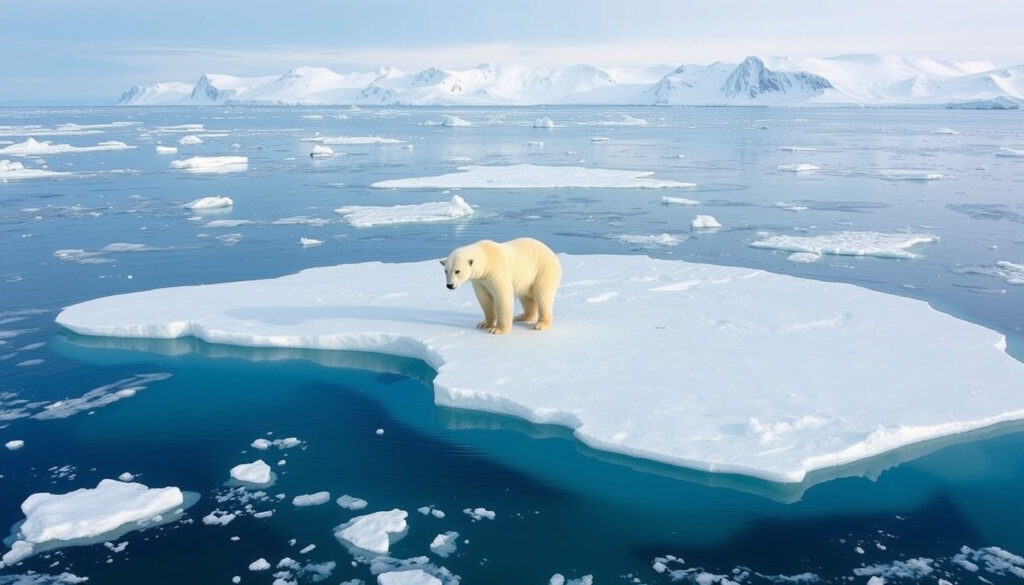
Polar bears are one of those rare animals that almost everyone recognizes but few truly know. They are marine mammals that depend entirely on Arctic sea ice to hunt their primary prey — ringed and bearded seals.
Adult male body mass: 300–800 kg (660–1,760 lb) · Global population estimate: ~26,000 (WWF, 2024) · Primary habitat: Arctic sea ice · Average lifespan in wild: 25–30 years · Sea ice loss rate: 14% per decade (WWF)
Quick snapshot
- Sea ice is essential for hunting, breeding, and resting (World Wildlife Fund)
- Polar bears are found in five Arctic nations (WWF Arctic)
- The ‘Last Ice Area’ north of Greenland and Canada is expected to become a critical refuge (World Wildlife Fund)
- Primary prey: ringed and bearded seals (Polar Bears International)
- Hunt by waiting at breathing holes or stalking seals on the ice (World Wildlife Fund)
- Can fast for months when ice melts (WWF Arctic)
- Mating occurs April–May; delayed implantation (Polar Bear Agreement)
- Cubs born in snow dens December–January (World Wildlife Fund)
- Litter size typically 2 cubs; stay with mother for 2.5 years (WWF Arctic)
- IUCN Red List: Vulnerable (2015 update) (Polar Bears International)
- Listed as Threatened under U.S. Endangered Species Act (2008) (World Wildlife Fund)
- Main threat: climate change reducing sea ice (WWF Arctic)
Six snapshots of polar bear biology, one consistent pattern: every measurement ties back to their life on the ice.
The table below summarizes key physical characteristics of polar bears.
| Attribute | Value |
|---|---|
| Scientific name | Ursus maritimus |
| Average male length | 2.4–3 m (7.9–9.8 ft) |
| Average female weight | 150–250 kg (330–550 lb) |
| Top speed on land | 40 km/h (25 mph) |
| Swimming speed | 10 km/h (6 mph) |
| Diet composition | >90% seals (primarily ringed and bearded) |
Are polar bears Arctic or Antarctic?
Polar bears are strictly Arctic animals. They inhabit the circumpolar region covering Canada, Alaska, Greenland, Russia, and Norway — nowhere else on Earth. World Wildlife Fund (global conservation group) states that polar bears are found only in the Arctic, where sea ice provides the platform for their entire life cycle. Antarctica, by contrast, has no polar bears; the ecological role of top marine predator there is filled by leopard seals and orcas.
Where exactly in the Arctic do polar bears live?
- Canada hosts the largest population: about 16,000 bears across 13 subpopulations, per WWF Arctic (Arctic conservation program).
- Other range states include Alaska (U.S.), Greenland, Norway (Svalbard archipelago), and Russia.
- Polar bears are most abundant in areas with seasonal sea ice, such as Hudson Bay, the Beaufort Sea, and Baffin Bay.
Why don’t polar bears live in Antarctica?
- Antarctica is a separate continent isolated by the Southern Ocean; polar bears never colonized it. (World Wildlife Fund)
- The Antarctic ecosystem lacks the shallow, productive shelves that support ringed and bearded seals.
- Antarctica has its own marine predators: leopard seals, killer whales, and penguins fill the niches that polar bears occupy in the North.
The implication: polar bears are not just Arctic residents — they are ice-dependent specialists. Their range is defined by sea ice, and as that ice contracts, so does their future.
How many polar bears will be left in 2050?
The global population of polar bears is estimated at approximately 26,000 individuals, according to World Wildlife Fund (global conservation group). But climate models project a 30–50% decline by 2050 if sea ice loss continues at current rates. Some subpopulations, such as those in the southern Beaufort Sea, are already declining.
What are the main threats driving population decline?
- Climate change: Arctic sea ice is shrinking by 14% per decade (World Wildlife Fund).
- Reduced access to seals forces longer fasting periods, lowering cub survival and adult body condition.
- Increased human activity: oil and gas exploration, shipping, and tourism compound stress (Polar Bear Agreement (intergovernmental treaty body)).
How do scientists model future polar bear numbers?
- Scientists use coupled general circulation models (GCMs) to project sea-ice extent under different emission scenarios.
- These models link ice-free days to polar bear fasting tolerance, using data on body fat, metabolism, and reproduction.
- Under a high-emission scenario (RCP 8.5), the population could decline by as much as 70% by 2050, according to Polar Bears International (scientific advocacy organization).
The 30–50% decline projected by 2050 is not a distant threat. For subpopulations like the southern Beaufort Sea, that decline is already happening today. Every year of delay in emissions reductions locks in more ice-free days and longer fasts for polar bears.
What are 5 facts about polar bears?
What is the polar bear’s scientific name?
Ursus maritimus, meaning “sea bear”, reflects their marine mammal classification. (World Wildlife Fund)
How big do polar bears get?
- Adult males weigh 300–800 kg and reach lengths of 2.4–3 m — the largest land carnivore. (World Wildlife Fund)
What do polar bears eat?
- Over 90% of their diet consists of ringed and bearded seals. They also scavenge on carcasses and occasionally eat birds, eggs, or vegetation when seals are scarce. (Polar Bears International)
How fast can a polar bear swim?
- Polar bears can swim at speeds of 10 km/h (6 mph) and cover distances over 100 km without rest. (WWF Arctic)
Why are polar bears threatened?
- The primary threat is sea-ice habitat loss due to climate change, as documented by WWF Arctic.
These five facts illustrate the polar bear’s specialized adaptation to Arctic life and the vulnerability that comes with it.
Which country has the most polar bears?
Canada is home to the largest polar bear population, estimated at roughly 16,000 individuals — about 60% of the global total. World Wildlife Fund notes that Canada manages 13 of the 19 recognized subpopulations. Other significant populations are in Greenland, Norway (Svalbard), Russia, and the United States (Alaska).
How many polar bear subpopulations exist in Canada?
- Canada has 13 subpopulations, ranging from the Beaufort Sea to Hudson Bay and Davis Strait. (Polar Bears International)
How does Canada’s population compare to other Arctic nations?
- Canada (60%), Greenland (about 20%), Norway (Svalbard), Russia, and Alaska (U.S.) together make up the global range. The Russian population is estimated at 3,000–5,000, but exact numbers are uncertain due to limited monitoring. (Polar Bear Agreement (intergovernmental treaty body))
The catch: Canada’s large population gives it a special responsibility, but also means it will face the greatest losses if sea ice disappears.
What is the biggest killer of polar bears?
Climate-driven sea ice loss is the most significant threat to polar bears globally. According to WWF Arctic, the loss of ice reduces access to seal hunting grounds, forcing longer fasting periods that lead to starvation and lower reproductive success. Secondary threats include pollution, oil spills, human-bear conflicts, and overharvesting in some subpopulations.
How does climate change affect polar bear survival?
- As ice-free seasons lengthen, bears are forced to fast longer. In Hudson Bay, for example, the ice-free period has increased by 3 weeks since 1979, reducing hunting time and body condition.
What other threats do polar bears face?
- Pollutants like PCBs and mercury accumulate in bear fat, affecting hormones and immune function. Oil spills could be catastrophic in ice-covered waters. Increased shipping and tourism cause stress and potential conflicts. (Polar Bear Agreement (intergovernmental treaty body))
Polar bears were nearly wiped out by hunting in the 20th century. International cooperation saved them — only to watch climate undo that progress. The 1973 agreement stopped the bullets; it couldn’t stop the warming.
The trade-off: polar bears face a suite of threats, but climate change is the multiplier — it worsens every other danger.
Are polar bears friendly to humans?
Polar bears are powerful predators and are not friendly to humans. They view people as potential prey or threats, especially when hungry. Most attacks occur when bears are surprised or in poor body condition. Polar Bears International emphasizes that encounters in the wild are rare but dangerous.
How should you behave if you encounter a polar bear?
- Stay calm, avoid direct eye contact, and slowly back away. Do not run. Carry bear spray or flares in known polar bear areas. (WWF Arctic)
Can polar bears be tamed?
- No. Polar bears have not been domesticated and require vast home ranges and specialized diets. Keeping them in captivity requires large, enriched environments; they are not suitable as pets under any circumstances. (World Wildlife Fund)
The reality: polar bears are not malicious, but they are wild, hungry, and incredibly powerful. Respect is the only safe strategy.
Timeline of polar bear conservation
- 1973 – International Agreement on the Conservation of Polar Bears signed by all five range states. (Polar Bear Agreement)
- 2008 – Polar bear listed as Threatened under the U.S. Endangered Species Act. (World Wildlife Fund)
- 2015 – IUCN Red List status updated to Vulnerable. (Polar Bears International)
- 2022 – Scientific review projects 50% decline under high-emission scenarios. (WWF Arctic)
What we know vs. what’s unclear
Confirmed facts
- Polar bears depend on sea ice for hunting seals (WWF)
- They are the largest land carnivore (WWF)
- Global population is approximately 26,000 (WWF)
- Climate change is the primary long-term threat (WWF Arctic)
What’s unclear
- Exact population numbers for remote subpopulations (e.g., Arctic Basin) (Polar Bears International)
- How quickly polar bears can adapt to longer ice-free seasons
- Impact of localized sea ice loss on individual subpopulation viability
- How quickly polar bears can adopt alternative food sources to compensate for reduced seal access
Expert perspectives
“The loss of sea ice due to climate change is the single most important threat to polar bears.”
— WWF Polar Bear Programme
“Under the worst-case scenario, we could see a 70% reduction in the global population by 2050.”
— Polar Bears International scientist
Summary
Polar bears are an icon of the Arctic, but their future hangs on sea ice that is vanishing faster than expected. Climate change is the primary driver, and even moderate warming scenarios project severe population declines by 2050. The Arctic is warming twice as fast as the rest of the world, and the ice that polar bears need for hunting, breeding, and denning is shrinking by 14% per decade. For Canada, home to 60% of the world’s polar bears, the choice is clear: accelerate climate action and protect critical ice refuges like the Last Ice Area, or watch the species decline toward extinction within our lifetime.
För den som vill fördjupa sig i isbjörnens storlek, diet och bevarande finns en utförlig guide hos isbjörnens storlek, diet och bevarande som sammanfattar de senaste forskningsrönen.
Frequently asked questions
How fast can polar bears swim?
They can swim at 10 km/h (6 mph) and cover distances over 100 km.
Do polar bears hibernate?
Only pregnant females enter dens in winter to give birth; other polar bears remain active year-round.
How many cubs do polar bears have?
Litter size is typically 2 cubs, occasionally 1 or 3.
What is the average weight of a polar bear cub?
Newborn cubs weigh about 0.6–0.7 kg (1.3–1.5 lb).
How long do polar bears live in the wild?
Average lifespan is 25–30 years, though some individuals live into their early 30s.
Are polar bears endangered?
They are listed as Vulnerable on the IUCN Red List and as Threatened under the U.S. Endangered Species Act.
What is a polar bear’s main predator?
Adult polar bears have no natural predators; cubs may be killed by wolves or other bears. Humans are their only significant predator through hunting.
Related reading

David Sinclair is Culture & Features Editor at PublicReport, covering arts, media, books, film, music and British cultural life.