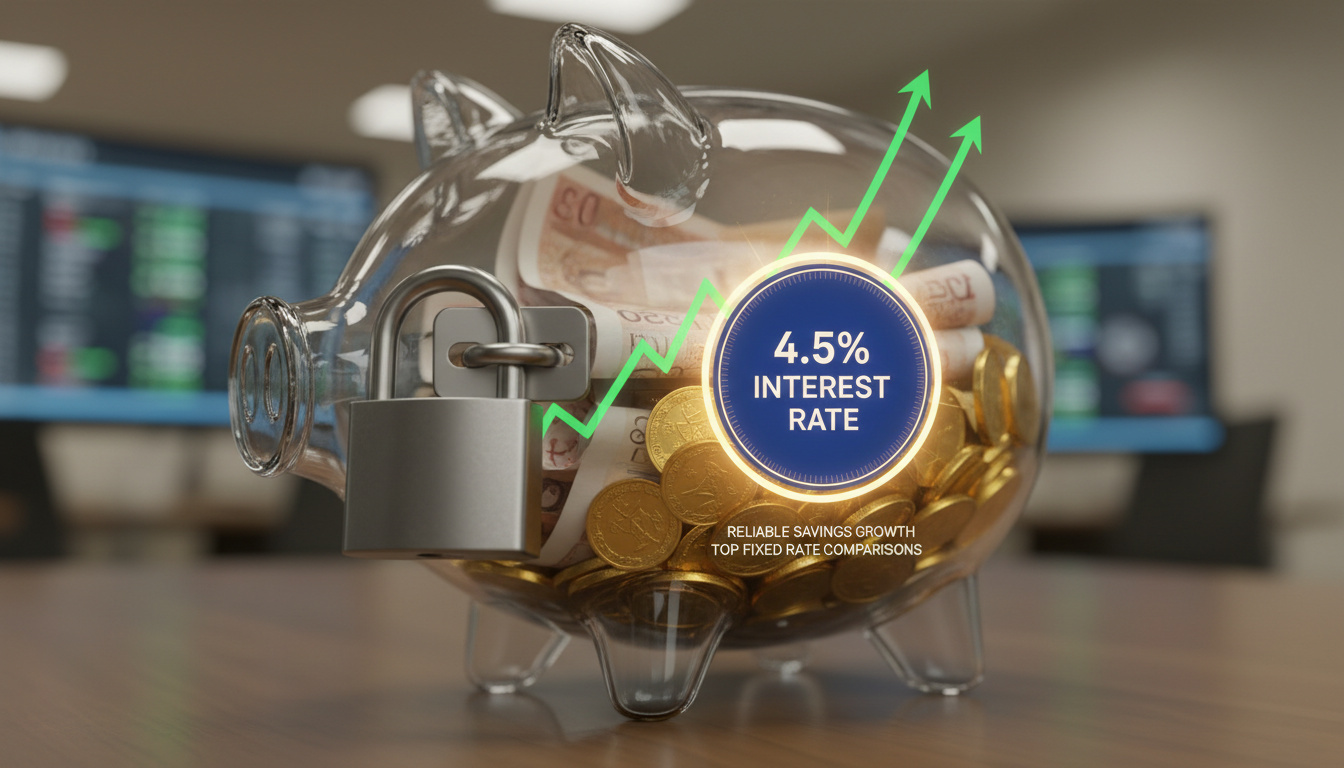
Savers seeking guaranteed returns face a narrowing window as fixed-rate cash ISA rates retreat from their post-inflation-peak highs. Leading providers currently offer tax-free Annual Equivalent Rates (AER) reaching 4.5%, though market averages have declined markedly since mid-2024.
The top one-year fixes from HSBC and Vanquis Bank sit at 4.5% and 4.46% respectively, while longer commitments yield marginal premiums with Vanquis offering 4.48% over two years and Nationwide matching the 4.5% figure but requiring a three-year lock-in. These products shield interest from UK income tax within the £20,000 annual allowance, yet stiff penalties apply for early access.
Financial comparison platforms report a contraction in headline rates following Bank of England monetary policy adjustments, with the average one-year fix dropping from 4.45% in July 2024 to 3.79% by January 2026 according to rate tracking data.
What is the Best Fixed Rate Cash ISA Right Now?
Market leaders currently cluster around the 4.5% threshold for short-term commitments, though accessibility restrictions vary significantly between institutions. HSBC demands an existing current account relationship for its top-tier one-year product, while digital-centric Vanquis Bank offers competitive rates with online-only servicing.
| Provider | AER (Tax-Free) | Term | Minimum Deposit |
|---|---|---|---|
| HSBC | 4.5% | 1 Year | £500 (current account required) |
| Vanquis Bank | 4.46% | 1 Year | £1,000 |
| Vanquis Bank | 4.48% | 2 Years | £1,000 |
| Nationwide | 4.5% | 3 Years | £1 |
- Peak rates: HSBC and Nationwide currently lead the market at 4.5% AER, though HSBC requires a current account relationship.
- Entry thresholds: Minimum deposits range from £1 at Nationwide to £1,000 at Vanquis and NatWest, with tiered rates often triggering above £25,000.
- Protection status: All listed providers maintain full FSCS protection covering £85,000 per person per banking licence.
- Rate trajectory: Market-leading rates have fallen approximately 66 basis points from July 2024 averages, suggesting further erosion may occur.
- Term premiums: Marginal gains for longer fixes (0.02% between Vanquis one-year and two-year products) may not justify extended capital lock-up.
- Transfer flexibility: Most top providers accept transfers from previous tax years’ ISAs, though penalty-free access remains restricted.
| Provider | AER | Term | Min Deposit | Early Withdrawal Penalty | Interest Paid |
|---|---|---|---|---|---|
| HSBC | 4.5% | 1 Year | £500 | Not specified | Not specified |
| Vanquis Bank | 4.46% | 1 Year | £1,000 | 90 days’ interest | Monthly or at maturity |
| Hampshire Trust Bank | 4.20% | 1 Year | Not specified | Not specified | Anniversary |
| NatWest | 4.05%-4.20% | 1 Year | £1,000 | Not specified | Not specified |
| Leeds BS (Issue 233) | 4.05% | 1 Year | Not specified | Not specified | On maturity (05.05.27) |
| Vanquis Bank | 4.48% | 2 Years | £1,000 | Not specified | Not specified |
| Nationwide | 4.5% | 3 Years | £1 | 300 days’ interest | Annually or at maturity |
| NatWest | 4.05%-4.30% | 2 Years | £1,000 | Not specified | Not specified |
| Leeds BS (Issue 221) | 4.10% | 2 Years | Not specified | Not specified | Annually |
| Kent Reliance | 4.45% | Not specified | £1,000 | 180 days’ interest | Monthly/annually/maturity |
Data sourced from MoneyFactsCompare, NatWest product listings, and Leeds Building Society terms.
What is a Fixed Rate Cash ISA and How Does it Work?
A fixed-rate cash ISA constitutes a tax-efficient savings wrapper that guarantees a specific AER for a predetermined term, typically ranging from one to five years. The account shields all interest payments from UK income tax and capital gains tax, provided deposits remain within the annual subscription limit.
Tax-Free Allowances and Limits
The annual ISA allowance stands at £20,000 for the 2025/26 tax year, a threshold unchanged from previous years according to HM Revenue & Customs guidelines. Savers may distribute this allowance across cash ISAs, stocks and shares ISAs, and innovative finance ISAs, though only one of each type may be funded per tax year.
Interest Calculation and Terms
Interest compounds tax-free throughout the fixed term, with payment frequencies varying by provider—some distribute monthly, others annually, or solely at maturity. The guaranteed rate remains static regardless of external Bank of England base rate movements, currently set at 3.75% as noted by financial analysts.
Basic-rate taxpayers can earn £1,000 in savings interest tax-free outside an ISA wrapper, while higher-rate taxpayers receive only £500. Those approaching these personal savings allowance limits benefit most from ISA protection.
Can I Withdraw Money Early from a Fixed Rate Cash ISA?
Accessing capital before the maturity date triggers financial penalties that vary significantly between providers. These charges typically manifest as lost interest rather than capital deductions, though the severity differs by term length and institution.
Early Withdrawal Penalties
Nationwide imposes 300 days’ lost interest on its three-year fixed product, while Kent Reliance applies 180 days’ interest. Vanquis Bank charges 90 days’ interest on its one-year fix. These penalties frequently eliminate all accumulated returns if triggered within the initial months. Car Finance for Bad Credit operates under similarly strict contractual terms regarding early termination, though financial products differ in regulatory treatment.
FSCS Protection and Safety
All listed providers maintain authorization from the Prudential Regulation Authority and operate under the Financial Services Compensation Scheme. This guarantees protection up to £85,000 per person per banking licence, covering both deposits and accrued interest in the event of institutional failure.
How to Choose the Best Fixed Rate Cash ISA?
Selection requires balancing headline rates against accessibility constraints, penalty structures, and existing banking relationships. Savers must verify whether top rates require current account migration or accept standalone deposits.
Assessing Accessibility and Terms
HSBC’s market-leading 4.5% rate demands an active current account, effectively restricting access to existing customers. Conversely, Nationwide permits entry with £1 but requires three-year capital commitment. Digital banks like Vanquis offer middle-ground accessibility with £1,000 minimums and online-only management.
Nationwide charges 300 days’ interest on its three-year fix, while Kent Reliance applies 180 days’ lost interest. These penalties frequently erode all accumulated interest if accessed within the first year.
Transferring Existing Savings
Savers holding ISAs from previous tax years may transfer funds into new fixed-rate products without consuming the current year’s allowance. The process requires direct application to the new provider; withdrawing cash personally voids the tax-free status. Tata Steel Port Talbot Transition demonstrates how major industrial shifts can influence regional savings rates and provider stability, though steel industry developments remain distinct from cash deposit products.
Savers must request transfers through the new provider; withdrawing cash personally loses the tax-free status. The process typically completes within 15 days for cash ISAs.
How Have Cash ISA Rates Changed Over Time?
- : Individual Savings Accounts launch, replacing PEPs and TESSAs with £7,000 annual allowance.
- : One-year fixed ISA rates average 4.45% following Bank of England base rate increases.
- : Annual ISA allowance remains frozen at £20,000 for the 2025/26 tax year.
- : Average one-year rates fall to 3.79%, though top-paying providers maintain offers near 4.5%.
What is Certain and Uncertain About Fixed Rate Cash ISAs?
| Established Facts | Uncertain or Variable Elements |
|---|---|
| Tax-free interest up to £20,000 annual allowance | Future interest rates upon term maturity |
| FSCS protection up to £85,000 per banking licence | Exact penalty calculations (vary by provider) |
| Guaranteed AER for the fixed term duration | Bank of England base rate trajectory |
| Penalty-free access only at maturity | Provider retention of current offers |
Why Do Fixed Rate Cash ISA Rates Fluctuate?
Fixed-rate products track broader monetary policy through swap rates and gilt yields rather than responding instantaneously to base rate changes. The recent decline from 4.45% to 3.79% reflects market anticipation of continued base rate reductions from the current 3.75% level.
Competition between incumbent banks and building societies also drives pricing, with mutuals like Leeds Building Society and Nationwide occasionally undercutting commercial banks to attract deposits. Short-term liquidity requirements influence promotional rate availability.
Where Does This Information Come From?
Shorter terms now make sense due to minimal rate uplift for longer locks, with normal savings potentially beating ISAs if you do not pay tax on interest.
MoneySavingExpert.com
Rate data derives from daily monitoring of provider websites and comparison platforms. FSCS protection status is verified through the Financial Conduct Authority’s Financial Services Register.
How Should Savers Approach Fixed Rate ISAs Today?
Current market conditions favor one-year fixes for rate-sensitive savers unwilling to lock capital at marginally higher long-term rates. With top products offering 4.5% tax-free against a backdrop of declining averages, immediate application is advisable before further base rate cuts erode availability. Those with existing ISAs should prioritize transfer-eligible products to maximize allowance efficiency.
Frequently Asked Questions
What is the Cash ISA allowance for 2024/25?
The annual allowance is £20,000 for the 2025/26 tax year, remaining unchanged from 2024/25. This limit applies across all ISA types combined.
Are Cash ISAs protected?
Yes. All authorized providers offer FSCS protection covering £85,000 per person per banking licence, including accrued interest.
How do fixed rate Cash ISAs work?
They guarantee a tax-free interest rate for a set term. You cannot access funds without penalty until maturity, though transfers to other ISAs are permitted.
Can I withdraw money early from a fixed rate ISA?
Early access is possible but incurs penalties, typically 90-300 days’ lost interest depending on the provider and term length.
What happens when the fixed term ends?
Accounts typically transfer to a variable-rate ISA or become accessible for withdrawal. Providers notify savers 14-30 days before maturity with options.
Is interest paid monthly or annually?
Payment frequency varies by provider. Vanquis offers monthly or at maturity, Nationwide pays annually or at maturity, while others pay only on anniversary dates.
Can I transfer an existing ISA to a fixed rate product?
Yes. Previous years’ ISA funds can be transferred without affecting your current £20,000 allowance. Request the transfer through your new provider.

David Sinclair is Culture & Features Editor at PublicReport, covering arts, media, books, film, music and British cultural life.