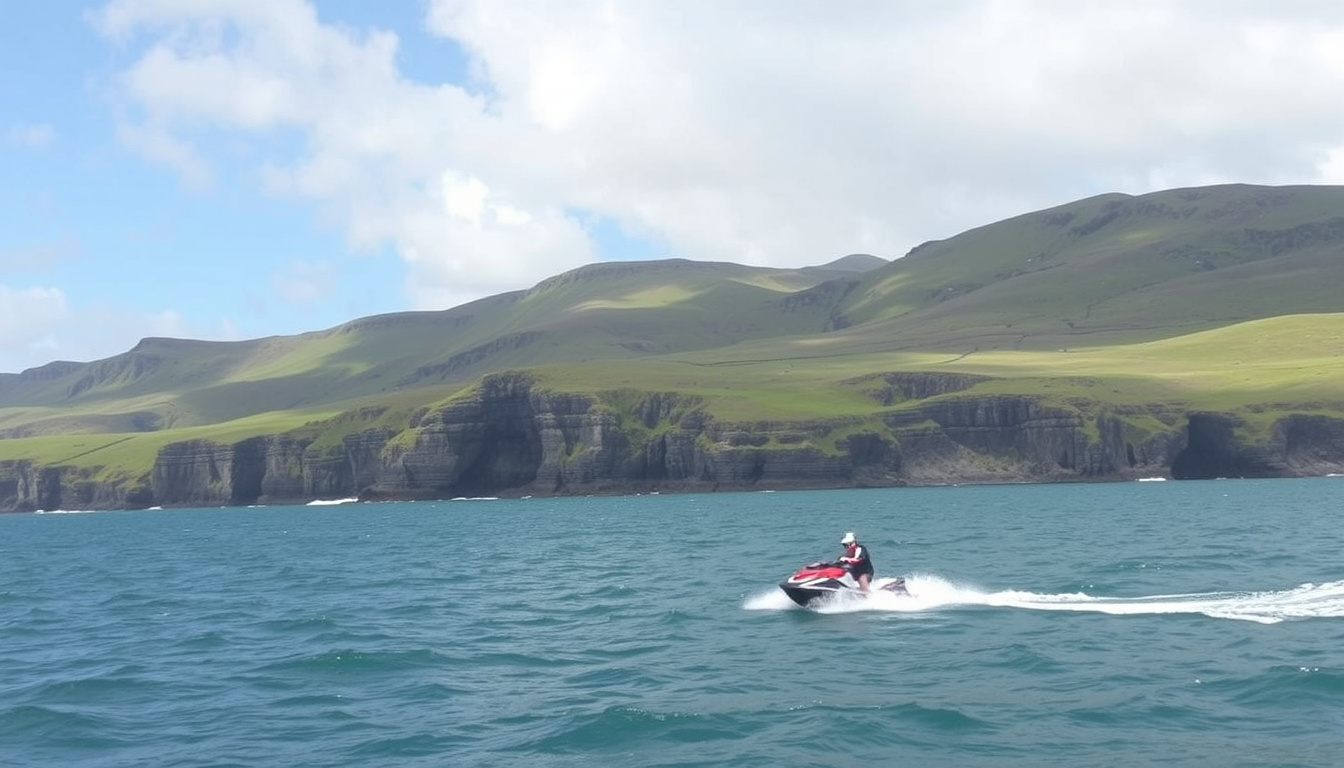

If you’ve ever watched someone zip across the water on a jet ski and wondered what it would be like to own one in Ireland, you’re not alone — between the coastal scenery and inland waterways, it’s a tempting idea. This guide pulls together the legal framework from Waterways Ireland, real marketplace data, and practical advice so you know exactly what you’re getting into before you buy or ride.
Average new jet ski price (2024): €8,000–€20,000 · Typical lifespan with proper maintenance: 200–300 hours or 10–15 years · Top speed of a stock jet ski: 60–70 mph · Minimum age to ride in Ireland: 16 years (with license) · Ireland registered jet skis (approx.): 1,500+
Quick snapshot
- Jet skis are legal in Ireland with registration and a license (Waterways Ireland – official navigation authority)
- Stock jet skis cannot reach 200 mph (industry consensus) (Waterways Ireland – official navigation authority)
- Non-swimmers face higher risk and must wear life jackets (GC Jet Ski – safety guide)
- Average engine life is 200–300 hours (general PWC knowledge) (Waterways Ireland – official navigation authority)
- Exact number of jet skis registered in Ireland – estimates vary
- Whether jet skis are allowed on all Irish lakes – varies by local bylaw
- Precise average rental cost nationwide – no central data
- September 2024 – Waterways Ireland issued a new Code of Practice for recreational craft (Waterways Ireland – marine notice)
- 2023 – Irish government updated PWC registration rules (Waterways Ireland – marine notice)
- 2022 – Fatal incidents prompted safety campaigns (Afloat – Irish sailing news)
- Buyers should check Waterways Ireland updates before purchasing
- New Code of Practice will affect how you launch and operate
- Insurance costs may rise as regulations tighten
The table below captures the core numbers every buyer and rider should have at hand.
| Fact | Value |
|---|---|
| Average new jet ski price | €8,000 – €20,000 |
| Average used jet ski price | €3,000 – €12,000 |
| Typical engine hours before overhaul | 200–300 hours |
| Top speed (stock) | 60–70 mph |
| Minimum age to ride in Ireland | 16 |
| Life jacket required by law | Yes |
What is a jet ski?
A jet ski is a brand name for a personal watercraft (PWC) – a small, powered vessel that you ride on the water instead of inside it. Unlike a boat, you steer by shifting your weight and turning the handlebars. The engine drives a jet pump that pushes water out the back, propelling you forward. No external propeller, which makes them safer around swimmers when operated correctly.
How does a jet ski work?
- Internal combustion engine (usually 1.0–1.8 litres) drives an impeller inside a jet pump
- Water is drawn in through a grate and expelled at high pressure through a nozzle
- Steering is done by moving the nozzle – no rudders. Reverse is a bucket that deflects the jet forward
What types of jet skis are available?
- Sit-down (recreational): Most common. Stable, seats 1–3. Examples: Yamaha VX, Sea‑Doo GTI
- Stand-up: Old‑school, more agile. Rider stands. Harder to ride. Examples: Kawasaki SX‑R
- Luxury/touring: Bigger, with seats, storage, GPS. Examples: Sea‑Doo GTX, Yamaha FX
How much should a jet ski cost?
The price of a jet ski in Ireland varies widely depending on whether you buy new or used, the brand, and the age. On DoneDeal – Ireland’s biggest classifieds marketplace, there were 178 listings at the time of research, showing healthy supply at both ends of the market.
What is the price range for new jet skis in Ireland?
New jet skis from the main brands – Sea‑Doo, Yamaha, Kawasaki – start around €8,000 for an entry‑level model and go up to €20,000 or more for a high‑end touring machine with satellite navigation and premium sound systems.
How much do used jet skis cost in Ireland?
- Entry‑level used (older than 10 years, high hours): €3,000 – €5,000
- Mid‑range used (5–10 years, 100–200 hours): €6,000 – €9,000
- Near‑new used (1–3 years, under 50 hours): €10,000 – €14,000
What additional costs come with owning a jet ski?
- Insurance: €200 – €600 per year, depending on value, experience, and location
- Storage: €500 – €1,500 per year for marina trailer storage or winter berth
- Maintenance: €300 – €800 per year for oil changes, spark plugs, impeller checks, and winterisation
- Fuel: Expect about 15–25 litres per hour of riding at moderate speed
Buyers who go for a used jet ski save upfront but face higher maintenance risk. A €5,000 used machine could need €1,500 in servicing within two seasons. New buyers pay more initially but get a warranty and predictable costs.
Are jet skis allowed in Ireland?
Yes, jet skis are legal in Ireland – but they are far from unregulated. Waterways Ireland (the cross‑border authority for inland navigation) makes clear that PWCs must be launched from designated sites, and canals are off‑limits. The rules are set out under SI 921 of 2005 and updated by the 2024 Code of Practice.
What are the legal requirements for jet skiing in Ireland?
- Must be registered with an approved body such as the Irish Sailing Association or a recognised PWC club
- Persons under 16 cannot operate a PWC (Afloat – Irish sailing publication citing SI 921/2005)
- Life jacket must be worn at all times (GC Jet Ski – safety requirements guide)
- Jet skis must be launched and recovered from designated launch sites – not any beach
Do I need a license to ride a jet ski in Ireland?
Yes, you need a valid PWC license or an equivalent qualification (such as an International Certificate of Competence). The minimum age is 16. If you’re 16 or 17, some insurers require you to have passed a recognised training course.
Where can I legally ride a jet ski in Ireland?
- Inland waterways managed by Waterways Ireland – many lakes and rivers are open, but check local by‑laws
- Coastal areas outside bathing zones and nature reserves – subject to harbour authority rules
- Canals are not suitable for power sports (Waterways Ireland – power sports guidance)
Riders who launch from an unauthorised slipway or ride in a prohibited zone risk fines, seizure of the craft, and invalidated insurance. The 2024 Code of Practice (Waterways Ireland – General Marine Notice 95/2024) is the latest update to those rules.
Can I jet ski if I can’t swim?
It is strongly discouraged but not illegal. The GC Jet Ski safety guide emphasises that a Coast Guard‑approved life jacket is mandatory at all times – but that alone is not a safety net.
What safety precautions should non-swimmers take?
- Wear a properly fitted life jacket (not just a buoyancy aid) – it must be rated for the rider’s weight
- Never ride alone; always have a companion who can swim
- Attach the kill‑switch lanyard to your wrist or life jacket
- Avoid rough water and high‑speed turns – falling off is common
Is a life jacket enough?
A life jacket will keep you afloat if you fall off, but it does not protect you from panic, cold water shock, or being hit by the craft if it circles back. The Irish Coast Guard (as quoted in Afloat) advises non‑swimmers to take a training course before riding.
Many jet ski rental operators in Ireland require you to sign a declaration that you can swim. If you can’t, you won’t be allowed to hire. Buyers should take a basic swimming test before committing to ownership.
What is the lifespan of a jet ski?
A well‑maintained jet ski engine typically lasts 200–300 hours of riding. With meticulous care that can stretch to 500+ hours. In calendar terms: 10–15 years for an average recreational rider who logs 20–30 hours per season.
How many hours can a jet ski engine last?
- Entry‑level recreational: 200–250 hours before major service
- Higher‑end models (supercharged): 300–400 hours if serviced strictly
- Maximum possible with full dealer maintenance: 500+ hours
What maintenance extends jet ski life?
- Winterisation: Engine must be fogged with oil, coolant flushed, battery disconnected
- Fresh water flush: After every saltwater use – run engine on hose for 5 minutes
- Oil changes: Every 50 hours or once per season
- Impeller check: Annually – a damaged impeller kills performance and engine
A used jet ski with 150 hours and full service records is often a better bet than a low‑hours machine that has been neglected. Check the service log. Impeller condition and compression test tell you more than the hour meter alone.
Can a jet ski go 200 mph?
No stock jet ski comes anywhere close to 200 mph. The fastest production models top out at 60–70 mph. Modified racing PWCs have been clocked at over 100 mph – but even those don’t reach 200 mph. The physics of water drag makes it extremely difficult.
What is the top speed of a stock jet ski?
- Recreational two‑seater: 55–60 mph
- Performance models (Sea‑Doo RXP‑X, Yamaha GP1800): 67–70 mph
- Stand‑up (Kawasaki SX‑R): 55–60 mph
Are there modified jet skis that go faster?
Yes, with engine mods, supercharger upgrades, and a lightweight hull, some PWCs have hit 110–120 mph in time trials. But 200 mph is beyond current technology for a watercraft. For context, 200 mph on water would require power and hull design closer to a speedboat than a consumer jet ski.
Do jet skis flip easily?
Jet skis are surprisingly stable – their hull design keeps them upright in normal conditions. But in rough water or during a sharp turn at speed, a flip can happen. Most modern models have a self‑righting feature that turns the craft back upright with the press of a button.
What causes a jet ski to flip?
- Sharp high‑speed turns – weight shift and centrifugal force can roll it
- Large waves or wakes – especially if hit at an angle
- Overloading – exceeding the recommended weight capacity
How do you right a flipped jet ski?
If the self‑righting feature fails (or if you have an older model), swim to the rear and push down on the back of the seat while pulling the front up. The kill‑switch lanyard must be attached to prevent the engine from running. Always wear the lanyard – it stops the craft from circling if you fall off.
A flipped jet ski can take on water if left too long. The self‑righting system works best when the engine is off. Practice righting in calm water before you head out.
Safety equipment and steps for first‑time riders
Before you launch, you need the right gear and a clear process. The 2024 Code of Practice from Waterways Ireland outlines the minimum requirements. Here’s a step‑by‑step guide for first‑time riders.
- Wear a life jacket – Coast Guard approved, properly fitted. Attach the kill‑switch lanyard to it.
- Check weather and water conditions – avoid high wind, fog, and strong currents.
- Locate a designated launch site – many towns provide free slipways (Waterways Ireland – power sports page). Do not launch from a beach or canal.
- Perform a pre‑ride check – fuel, oil, battery, impeller, steering, and throttle.
- Enter the water slowly – no throttle until you are in deep enough water.
- Keep a safe distance – 50 metres from swimmers, 30 metres from other craft and shore.
- Return to the designated recovery site – never beaching on a private or prohibited shoreline.
Clarity check: what’s confirmed and what’s still unclear
Confirmed facts
- Jet skis are legal in Ireland with registration and a PWC license
- Minimum age 16 (SI 921/2005)
- Life jacket mandatory at all times
- Stock jet skis cannot reach 200 mph
- Canals are not suitable for power sports
- Waterways Ireland issued a new Code of Practice in September 2024
What’s still unclear
- Exact number of registered jet skis in Ireland (estimates only)
- Which lakes allow PWCs – depends on local by‑laws not centralised
- Average rental price – varies by operator and location
- Whether all insurers accept a PWC license from every training body
- Exact number of jet skis listed on DoneDeal at time of research (market snapshot only)
The implication: while the legal baseline is clear, local variations and data gaps mean buyers and riders must do their own verification with Waterways Ireland and local authorities.
Expert perspectives
“The new Code of Practice is designed to make recreational craft safer for everyone – owners, other water users, and the environment.”
– Irish Sailing Association spokesperson (Waterways Ireland – marine notice)
“Annual maintenance on a jet ski runs about €400–€600 for a basic service. If you skip winterisation, you can double that in repairs the following spring.”
– Jet Products dealer, Ireland (Afloat – industry insight)
“A life jacket is essential, but it’s not a substitute for swimming ability. We strongly advise taking a water safety course before your first ride.”
– Irish Coast Guard representative (GC Jet Ski – safety guide)
These perspectives underscore that formal guidance, dealer experience, and safety authorities all point to the same conclusion: preparation and compliance are non‑negotiable.
Related reading: Estate Cars for Sale in Ireland – Complete Buyer’s Guide
samboat.com, superyachtpwc.com, sharkskin.com.au, youtube.com, facebook.com, boatsetter.com, instagram.com, youtube.com, nyhedszone.dk
For German-speaking readers, a German-language guide to jet ski costs and laws in Ireland offers a parallel perspective on buying, renting, and legal requirements.
Frequently asked questions
Do I need a license to ride a jet ski in Ireland?
Yes. You need a valid PWC license or an International Certificate of Competence. Minimum age is 16. The legal basis is SI 921 of 2005.
What is the best jet ski for beginners?
A recreational sit‑down model like the Sea‑Doo GTI or Yamaha VX. They are stable, have low‑power modes for learning, and are widely available in the Irish market.
How much does jet ski insurance cost in Ireland?
Between €200 and €600 per year, depending on value of the craft, rider experience, and whether it’s stored ashore or moored.
Can I ride a jet ski on any lake in Ireland?
No. Some lakes are managed by Waterways Ireland and permit PWCs; others have local by‑laws that restrict them. Always check with the local authority or Waterways Ireland before launching.
What should I wear when jet skiing?
A life jacket (mandatory), a wetsuit or quick‑dry clothing, gloves, and sunglasses with a retainer strap. In cold water, a drysuit may be needed.
How do I transport a jet ski?
Most owners use a trailer. You’ll need a trailer registered for the craft’s weight, a towing vehicle with the correct licence category, and a launching certificate if using Waterways Ireland facilities.
Is jet skiing dangerous?
Like any power sport, it carries risks. The main dangers are collisions, falling off, cold water shock, and injury from high‑speed impact. Following the 2024 Code of Practice reduces those risks significantly.
For anyone in Ireland considering a jet ski, the choice is clear: do your homework on the legal side, budget for insurance and storage, and invest in a training course before you hit the water. The reward is an exhilarating sport – but only if you respect the rules and the water.

Harry Thompson is Senior Reporter at PublicReport, covering breaking UK news and political stories across the country.