
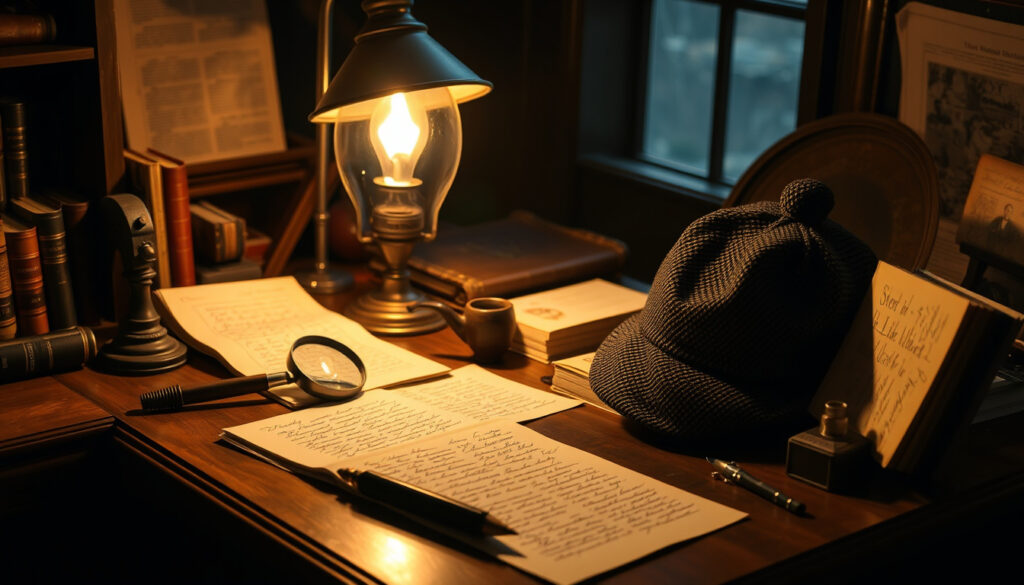
Sherlock Holmes is so vivid — the deerstalker, the violin, the cold logic — that the man who invented him can fade into the backdrop, yet Arthur Conan Doyle was a busy Edinburgh doctor, an energetic campaigner, and, in his final decades, a spiritualist who believed the dead could speak (Stanford University biography). His life away from 221B Baker Street was messier and stranger than any of his mysteries, and this guide sorts the documented facts from the legends that still cling to his name.
Born: 22 May 1859 · Died: 7 July 1930 · Known for: Creating Sherlock Holmes · Holmes stories: 4 novels and 56 short stories · Wives: 2 · Children: 5
Quick snapshot
- The Sherlock Holmes canon runs to 4 novels and 56 short stories (IMDb author biography)
- Doyle qualified as a physician and practised medicine before writing became his main income (Stanford University biography)
- The exact wording of Conan Doyle’s last words varies by source (Arthur Conan Doyle Encyclopedia chronology)
- 1893: “The Final Problem” kills Sherlock Holmes; 1903: “The Empty House” brings him back (The Victorian Web chronology)
- The Conan Doyle Estate, steered by descendants, continues to manage his literary legacy (Arthur Conan Doyle Encyclopedia chronology)
Seven rows, one pattern: the public biography is short, and the private one is where the story turns strange.
| Label | Detail |
|---|---|
| Full name | Arthur Ignatius Conan Doyle (Encyclopedia.com biography) |
| Born | 22 May 1859, Edinburgh, Scotland (Stanford University biography) |
| Died | 7 July 1930, Crowborough, England (Arthur Conan Doyle Encyclopedia chronology) |
| Occupation | Writer, physician |
| Sherlock Holmes output | 4 novels, 56 short stories |
| First Holmes work | “A Study in Scarlet” (1887) (IMDb author biography) |
| Wives and children | Louisa Hawkins (m. 1885); Jean Leckie (m. 1907); five children (Britain Express biography) |
The takeaway: the same man had two families, two careers, and two public identities, and the second version of each is the one readers usually skip.
What was Arthur Conan Doyle famous for?
Arthur Conan Doyle’s fame rests on one creation, and that creation eventually took over his working life. Sherlock Holmes first appeared in “A Study in Scarlet” in 1887, and within a few years the detective was the most recognisable figure in English fiction: 4 novels and 56 short stories in total, a count that appears in every major summary of the canon (IMDb author biography).
Doyle was born in Edinburgh on 22 May 1859 and died on 7 July 1930, which makes his career Victorian in shape but modern in reach. He was raised in a Roman Catholic family with Irish connections (Encyclopedia.com biography), a background that gave his moral seriousness an edge and, later, gave his spiritualism an unlikely fervour.
- “A Study in Scarlet” (1887) introduced Holmes and Dr. Watson.
- “The Hound of the Baskervilles” (1902) is the Holmes novel people name even when they haven’t read it.
- The complete canon: 4 novels and 56 short stories.
Holmes became such a complete brand that Doyle’s medical training, his historical novels, and his spiritualist campaigns are now treated as curiosities attached to a detective story.
The implication: Doyle built a fame machine he could not switch off, and the rest of his life was a struggle to be taken seriously on his own terms.
What was Arthur Conan Doyle like as a person?
Doyle’s Edinburgh shaped his early life in ways that recall his fellow city writer Robert Louis Stevenson (Robert Louis Stevenson biography). His father, Charles Altamont Doyle, was an architect and illustrator whose health later broke down, and after Jesuit schooling Doyle studied medicine at the University of Edinburgh, qualifying as a physician and practising until writing became his main income (Britain Express biography).
- Physician before full-time writer
- Energetic, public-spirited campaigner
- Declared spiritualist in 1916
He was energetic, public-spirited, and active in legal campaigns, with the same drive in public life that he brought to fiction. In 1916 he publicly declared himself a spiritualist (Stanford University biography), and from then on his public persona ran on two tracks: the famous writer and the believer.
His spiritualism developed earlier and more gradually than the standard story suggests. Biographical reference material places his first séance around 1880, decades before the First World War, and his commitment deepened over a long period rather than appearing suddenly after 1918 (Encyclopedia.com biography). He wrote about that commitment in the spiritualist periodical “Light”, began speaking publicly on the subject in 1917, and published “The New Revelation” in 1918.
Did Agatha Christie ever meet Arthur Conan Doyle?
- Both wrote detective fiction at the height of the genre’s first golden age.
- No surviving diary, letter, or memoir in the public record confirms a meeting.
The question comes up because the two names define the genre’s first century. Conan Doyle’s fame peaked in the 1890s and carried into the 1920s; Christie’s career took off in that same final decade of his life. Yet the documentary record contains no confirmed meeting, no correspondence that settles it, and no memoir from either side describing the encounter.
What this means: the Agatha Christie connection is a plausible story looking for evidence. Until a letter or diary surfaces, it belongs in the “unclear” column.
The pattern: every attempt to file Conan Doyle under a single label misses the tension between the public man and the private one.
Why did Doyle not like Sherlock Holmes?
“Not like” is too strong; “resented the competition” is closer. Holmes’s success crowded out the historical novels, plays, and spiritualist writing that Doyle considered his serious work. He wanted the literary standing that serious Victorian novelists such as Charlotte Brontë had earned (Charlotte Brontë biography), not the fame of a genre entertainer.
In 1893 he acted on the frustration. “The Final Problem” sent Holmes and Professor Moriarty over the Reichenbach Falls together, and in 1903, after years of pressure, “The Empty House” brought Holmes back (The Victorian Web chronology).
The popular “Doyle hated Holmes” story is half right: he was frustrated by the overshadowing, not contemptuous of the work. He kept writing the stories, and they kept selling.
Who was the only person to outsmart Sherlock Holmes?
- Irene Adler, a retired opera singer, in “A Scandal in Bohemia”.
- Watson’s opening narration calls her “the woman”.
In “A Scandal in Bohemia”, Holmes is outmanoeuvred by a woman who spots his disguise, checks his trap, and walks away before he can recover the photograph he was hired to retrieve. Watson’s opening line set the terms of her legend: “To Sherlock Holmes she is always the woman” (Stanford University, Discovering Sherlock Holmes).
The pattern: the only person who truly beat Holmes is a figure Doyle introduced once and then let recede — a reminder that Holmes’s universe was always smaller than his fame.
How many wives did Sir Arthur Conan Doyle have?
Doyle married twice, and the family structure influenced his writing more than most summaries admit (Britain Express biography).
- Louisa Hawkins (m. 1885): two children; her long illness shaped Doyle’s middle years.
- Jean Leckie (m. 1907): three children; their marriage coincided with his fame and spiritualist years.
The gap between the marriages divides his biography cleanly. The first family belonged to his years as a working physician; the second belonged to his celebrity. The five children from those two marriages became the anchor of the family’s later custodianship of his legacy.
What this means: the domestic timeline runs parallel to the literary one. The struggling doctor’s household produced the early Holmes stories; the secure, famous household produced the spiritualist campaigns.
Are there any living descendants of Arthur Conan Doyle?
Yes. The family line runs through his five children, and living descendants continue to be involved with the Conan Doyle Estate, which manages his literary legacy (Arthur Conan Doyle Encyclopedia chronology).
The continuity matters more than it might for other authors. Because Doyle’s papers are spread across family collections and private archives, the estate’s choices have shaped which parts of his life stay visible — and which parts stay obscure.
How is Benedict Cumberbatch related to Arthur Conan Doyle?
- Cumberbatch played Sherlock Holmes in the BBC series “Sherlock”.
- The idea that he is a descendant of Conan Doyle circulates online.
- No close, documented family link appears in the biographical record.
Benedict Cumberbatch’s connection to Holmes is professional, not genealogical. The recurring rumour that he descends from Conan Doyle resurfaces every few years, but biographical reference works trace no close family connection between the actor and the Doyle line (Encyclopedia.com biography). It is a modern myth built on the strange intimacy audiences feel with Holmes.
Why was Arthur Conan Doyle buried standing up?
Doyle died at his home, Windlesham, on 7 July 1930, and was first buried in the garden there. In 1955 his remains were moved to All Souls Churchyard at Minstead in Hampshire (Arthur Conan Doyle Encyclopedia chronology).
The standing-up story attaches to that grave. Some accounts say Doyle asked to be buried standing so he could rise to meet the resurrection — a detail that fits his spiritualist beliefs almost too neatly. The problem is documentation: original burial records don’t settle the question, and biographers differ on whether the upright burial happened as described.
What were the last words of Arthur Conan Doyle?
- Some accounts describe a sudden death in the garden at Windlesham.
- Other versions record final words addressed to his wife, Jean.
- The sources do not agree on a single authoritative wording.
Different memoirs record different versions of his final moments, and the conflict is a trap for anyone looking for a clean ending. What the sources agree on is the date: 7 July 1930, at Windlesham, with family nearby. The exact sentence remains one of the unresolvable details of his biography.
The standing-burial legend survives because it fits the spiritualist narrative perfectly. The quieter documentary record suggests an ordinary grave — and a more complicated man.
The catch: the standing-burial legend survives because it explains too neatly what the documents leave open.
Arthur Conan Doyle: life in dates
Ten dates, one through-line: a writer who kept trying to bury his most famous creation while the public kept digging it up.
| Date | Event |
|---|---|
| 1859 | Born in Edinburgh |
| 1887 | Published “A Study in Scarlet”, introducing Sherlock Holmes |
| 1893 | Killed off Holmes in “The Final Problem” |
| 1902 | Published “The Hound of the Baskervilles” |
| 1903 | Revived Holmes in “The Empty House” |
| 1907 | Married Jean Leckie |
| 1916 | Publicly declared himself a spiritualist |
| 1917–1918 | Began public spiritualist talks; published “The New Revelation” |
| 1930 | Died at Windlesham; initially buried in the garden |
| 1955 | Remains moved to All Souls Churchyard, Minstead |
Compiled from the The Victorian Web chronology, the Arthur Conan Doyle Encyclopedia chronology, and the Stanford University biography.
The pattern across those dates: every attempt to end Holmes failed, and every turn toward spiritualism cost Doyle something in public respect. The two threads never untangled.
What’s confirmed and what’s still fuzzy
Confirmed facts
- Born in Edinburgh on 22 May 1859; died 7 July 1930 (Encyclopedia.com biography).
- Created Sherlock Holmes; the detective first appeared in “A Study in Scarlet” in 1887 (Britain Express biography).
- Married twice and had five children (Britain Express biography).
- Publicly declared himself a spiritualist in 1916 (The Victorian Web chronology).
What’s unclear
- The exact wording of his last words varies by source (Arthur Conan Doyle Encyclopedia chronology).
- The reason for the standing burial is tied to spiritualism in popular retellings, but original documentation is not conclusive.
- No confirmed record shows that Conan Doyle and Agatha Christie ever met.
- No close, documented family link between Benedict Cumberbatch and Conan Doyle has been established.
- The “Doyle hated Holmes” story is overstated; frustration with overshadowing is better supported than contempt.
The balance of evidence: his birth, his marriages, and his Holmes canon are on solid ground. The myths cluster around his death, his last words, and his imagined connections to other celebrities — exactly where documents go missing.
Three quotes that explain the man
“To Sherlock Holmes she is always the woman.”
Dr. Watson, “A Scandal in Bohemia” — Stanford University, Discovering Sherlock Holmes
“There’s a scarlet thread of murder running through the colourless skein of life, and our duty is to unravel it, and isolate it, and expose every inch of it.”
Sherlock Holmes, “A Study in Scarlet” — The Victorian Web
“I have had such an overdose of him that I feel towards him as I do towards pâté de foie gras, of which I once ate too much, so that the name of it gives me a qualm.”
Arthur Conan Doyle, on Sherlock Holmes — Britain Express biography
The pattern: all three voices circle the same tension — the creator, the character, and the woman who got away.
The man behind the detective
Conan Doyle’s afterlife is a study in how fame strips a person of their own biography. For today’s readers and the estate that manages his name, the choice is between the flattened “creator of Sherlock Holmes” label and the stranger, harder version: the physician, the campaigner, the spiritualist, the man who buried his creation and was, perhaps, buried standing up for reasons the documents won’t fully confirm. For readers who keep the canon alive, the honest move is clear — keep the detective, but stop letting him crowd out the man.
Frequently asked questions
What was Arthur Conan Doyle’s first Sherlock Holmes novel?
“A Study in Scarlet”, published in 1887. It introduced Holmes and Watson and established the detective’s method.
Where was Arthur Conan Doyle buried?
Initially in the garden at his home, Windlesham, near Crowborough. His remains were moved in 1955 to All Souls Churchyard at Minstead in Hampshire.
Was Arthur Conan Doyle a doctor?
Yes. He studied medicine at the University of Edinburgh and qualified as a physician, practising until writing became his main income.
Who was Sherlock Holmes based on?
Biographical accounts commonly trace Holmes’s deductive methods to Dr. Joseph Bell, an Edinburgh surgeon who taught Doyle and was known for sharp diagnostic observation.
How did Arthur Conan Doyle become interested in spiritualism?
His first recorded séance was around 1880, and the interest deepened over decades. He publicly declared himself a spiritualist in 1916 and promoted the cause for the rest of his life.
How do you pronounce Conan Doyle?
“Conan” is pronounced KO-nan, with the stress on the first syllable, and “Doyle” rhymes with “boil”.
The short version: the confirmed facts are stable; the myths cluster where documents go quiet.

Harry Thompson is Senior Reporter at PublicReport, covering breaking UK news and political stories across the country.