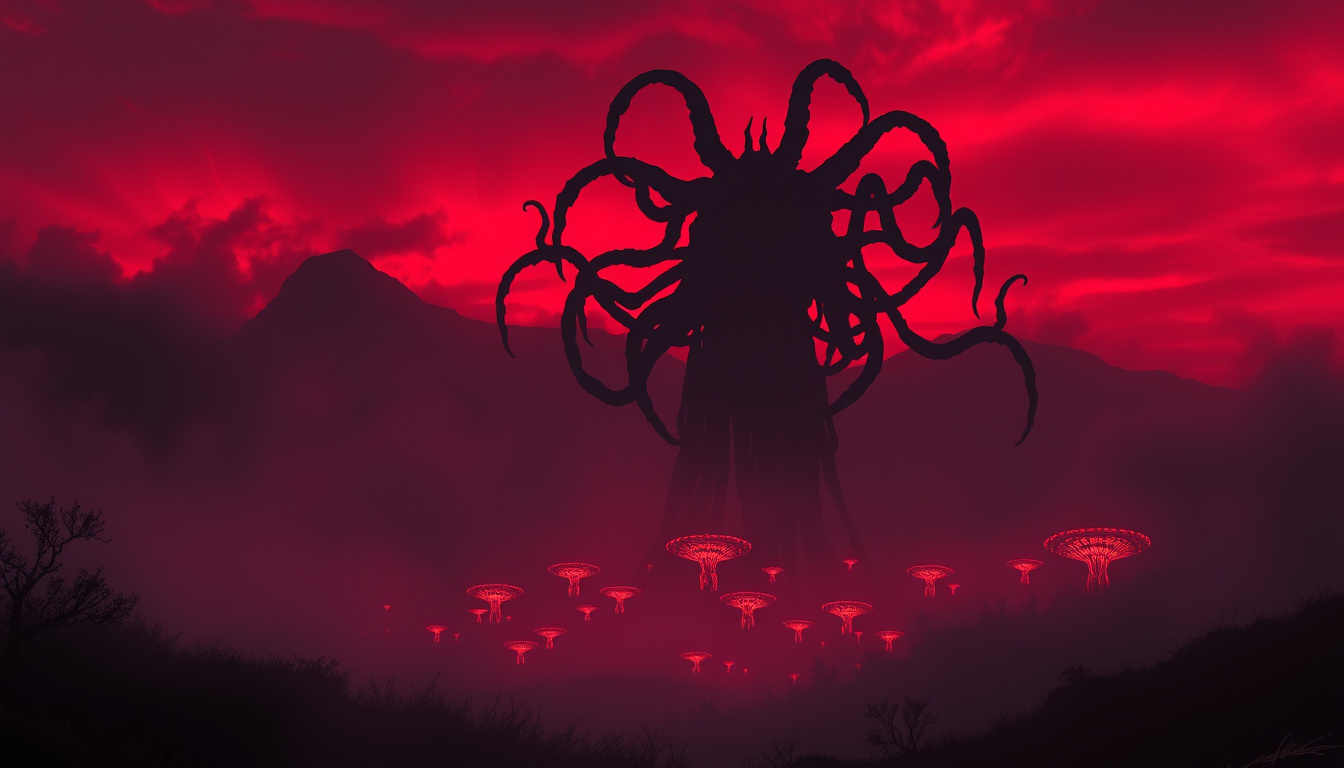
Anyone who watched Stranger Things season 2 remembers the shadow monster — a towering cloud of black particles with a mind of its own — but its roots go deeper than Hawkins, Indiana, to Dungeons & Dragons’ illithids introduced in 1977. Understanding both versions reveals how a single name can produce two very different nightmares.
In Stranger Things: Shadow monster controlling the Upside Down ·
In Dungeons & Dragons: Illithid – psionic aberration ·
Species type: Aberration (D&D); Upside Down entity (Stranger Things) ·
Alignment (D&D): Usually lawful evil ·
Notable appearances: Stranger Things seasons 2–4; D&D 5th edition
Quick snapshot
- Mind Flayer is the overarching antagonist in Stranger Things seasons 2 and 3. (Stranger Things Wiki)
- In D&D, mind flayers are illithids with psionic powers. (Wikipedia)
- Vecna was Henry Creel, influenced by the Mind Flayer. (Stranger Things Wiki)
- Whether the Mind Flayer is truly a single entity or a collective.
- The exact nature of the Mind Flayer’s origin in the Upside Down.
- If the Mind Flayer will return in Stranger Things season 5.
- Possible return of the Mind Flayer in Stranger Things season 5.
- Continued evolution of illithids in future D&D supplements.
Four key facts, one pattern: both versions anchor their identity in psychic domination, but the show makes it a singular cosmic force while the game treats it as a species.
| Fact | Value |
|---|---|
| First appearance in Stranger Things | Season 2, episode 8 (2017) |
| First appearance in D&D | Original 1st edition (1977) |
| Alignment (D&D) | Lawful Evil |
| Key ability | Mind control and possession |
What exactly is the mind flayer?
Definition in Stranger Things
- The Mind Flayer is the main antagonist in Stranger Things season 2 and 3, controlling the Upside Down (Stranger Things Wiki).
- Described in fan references as exercising control through a psychic link over Demogorgons, vines, and Demobats (Stranger Things Wiki).
Definition in Dungeons & Dragons
- In D&D, mind flayers are illithids, telepathic aberrations with a hive mind (Wikipedia).
- They are monstrous humanoid aberrations with psionic powers, typically depicted with a squid-like head (Nerdarchy).
- Mind flayers are associated with domination and mental control over others (D&D Beyond).
The Stranger Things version is a singular intelligence; the D&D version is a whole species. One is a cosmic puppet master, the other a colony of brain-eating predators.
Why this matters: The show uses “Mind Flayer” as a proper noun for one entity; the game uses it as a common noun for a category of monster. That distinction shapes everything from narrative stakes to gameplay mechanics.
Is Mind Flayer the Demogorgon?
Differences between Mind Flayer and Demogorgon
- The Demogorgon is a lower-tier predator; the Mind Flayer is the overarching hive mind (Stranger Things Wiki).
- In the show, the Demogorgon is a physical brute while the Mind Flayer uses possession and strategy (Stranger Things Wiki).
Similarities in Stranger Things
- Both originate from the Upside Down but differ in intelligence and scope (Couch Soup).
Origin in the Upside Down
- The Demogorgon appears in season 1 as a solo predator; the Mind Flayer reveals itself in season 2 as the controlling force behind the hive.
Fans often conflate the two because both are named after D&D monsters. But the show deliberately escalates from a single brute to a strategic shadow intelligence.
The pattern: The Demogorgon is a foot soldier; the Mind Flayer is the general. D&D players would recognize the Demogorgon as a demon prince, but the show strips away that backstory entirely.
Is Mind Flayer Vecna?
Vecna’s role in Stranger Things season 4
- Vecna was originally human (Henry Creel) corrupted by the Mind Flayer (Stranger Things Wiki).
- Vecna acts as a general for the Mind Flayer, not the same entity (The Nerdd).
Connection between Mind Flayer and Vecna
- The Mind Flayer remains the greater hive-mind behind the Upside Down (Stranger Things Wiki).
- Vecna gained control over Demogorgons and other creatures after merging with the Mind Flayer’s influence.
Differences in power and origin
- Vecna is a corrupted human with a personal grudge; the Mind Flayer is an ancient, alien force.
Treating Vecna as the main villain risks downplaying the Mind Flayer’s role as the true cosmic horror. The show’s season 4 twist made Vecna a compelling face, but the shadow behind him remains the bigger threat.
What this means: Vecna is the Mind Flayer’s lieutenant, not the final boss. D&D lore also has a lich-god named Vecna, but the show reimagines him as a psychic child turned monster.
Why did 001 become Vecna?
Henry Creel’s backstory
- Henry Creel (001) was a psychic child experimented on by Dr. Brenner (Stranger Things Wiki).
The Mind Flayer’s influence
- He encountered the Mind Flayer in the Upside Down and became its vessel (Stranger Things Wiki).
Transformation into Vecna
- His transformation into Vecna involved gaining control over the Demogorgons and other creatures.
The implication: Henry Creel didn’t become Vecna on his own — the Mind Flayer provided the power. This makes the Mind Flayer the architect of the Upside Down’s entire army.
Who killed Mind Flayer in Stranger Things?
The battle in Starcourt Mall
- The Mind Flayer was defeated by Eleven, Steve, Robin, Erica, Dustin, and others at Starcourt Mall in season 3 (Stranger Things Wiki).
- Eleven closed the Russian gate and caused the flayed to melt, but the Mind Flayer entity retreated (Stranger Things Wiki).
Aftermath
- It was not permanently destroyed; it remains in the Upside Down and regroups in season 4 (Stranger Things Wiki).
The catch: The show leaves the Mind Flayer’s ultimate fate open. In D&D, mind flayers can be killed by destroying their Elder Brain, but the Upside Down’s equivalent remains unknown.
Now, a direct comparison between both versions across key attributes.
| Attribute | Stranger Things Mind Flayer | Dungeons & Dragons Illithid |
|---|---|---|
| Origin | Upside Down, ancient cosmic entity | Underdark, alien species from the Far Realm (D&D Beyond) |
| Nature | Singular hive-mind intelligence | Species with a collective consciousness ruled by an Elder Brain (Wikipedia) |
| Powers | Psychic possession, control over Demogorgons, vines, Demobats | Psionic abilities: mind blast, domination, levitation, brain extraction (Nerdarchy) |
| Role in story | Main antagonist of seasons 2–3, background threat in season 4 | Common high-level foe, can be encountered in lairs or as part of illithid plots (D&D Beyond) |
What this means: The table shows how the same name masks radically different concepts. Netflix’s Mind Flayer is a narrative device — a cosmic evil. D&D’s mind flayer is a mechanical monster with defined stats and a place in a bestiary.
Timeline
- — Illithids introduced in D&D 1st edition (Wikipedia).
- — Mind Flayer revealed in Stranger Things season 2 (Rossonl Blog).
- — Mind Flayer defeated at Starcourt Mall (season 3).
- — Mind Flayer’s connection to Vecna revealed in season 4.
The pattern: The timeline shows the Mind Flayer’s evolution from D&D origins to a TV antagonist over 45 years.
Clarity check
What’s confirmed
- Mind Flayer is the overarching antagonist in Stranger Things seasons 2 and 3 (Stranger Things Wiki).
- In D&D, mind flayers are illithids with psionic powers (Wikipedia).
- Vecna was Henry Creel, influenced by the Mind Flayer (Stranger Things Wiki).
What’s unclear
- Whether the Mind Flayer is truly a single entity or a collective.
- The exact nature of the Mind Flayer’s origin in the Upside Down.
- If the Mind Flayer will return in Stranger Things season 5.
- Whether the Mind Flayer has a physical form beyond the cloud of particles.
The more we learn about the Mind Flayer, the less certain its boundaries become. D&D’s illithid lore, by contrast, is meticulously codified — you can open a sourcebook and see its exact hit points.
What this means: The paradox echoes the show’s central mystery.
Quotes from the source material
“The Mind Flayer — it’s the shadow monster. It’s like a giant spider made of melted stuff. It’s been controlling everything.”
— Dustin Henderson, Stranger Things season 2 (Stranger Things Wiki)
“I’m the Mind Flayer. I’ve been here the whole time.”
— Henry Creel / Vecna, Stranger Things season 4 (Stranger Things Wiki)
“Illithids are aberrations with a hive-mind psychology, driven by a relentless hunger for the brains of intelligent creatures.”
— Volo’s Guide to Monsters (D&D 5e) (D&D Beyond)
Why these quotes matter: Dustin’s description matches a child’s attempt to articulate a cosmic horror. Vecna’s claim recontextualizes the entire show. The D&D sourcebook offers cold, mechanical clarity — the opposite of the show’s ambiguity.
Summary
The Mind Flayer is not one thing. For Stranger Things fans, it’s a shadowy hive-mind that embodies the Upside Down’s corruption. For D&D players, it’s a species of brain-eating aberrations with a detailed ecology. The name is a bridge, but the substance differs vastly. For anyone trying to understand the Mind Flayer’s role in either universe, the key is recognizing the translation gap: the show uses the name as a metaphor, while the game uses it as a monster manual entry. The consequence for viewers and players alike is clear: treating them as the same entity leads to confusion — but appreciating both versions enriches the experience.
youtube.com, gmbinder.com, youtube.com, reddit.com, jandjgamingfactory.com, abendbericht.de
For en detaljeret gennemgang af forskellene mellem skabningen i de to universer, kan du se Mind Flayer i D&D og Stranger Things.
Frequently asked questions
Are mind flayers evil?
In D&D, mind flayers are usually lawful evil — they are intelligent, strategic, and morally malevolent. In Stranger Things, the Mind Flayer is depicted as an alien force of pure destruction, without a moral code as humans understand it (Wikipedia).
Why did Vecna choose 12 kids?
In Stranger Things, Vecna (Henry Creel) targeted children because they were psychic subjects of Dr. Brenner’s program — he saw them as rivals or tools. The exact number 12 relates to the Hawkins Lab test subjects (Stranger Things Wiki).
How does the Mind Flayer control its victims?
In Stranger Things, the Mind Flayer uses a psychic link to possess people, turning them into “flayed” puppets. It can also control Demogorgons, vines, and Demobats through the same hive-mind connection (Stranger Things Wiki).
What is the Mind Flayer’s weakness?
In the show, heat and fire can destroy the physical form of the Mind Flayer (the fleshy mass melted at Starcourt). In D&D, illithids are vulnerable to psychic damage and can be killed by destroying their Elder Brain (D&D Beyond).
Can a mind flayer be killed permanently?
In D&D, yes — kill the individual illithid or the Elder Brain of its colony. In Stranger Things, the Mind Flayer seems to be a persistent, almost immortal force; it retreated after Starcourt but was not destroyed (Stranger Things Wiki).
Do mind flayers appear in other D&D editions?
Yes, mind flayers (illithids) appear in all major editions of D&D, from 1st edition (1977) through 5th edition, with varying lore but consistent psionic themes (Wikipedia).
What is an Elder Brain in D&D?
An Elder Brain is the central intelligence of an illithid colony — a giant brain in a pool of brine that directs the minds of all mind flayers in its domain (D&D Beyond).

Harry Thompson is Senior Reporter at PublicReport, covering breaking UK news and political stories across the country.