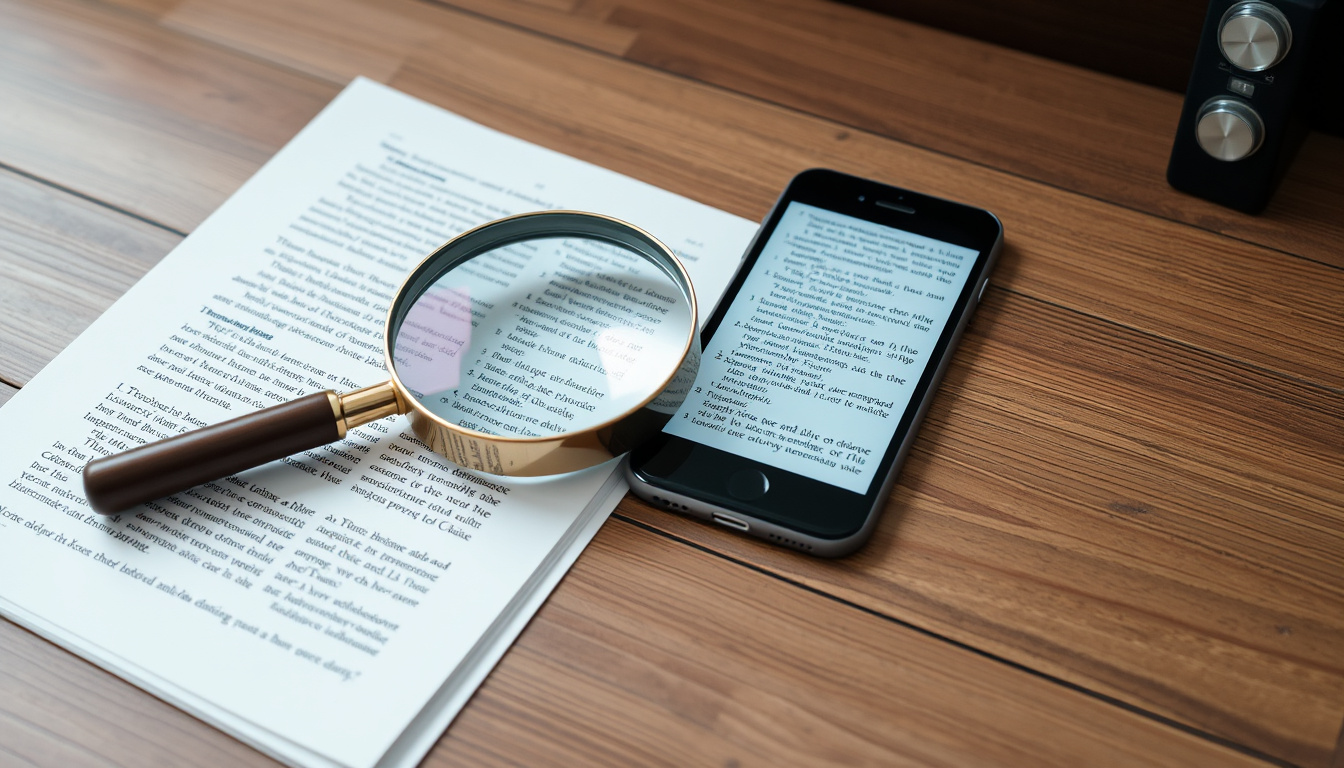
A magnifying glass solves a common problem in seconds — a simple one typically provides about 2x to 6x magnification (RP Photonics optics encyclopedia). Here’s how the strengths, the trade-offs, and the free phone alternative line up, so you can pick the right tool instead of the most powerful one.
Price range of magnifying glasses: Under £4 to over £50 ·
Cost of magnifying glass app: Free on Android ·
Common magnification strengths: 2X, 3X, 5X, 10X ·
Typical lens diameter: 50mm to 100mm
Quick snapshot
- Most phone main cameras offer about 1x optical magnification — only some telephoto models go higher (Microscope Club phone microscope guide).
- The “best” magnification shifts with the task, the lighting, and the user — there is no universal setting.
- The exact number of magnifier apps in app stores isn’t reliably documented.
- Phone-based magnification for accessibility now routinely spans 2x to 4x (Lenstroop phone magnifier guide).
- Test the magnifier on the exact text or objects you’ll actually use — then buy (American Foundation for the Blind low-vision nonprofit).
Eight specs explain most of what a magnifier does — and one pattern runs through them: the lens geometry decides how big, how sharp, and how easy the view is.
| Fact | Detail |
|---|---|
| Basic principle | A convex lens magnifies the image; simple handheld lenses typically provide about 2x to 6x magnification (RP Photonics optics encyclopedia). |
| Common magnifications | 2X, 3X, 5X, 10X are the usual commercial strengths. |
| Typical uses | Reading, hobbies, inspection, and low-vision support. |
| Phone alternative | Built-in accessibility tools or third-party apps; screen enlargement is the main accessibility use case (Lenstroop phone magnifier guide). |
| Sharpest position | At or near the lens’s focal length (2020 Magazine optometry education resource). |
| Phone method | Camera app plus zoom, held about 5 to 15 cm from the object, per LoupeLens (LoupeLens phone magnifier guide). |
| Phone stability | A stand or tripod reduces blur in close-up work (Dolphin Multimedia phone camera lens guide). |
| Low-vision principle | Use the lowest effective magnification that still completes the task (Low Vision Guide low-vision magnifier resource). |
Can I Use My Phone as a Magnifying Glass?
Yes — and the trick is simpler than people expect. Open the camera, zoom in, and the phone becomes a magnifier for quick looks at labels, packaging, and small print.
The catch is optical. According to Microscope Club, most phone main cameras sit at about 1x optical magnification, and the zoom beyond that is digital — it enlarges the image rather than preserving optical detail (Microscope Club phone microscope guide).
Don’t expect digital zoom to add detail the lens never captured. Zooming into a soft image just makes a bigger soft image.
Where is the magnifying glass feature on my phone?
- Look in Accessibility or Vision settings first — that’s where Android and iOS keep the system magnifier.
- If there’s no built-in tool, a third-party magnifier app is the standard fallback.
- The system-level Magnifier app is free on Android and iOS.
For casual use, the built-in route is usually enough: open the tool, point it at the text, and zoom until the words are readable.
How do I check if my phone has a built-in magnifier?
- Open Settings and search for “magnifier” or “magnification”.
- Check under Accessibility or Vision categories.
- If nothing comes up, search your app store for a magnifier app.
Most modern phones have the feature somewhere; the challenge is usually just finding it in the settings menu.
How to use your phone as a magnifier in four steps:
- Open the camera app and hold the phone roughly 5 to 15 cm from the object (LoupeLens phone magnifier guide).
- Pinch to zoom until the text or detail is readable.
- Bring in extra light — the method works best with controlled lighting (LoupeLens phone magnifier guide).
- Steady the phone on a surface or use a small tripod — Dolphin Multimedia notes that stands reduce blur in close-up work (Dolphin Multimedia phone camera lens guide).
For a fuller walkthrough of how to get the sharpest results, our phone-based magnification guide covers the setup in more detail.
The implication: the phone is a capable casual magnifier, but because it starts from a 1X optical base, a physical lens still leads when genuine close-up detail matters.
What Strength Magnifying Glass Is Best?
Before asking which strength is best, decide what the magnifier is actually for: screen enlargement for reading or lens-based enhancement for photography (Lenstroop phone magnifier guide). From there, the practical rule is simple — choose the lowest effective magnification that still completes the task, matched to the material size, lighting, and the user’s comfort (Low Vision Guide low-vision magnifier resource).
More magnification sounds like more help, but every step up narrows the visible area and shortens the comfortable working distance.
What magnification do I need for reading?
- 2X–3X: the comfort zone for continuous reading.
- 50mm to 100mm lens diameter: larger lenses cover more text per line.
- Low power keeps the field of view wide, so your eyes don’t lose the line.
Reading is a marathon, not a magnification contest. At 2X–3X, the text is enlarged just enough to relax your eyes while the lens still covers a line or two of print. Push higher and you gain detail you don’t need while reading — and lose the wider view that keeps your place.
What strength of magnifier do I need for hobbies?
- 5X: stamps, coins, labels, and jewellery — a solid balance of detail and coverage.
- 10X: tiny parts and precision inspection — expect a narrow field and a shakier image.
- Stand or headband designs: hands-free work for electronics, craft, and assembly.
For workshop and lab tasks, there’s a safety angle too: magnifying safety glasses sold by industrial suppliers may carry ANSI Z87.1 impact ratings (Grainger industrial safety supplier). That rating matters more than an extra X of power when you’re working around tools.
Which Magnification Is Better: 3X, 5X, or 10X?
None of them wins outright — 3X, 5X, and 10X are different tools for different jobs. The decision rule comes back to the same principle: the lowest effective magnification that still gets the job done (Low Vision Guide low-vision magnifier resource).
Is 5x magnification better than 10X?
- 5X: better for handheld use — wider view, more forgiving on movement.
- 10X: more detail, but a smaller visible area and less room for error.
- Rule of thumb: 5X is the practical ceiling for comfortable handheld reading.
At 10X, you see more detail but less of the object at once. For handheld work, most people find 5X easier to manage because the field of view stays wide enough to keep orientated, and hand shake doesn’t dominate the image.
Which is better, a 3X or a 5x magnifier?
- 3X: better for reading blocks of text; keeps your place in the line.
- 5X: better for inspecting fine detail — labels, coins, stamps, and small parts.
If the task is continuous reading, 3X is usually the steadier companion. If the task is a close look at something small, 5X shows more without demanding loupe-level control.
Three strengths, one trade-off: each step up in power narrows the field of view and demands a steadier hand.
| 3X | 5X | 10X | |
|---|---|---|---|
| Best for | Reading continuous text | Labels, hobby detail, small parts | Fine inspection, tiny components |
| Field of view | Wide — keeps your place in a line | Moderate — you move the lens more | Narrow — a small patch at a time |
| Hand steadiness | Forgiving | Moderate | Demanding — a stand or loupe helps |
| Working distance | Comfortable | Closer | Very close |
| Typical form | Handheld | Handheld | Loupe or stand magnifier |
| Reading daily text | Excellent | Good | Less comfortable |
Why it matters: choosing magnification is choosing a trade-off between detail and coverage. Match the power to the task, and the lens will feel effortless; chase raw power, and you’ll fight the field of view all day.
How Strong Is a 5X Magnifying Glass?
A 5X magnifier makes an object appear five times larger than its actual size. That sounds modest until you hold one: a postage stamp becomes a page-sized image, and the working distance shrinks to a few centimetres.
How far can a 5x magnifier see?
- Close — the lens must sit near the object, at roughly its focal length.
- The higher the power, the shorter the comfortable working distance.
- It won’t work like binoculars — you measure working distance in centimetres, not metres.
Hold the lens at or near its focal length and the image snaps into sharpness; pull it too far away and the magnification collapses.
Is a 6x magnifier good?
- 6X sits near the top of the simple handheld range — basic magnifiers typically deliver 2x to 6x (RP Photonics optics encyclopedia).
- It’s a strong choice for fine inspection, but the visible area narrows.
- Expect to brace the lens or use a stand for comfortable viewing.
At 6X the lens is still the easy part; the human hand becomes the weak link. For stamps, solder joints, or insect details, 6X is genuinely useful — just steady it.
A 5X or 6X lens magnifies movement too. Brace the hand or choose a stand, or the extra power will blur more than it reveals.
Why this matters: an impressive-looking high-power lens is only useful if you can hold it steady at the right distance — which is why the lowest effective power usually wins.
How to Choose a Good Magnifying Glass?
A good magnifier is less about brand names and more about behavior: how you hold it, what you point it at, and how steady your hands are. The quality checklist below covers the details that separate a useful lens from a frustrating one. For a step-by-step version of the task-matching method, our guide to choosing a magnifier for low vision walks through it in detail.
What is a good quality magnifying glass?
- Use it at or near its focal length, view through the center, and keep the lens away from objects so it doesn’t scratch (2020 Magazine optometry education resource).
- If you go the clip-on phone-lens route, look for optical quality, anti-reflective coatings, and minimal edge distortion (Dolphin Multimedia phone camera lens guide).
Magnifiers live a hard life — they get dropped, scratched, and shoved into drawers. The good ones survive because they’re handled correctly: held at the right distance, viewed through the center, and never pressed against the object.
Eight specifications, one idea: a magnifier is a system — power, lens size, distance, and support all act together.
| Specification | Typical value | What it changes |
|---|---|---|
| Lens type | Convex | Creates the enlarged image |
| Magnification | 2X–6X for simple handheld lenses | Lower is often better for reading |
| Common strengths | 2X, 3X, 5X, 10X | 10X suits inspection, not page reading |
| Lens diameter | 50mm to 100mm | Larger lens covers more text per line |
| Optimal distance | At or near the focal length | Too far away, and the image blurs |
| Field of view | Shrinks as power rises | The main trade-off at higher magnification |
| Distortion | Least in the center of the lens | View through the middle |
| Support | Handheld, stand, or headband | Decides whether your hands stay free |
Five steps to pick the right magnifier:
- Name the task — reading, hobby work, or close inspection.
- Start with the lowest magnification that makes the task comfortable, and only step up if the detail isn’t there.
- Test it on the exact text or object you’ll actually use.
- Choose the form: handheld for portability, stand for hands-free work, headband for both-hands tasks.
- Check the handling basics: hold it at the right distance, look through the center, and keep the lens away from scratch risks.
The pattern: every good magnifier choice balances power, field of view, and steadiness — and the balance point is different for every task.
Confirmed Facts and What’s Unclear
The practical evidence is clear on a few points — and honestly still open on others.
- Confirmed: simple handheld magnifiers typically deliver 2x to 6x magnification (RP Photonics optics encyclopedia).
- Confirmed: magnifiers stay sharpest when held at or near their focal length.
- Confirmed: the most practical selection test is trying the magnifier on the exact text or object you’ll use (American Foundation for the Blind low-vision nonprofit).
- Unclear: which single magnification is “best” depends on the task, the material, the lighting, and the user’s comfort.
- Unclear: how far a phone’s digital zoom can usefully go varies by device and app.
- Unclear: how many magnifier apps actually exist — app-store counts shift constantly.
- Unclear: whether a phone or an optical lens serves you better changes with the job.
The implication: stay skeptical of anyone promising a single “best” magnifier — the evidence points to task-matching instead.
What the Experts Say
Three voices worth remembering — an optometry educator, a low-vision nonprofit, and an industrial safety supplier:
“Handheld magnifiers should be used at or near their focal length to achieve maximum sharpness and magnification together.”
“Try the device on the exact text or objects you normally use to find the zoom level that works best.”
“Magnifying safety glasses sold by major industrial suppliers may be rated to ANSI Z87.1 or ANSI Z87.1+.”
The pattern: the tool matters less than the match between tool, task, and user — and the same rule applies whether you buy a lens or use a phone.
The Takeaway
The magnifying glass is a deliberately simple tool — a convex lens that enlarges whatever you point it at — and the smartest purchase is equally simple: the lowest magnification that gets the job done, used at the right distance, with good light and a steady hand. The real decision is the form factor: a 2X–3X handheld lens for daily reading, a stand or headband for hands-free work, and the phone for quick zoom-and-look moments. For anyone who reads fine print every day, the choice is clear: buy a simple, low-power optical magnifier for genuine reading comfort, or keep fighting the phone’s digital zoom and its 1X optical starting point.
telectronichub.com, dolphinmultimedia.com, grainger.com, nancyrayshop.com
Frequently asked questions
What is the best magnifying glass for reading?
A 2X–3X handheld lens is the everyday reading range: it enlarges text enough to relax your eyes while keeping a useful field of view. Simple magnifiers typically deliver 2x to 6x magnification, and the advice is to pick the lowest power that makes reading comfortable.
Can I use a magnifying glass for soldering?
Yes — and for soldering, a stand or headband magnifier makes more sense than a handheld lens because both hands stay free. Keep the lens at its focal length for sharp focus, and for workshop tasks consider magnifying safety glasses with an ANSI Z87.1 rating (Grainger industrial safety supplier).
How do I clean a magnifying glass?
Avoid pressing the lens against objects or hard surfaces — direct contact risks scratches. Remove dust gently and store the lens so it doesn’t rub against anything hard; the lens itself is the part you’re protecting.
Is a magnifying glass the same as a loupe?
They work on the same convex-lens principle. A loupe is a compact, higher-power magnifier designed to be held close to the eye for fine inspection, while a magnifying glass is usually held farther away and covers more area. The selection rule is the same: choose the lowest power that completes the task.
What is the difference between optical zoom and digital zoom on a phone?
Optical zoom uses the lens to magnify before the image is captured; digital zoom simply enlarges the captured image, so it doesn’t add optical detail (Microscope Club phone microscope guide). Most phone main cameras start at about 1x optical magnification, which is why phone zoom is mostly digital.
Are magnifying glasses with LED lights better?
They help in dim conditions, because lighting is part of the match between tool and task. In good light, a plain lens is lighter and simpler — and the lowest effective magnification still does the job.
How do I measure the magnification of a magnifying glass?
The number on the handle or frame tells you how many times larger the object appears — 5X means five times life size. For your own use, the more practical test is whether the lowest power that makes text readable feels comfortable in hand.

Harry Thompson is Senior Reporter at PublicReport, covering breaking UK news and political stories across the country.