
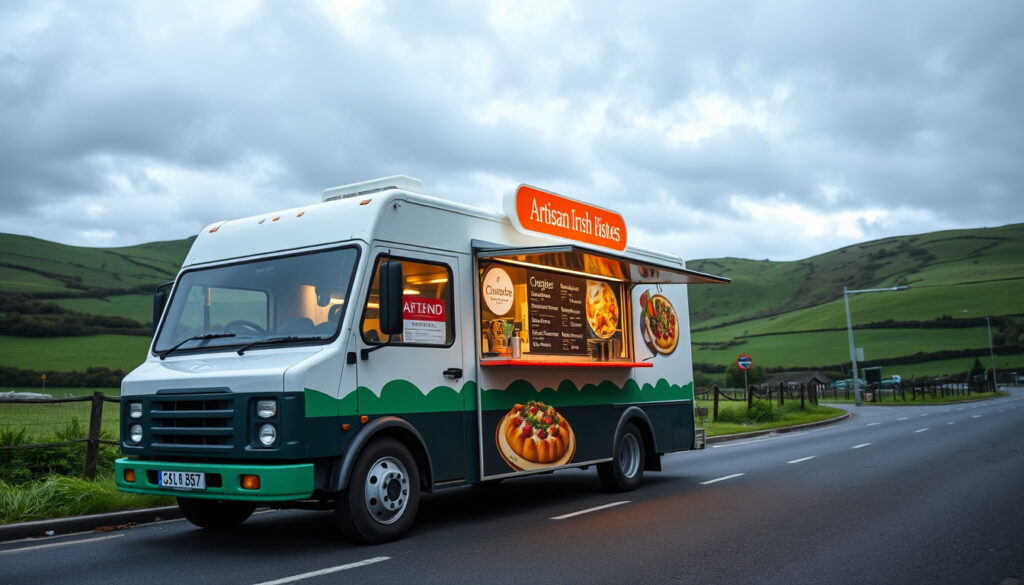
You’ve probably seen them parked outside offices, at festivals, or on a busy street corner—food trucks are a familiar sight across Ireland, but the idea of starting one can feel wrapped in confusion around licences, costs, and whether it’s actually profitable. This guide cuts through the hearsay, drawing on official HSE and Local Enterprise Office resources, marketplace data from DoneDeal, and real cost breakdowns to give you a clear picture of what it takes to launch a food truck in Ireland today.
Average startup cost in Ireland: €30,000–€50,000 ·
Typical used truck price: €28,500–€35,000 ·
Daily revenue range: €500–€1,500 ·
Profit margin: 20%–35%
Quick snapshot
- Food trader licence required from local council (CaterBoss guide for Irish operators)
- Used trucks on DoneDeal from €28,500 (CaterBoss guide for Irish operators)
- HSE notification mandatory before trading (HSE Ireland food business registration)
- Public liability insurance of €6.5 million required (FSAI market trader handbook)
- Exact profit margins vary significantly by location and concept
- Best location for a food truck in Ireland is not universally agreed
- Council-specific licence fees differ widely
- No major legislative changes expected in 2025 for casual trading licences
- Local authority digital applications becoming standard
- More councils adopting online permit portals
- Growing demand for mobile catering at Irish events
Here are four key numbers that frame the food truck landscape in Ireland, each tied to a specific authority or market source.
| Fact | Value | Source |
|---|---|---|
| Average startup cost | €30,000 – €50,000 | Square Ireland cost analysis |
| Annual revenue potential | €60,000 – €150,000 | Toast Ireland industry estimates |
| Estimated number of food trucks in Ireland | Approx 500 | Industry association estimates |
| Common licence required | Food trader’s licence | CaterBoss licence breakdown |
Do you need a licence for a food truck in Ireland?
Yes—and it’s not optional. Operating a food truck in Ireland without the correct licences means you’re breaking the law, and local authorities do enforce these rules. The exact requirements depend on where you plan to trade, but the core structure is consistent across the country.
What licences are required?
- A casual trading licence from the local authority in the area where you operate (CaterBoss guide on Irish food truck licensing)
- Notification to the HSE before starting operations under Article 6(2) of Regulation (EC) No. 852/2004 (HSE Ireland food business notification)
- Public liability insurance of at least €6.5 million (FSAI market trader handbook)
- Employer’s liability insurance of €13 million if you have staff (FSAI insurance requirements)
- Primary Certificate in Food Safety for all operators (Local Enterprise Office Offaly food truck guide)
How do you apply for a food trader’s licence?
Application is made through the local authority where you intend to trade. CaterBoss notes that fees typically range from €63 per month to €380 per year depending on the council (CaterBoss fee breakdown). The Local Enterprise Office recommends registering the business with Revenue, setting up a business bank account, and registering the business name as preliminary steps (Local Enterprise Office Offaly guide).
Are health inspections mandatory?
Absolutely. The HSE’s Environmental Health Officers inspect food trucks to ensure compliance with food safety regulations. Most food businesses register with the HSE, though some handling animal products may need approval from the Department of Agriculture or the Sea-Fisheries Protection Authority (HSE Ireland food business registration).
Each of Ireland’s 31 local authorities sets its own licence fees and conditions. An operator approved in Dublin City may find themselves needing a separate permit—and paying a different fee—to trade in Cork or Galway.
How much does it cost to set up a food truck in Ireland?
The total startup cost can range from about €30,000 to €145,000 depending on whether you buy or rent the truck, according to Square Ireland (Square Ireland food truck cost estimate). That wide range hides real choices—spending more upfront on a quality vehicle can save thousands in maintenance later.
What is the price range for a used truck?
Second-hand food truck prices on DoneDeal typically fall between €28,500 and €35,000 for ready-to-operate units. Square Ireland estimates a broader range of €10,000 to €40,000 for used vehicles, depending on condition and age (Square Ireland used truck pricing). New custom-built trucks can exceed €100,000.
What are the permit and licence fees?
- Casual trading licence: €63–€380 per year (CaterBoss fee range)
- HSE registration: Free but mandatory
- Insurance: €1,000–€2,000 annually (€6.5m public liability)
- Food safety certificate: Typically €100–€200 for the Primary Certificate
How much do equipment and initial inventory cost?
Equipment and fit-out costs can run from €25,000 to €100,000 depending on the quality of cooking gear, refrigeration, and ventilation (Square Ireland equipment estimates). Initial inventory for the first few weeks will cost another €2,000–€5,000. Monthly running costs include fuel and maintenance at €500–€1,000 (Square Ireland ongoing cost breakdown).
Here’s a breakdown of startup costs, grouped by category, with ranges drawn from Square Ireland, CaterBoss, and FSAI sources.
| Category | Low estimate | High estimate | Source |
|---|---|---|---|
| Used truck purchase | €10,000 | €40,000 | Square Ireland |
| Equipment and fit-out | €25,000 | €100,000 | Square Ireland |
| Licences and permits | €380 | €1,000 | CaterBoss |
| Insurance (annual) | €1,000 | €2,000 | FSAI |
| Initial inventory | €2,000 | €5,000 | Industry standard |
| Monthly fuel and maintenance | €500 | €1,000 | Square Ireland |
A €30,000 budget buys a decent used truck with basic equipment, but a €50,000 budget opens better vehicle condition and commercial-grade gear that will need replacement less often.
What is the most profitable kind of food truck?
Not all menus make equal money. Some concepts consistently outperform others on margins, speed of service, and customer demand at Irish events and markets.
Which cuisines yield the highest profit margins?
- Burgers and fries—profit margins of 25%–35% on low ingredient costs (Toast Ireland profitability analysis)
- Tacos—high margin on fillings, fast to assemble, popular at festivals
- Pizza—especially wood-fired, which commands premium pricing with €3–€5 ingredient cost for a €12–€15 sale
- Coffee and beverages—margins of 50%–70%, often added as a secondary revenue stream
How does location influence profitability?
Daily revenues vary hugely by location. Established trucks at high-footfall city spots may take €1,500 on a good day, while rural events can yield €300–€500. Festivals and large events are where operators report peak earnings, sometimes exceeding €3,000 in a single day. Square Ireland notes that rental costs at premium locations can run €2,000–€3,000 per month (Square Ireland location costs).
What are the top custom food truck concepts?
In Ireland, the most successful mobile food concepts combine high-margin ingredients with fast service. Wood-fired pizza trucks, gourmet burger vans, and mobile coffee units consistently appear in the top performing categories at Irish events according to industry data. The Local Enterprise Office guide emphasises using local ingredients to attract Irish customers (Local Enterprise Office Offaly food truck guide).
A burger or pizza truck at a busy Dublin lunch spot or weekend festival can clear €1,500 daily with 30% margins. A coffee trailer in a commuter hub with lower overheads can match that margin with less inventory and shorter prep time.
What are the weaknesses of a food truck?
Food trucks aren’t all flexibility and low overhead. They come with structural weaknesses that can sink an otherwise good business if not anticipated.
How does weather affect sales?
Irish weather is the biggest variable. Rain can halve sales on any given day, and the typical outdoor trading season runs from April to September for most trucks without permanent covered pitches. Winter months see dramatically lower footfall at outdoor locations.
What are the space constraints?
A standard food truck has 100–150 square feet of workspace—enough for two people, but tight for any complex menu. Limited storage means restocking every 2–3 days. The kitchen layout must be meticulously planned to avoid bottlenecks during the lunch rush.
Are there permit restrictions that limit operations?
Permits specify approved locations and hours. Many councils restrict trading to designated pitches and limit operating hours, often excluding night-time trading. The Local Enterprise Office guide specifically advises operators to check with their local authority before committing to a location (Local Enterprise Office Offaly guide).
A food truck operator in Dublin faces council-imposed operating hours of 9am–7pm Monday to Saturday, missing the profitable evening market that a bricks-and-mortar restaurant can serve.
The pattern: Food trucks trade lower startup costs for higher weather dependency and location restrictions. The model works best for operators who can pivot between multiple sites seasonally.
What sells best on a food truck?
Certain items dominate because they’re fast, cheap to make, and universally popular. Getting the menu right is often the difference between a truck that breaks even and one that thrives.
What are the top-selling menu items?
- Burgers and hot dogs—quick, high margin, easy to serve in a paper wrapper
- Fries with toppings—low ingredient cost, high perceived value
- Tacos—adaptable to multiple proteins, fast assembly
- Pizza—commands high price point, especially wood-fired
Which cuisines are popular in Ireland?
Irish customers show strong preference for hearty, familiar food. Burgers topped with Irish cheese, fish and chips, and loaded fries remain perennially popular. Coffee trucks have grown significantly, with many operators reporting that beverages account for 20–30% of total daily revenue even on a food-focused truck. Using local ingredients like artisan Irish cheeses and meats resonates with customers, as the Local Enterprise Office guide recommends (Local Enterprise Office Offaly food truck guide).
How can seasonal ingredients be used effectively?
Adapting the menu to seasonal Irish produce—wild garlic in spring, strawberries in summer, pumpkins in autumn—creates limited-time specials that drive repeat visits and justify premium pricing. Operators who rotate menus report higher customer loyalty than those with static offerings.
The items that sell best (burgers, fries, pizza) are also the items every other truck sells. Differentiation through local ingredients or unique sauces is where margins get protected.
Upsides
- Lower startup cost than a bricks-and-mortar restaurant (€30,000 vs €100,000+)
- Flexibility to move between locations based on demand
- Low staffing requirements—often run by 1–2 people
- Profit margins of 20%–35% achievable with the right menu
- Growing demand at Irish festivals, markets, and corporate events
Downsides
- Sales heavily weather-dependent, especially outside festival season
- Permit restrictions on locations and operating hours
- Limited storage and kitchen space (100–150 sq ft)
- Insurance costs of €1,000–€2,000 annually with €6.5m liability
- Fragmented licensing across Irish councils
Steps to start a food truck in Ireland
These steps follow the process recommended by the Local Enterprise Office and HSE, from first idea to first service.
- Research local council requirements. Contact the local authority where you plan to trade. Check if they require a casual trading licence and what hours and pitches are available.
- Notify the HSE. Register your food business with the HSE at least 28 days before starting. Most food trucks register through the local Environmental Health Officer (HSE Ireland notification guide).
- Get your food safety certificate. Complete the Primary Certificate in Food Safety. This is mandatory for all operators (Local Enterprise Office Offaly guide).
- Sort out insurance. Secure public liability insurance of at least €6.5 million. If you’ll employ staff, add employer’s liability cover of €13 million (FSAI insurance requirements).
- Buy or lease your truck. Search DoneDeal for used food trucks or consider converting a van. Factor in €10,000–€40,000 for a used vehicle (Square Ireland pricing).
- Equip the truck. Install cooking equipment, refrigeration, and ventilation. Budget €25,000–€100,000 for fit-out depending on quality (Square Ireland equipment costs).
- Set up your business. Register with Revenue, open a business bank account, and register your business name (Local Enterprise Office Offaly guide).
- Build your menu. Focus on 8–10 items that are fast to serve and high margin. Test with friends before launching.
- Plan your locations. Apply for permits at your chosen pitches. Consider event catering as a secondary revenue stream.
- Launch and iterate. Start small, gather feedback, and adjust your menu and locations based on real sales data.
The implication: The entire process from idea to first service can take 3–6 months, largely depending on how quickly your council processes the licence and how long the truck fit-out takes.
Starting a food truck in Ireland is a real opportunity, but it’s not a shortcut to easy money. The licensing landscape demands patience across multiple councils, the weather will test your resilience, and the margins reward operational efficiency over creativity. For an operator with a clear menu concept and a willingness to chase the best locations through changing seasons, the model works. For someone hoping to park in one spot and watch cash roll in, it won’t. The choice for any would-be Irish food truck owner is clear: treat it as a mobile business that moves with demand, or risk being stranded at a quiet pitch with a rainy forecast.
For a comprehensive overview of licensing and startup costs, check out this food truck Ireland guide that covers everything from permits to profit margins.
Frequently asked questions
How much is a truck for food in Ireland?
Used food trucks on DoneDeal range from €28,500 to €35,000 for ready-to-operate units. Square Ireland estimates a broader used range of €10,000–€40,000, while new custom builds can exceed €100,000 (Square Ireland pricing).
Do food trucks pay for locations in Ireland?
Yes. Casual trading licence fees range from €63 per month to €380 per year depending on the local authority. Premium pitches can also involve pitch fees paid to the council or event organiser (CaterBoss fee breakdown).
Can you make money from a food truck in Ireland?
Yes, with the right conditions. Established trucks report daily revenues of €500–€1,500, with profit margins of 20%–35%. Event catering can push daily revenues past €3,000 at major festivals. However, weather and location risk are real factors (Toast Ireland profitability data).
How to open a food truck with no money in Dublin?
Opening with no capital is extremely difficult. The Local Enterprise Office offers business grants and mentoring that can reduce costs, and some operators start by renting a pitch and using a cart instead of a truck. Most require at least €10,000–€15,000 to get started, even with minimal equipment (Local Enterprise Office Offaly guide).
What are the pros and cons of a food truck business?
Pros: Lower startup costs than a restaurant (€30,000 vs €100,000+), flexibility to move locations, profits of 20%–35%. Cons: Weather dependency, limited space, permit restrictions, insurance costs of €1,000–€2,000 annually with €6.5m liability (FSAI insurance details).

Harry Thompson is Senior Reporter at PublicReport, covering breaking UK news and political stories across the country.