
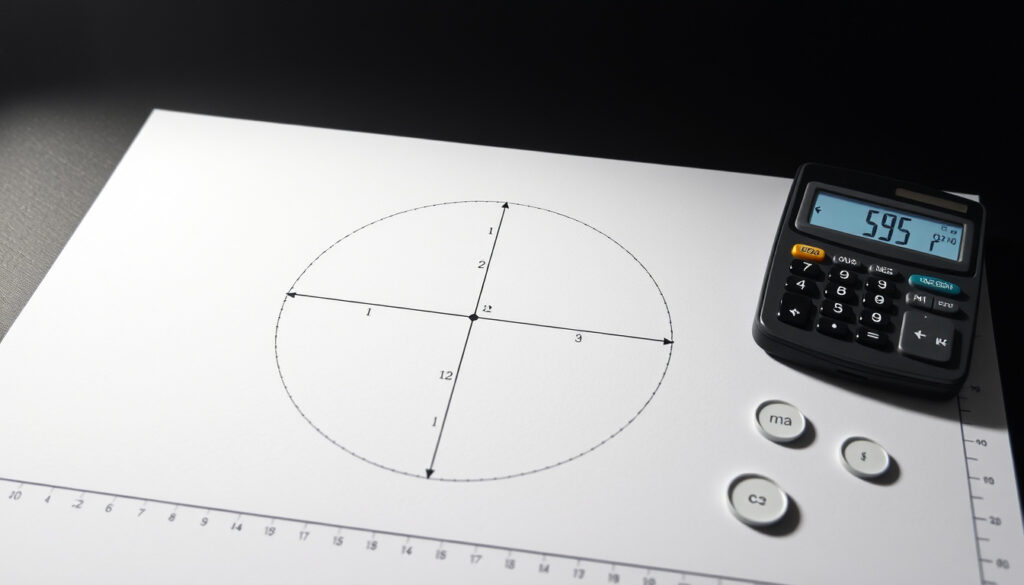
Finding the diameter of a circle is one of those skills that keeps paying off—whether you’re staring at a circular table and wondering how wide it really is, or cutting a pipe to exactly the right size. The math involved is surprisingly elegant: three reliable methods, one constant number, and you’re sorted.
Basic Formula: d = 2r · Circumference Relation: C = πd ≈ 3.14d · Example: 9-inch radius: 18 inches diameter · Pi Value: 3.14159… · Diameter Definition: Line through circle center
Quick snapshot
- d = 2r is the universal diameter formula (Omni Calculator)
- π is irrational and equals approximately 3.14159265… (Calculator.net)
- C = πd gives circumference from diameter (Insight Security)
- Which measurement method suits irregular physical objects best
- Rounding precision for non-standard materials
- Best practice for circles with no visible center point
- Modern online calculators developed in 2000s–2020s (Omni Calculator)
- Mobile apps emerged throughout 2010s–2020s (Omni Calculator)
- Classic formulas trace to ancient geometry (Omni Calculator)
- Pick your known value: radius, circumference, or area
- Apply the matching formula below
- Double-check with an online calculator for real-world projects
Key formulas for circle diameter calculations appear in the table below.
| Property | Value | Source |
|---|---|---|
| Definition | Straight line through circle center to edge | Calculator.net |
| Formula from Radius | d = 2r | Omni Calculator |
| From Circumference | d = C / π | Omni Calculator |
| Pi Approximation | 3.14 | Insight Security |
| Symbol | ø or d | Calculator.net |
| From Area | d = 2√(A/π) | Cuemath |
How do you find the diameter of a circle?
Three primary paths lead to the diameter, depending on which circle measurement you already have on hand. The most direct route uses the radius, but the circumference and area methods are equally valid when radius isn’t available.
From radius
If you know the radius, multiplying by two gives you the diameter instantly. The formula reads d = 2r, where “d” stands for diameter and “r” is the radius. A radius of 3 units produces a 6-unit diameter, according to eMathHelp’s calculator. This method requires no knowledge of pi whatsoever—radius and diameter exist in a simple 2:1 ratio regardless of circle size.
From circumference
When circumference is your starting point, divide by pi (approximately 3.14159) to isolate the diameter. The calculation d = C / π reveals that a 12-unit circumference yields a diameter of roughly 3.82 units, per Cuemath’s formula reference. Conversely, a 5 cm diameter produces a circumference of approximately 15.708 cm, as shown on Omni Calculator.
The circumference-to-diameter ratio stays locked at π no matter how big or small the circle gets. This constancy is what makes π such a powerful constant in geometry.
Using the center line definition
Geometrically, the diameter is simply any chord that passes through the circle’s center point. Calculator.net defines it as a straight line segment whose endpoints lie on the circle’s circumference and whose midpoint coincides with the circle’s center.
For physical circles—a wheel, a pizza, a pipe cross-section—finding the exact center first ensures your diameter measurement is accurate. Estimation without the center leads to reading errors.
What is the diameter of a circle formula?
The diameter formula adapts depending on your available input, but all three versions flow from the same geometric relationships governing every circle.
Basic d = 2r
The most fundamental formula is d = 2r. “The easiest formula for the diameter is d = 2r, where d is the diameter and r is the radius,” according to Omni Calculator. For a circle with a 10-foot radius, the diameter equals 20 feet, per Study.com’s lesson. A 9-inch radius yields an 18-inch diameter, confirmed by Omni Calculator’s worked example.
From area
Deriving diameter from area requires two steps. First, calculate the radius using r = √(A/π), then multiply by 2 to get diameter. The Oo Kingdom calculator demonstrates this two-step approach. For a circle with 25 square centimeters of area, the resulting diameter is approximately 5.64 centimeters, as shown on wikiHow’s video tutorial.
The symbol ø
The diameter symbol (ø) appears in engineering drawings, technical specifications, and mathematical notation. In writing formulas, “d” serves as the standard variable name for diameter, while “r” represents radius.
Calculating from area introduces an extra square root step compared to the radius method. For everyday carpentry or engineering, measuring radius or circumference directly saves time and reduces rounding error accumulation.
How do I calculate a diameter?
Working through diameter calculations by hand builds intuition for how circle measurements interlock. Here are the practical steps.
Step-by-step from radius
- Identify the radius. Look for “r” in the problem or measure from center to edge of your circle.
- Double it. Multiply the radius value by 2.
- Label the result. Your answer is the diameter—write it with the same unit as your radius.
Example: A circle with radius 10 cm → d = 2 × 10 cm = 20 cm.
Using circumference
- Find the circumference. This is the distance around the circle’s edge.
- Divide by pi. Use 3.14 for everyday work, or 3.14159 for higher precision.
- Calculate the result. d = C ÷ π.
Example: A circumference of 20 inches gives d = 20 ÷ 3.14 ≈ 6.37 inches, per Omni Calculator.
Using 3.14 instead of the full π value introduces a tiny error margin (about 0.05%). For carpentry or home projects, 3.14 is perfectly adequate. For aerospace or precision engineering, use π to full precision or verify with calibration tools.
Using online calculators
Calculator.net and Omni Calculator accept any single circle measurement and return all related values automatically. Omni Calculator notes that these tools estimate all circle parameters when given one input value.
Is the circumference 3.14 times the diameter?
Yes—with an important clarification. The circumference equals π times the diameter, and π approximates to 3.14159…, not exactly 3.14.
Pi explanation
“π is an irrational number meaning that it cannot be expressed exactly as a fraction,” according to Calculator.net. The platform further notes that π is transcendental, meaning it is not the root of any non-zero polynomial with rational coefficients.
C = πd formula
The circumference formula C = πd (or equivalently C = 2πr) expresses that relationship directly. A 6-foot diameter circle has a circumference of 18.8496 feet, as calculated on Omni Calculator. “If you divide the circumference by the diameter, independently of the size, it’ll always be 3.14159265…,” notes Omni Calculator in their explanation.
Using 3.14 is accurate enough for most real-world tasks, yet π cannot be written down exactly. Every circle you’ve ever measured inherits this beautiful imprecision at its mathematical core.
What is the diameter of a 12 inch circle?
“12 inches” can refer to either the radius or the circumference—the answer differs dramatically depending on which one the problem means.
If radius is 12 inches
A 12-inch radius gives a diameter of 24 inches. The formula d = 2r confirms this directly.
If circumference is 12 inches
A 12-inch circumference yields d = 12 ÷ 3.14159 ≈ 3.82 inches. Cuemath confirms this calculation for a circle with 12-unit circumference.
Multiple choice interpretation
Standardized test questions about “a 12 inch circle” typically mean the diameter equals 12 inches. Always check whether the problem states radius, diameter, circumference, or area before calculating.
When answering “diameter of a 12 inch circle” questions, read the question stem carefully. Is 12 the radius, diameter, circumference, or area? The same circle can have all four values, but they are not interchangeable.
“The number π is a constant equal to the circumference-to-diameter ratio of a circle (π = c/d). If you divide the circumference by the diameter, independently of the size, it’ll always be 3.14159265…”
— Omni Calculator (Educational mathematics resource)
“A chord that passes through the center of the circle is a diameter of the circle.”
— Calculator.net (Educational calculator resource)
“Pi is generally approximated to 3.14 or 3.142, which is adequately accurate for most practical applications.”
— Insight Security (Technical resource)
For students, the takeaway is straightforward: memorize d = 2r and d = C / π, and you’ll handle diameter questions confidently whether they appear on homework or standardized tests. For crafters, plumbers, and makers, online calculators eliminate manual arithmetic and provide instant verification for cuts, fittings, and materials.
Related reading: Right Angle Triangle Calculator
While d=2r provides the quickest path, this detailed formula guidedelivers step-by-step examples for deriving diameter from circumference or area too.
Frequently asked questions
What is 2π equal to?
2π equals approximately 6.28318. This value appears in circumference calculations using the radius form (C = 2πr) and in circle area formulas. The exact value is 2 × 3.14159265… = 6.2831853…
Why is 3.14 the value of pi?
Pi equals approximately 3.14 because that’s the numerical ratio of any circle’s circumference to its diameter. Ancient mathematicians discovered this constant by measuring physical circles. It cannot be expressed as a simple fraction, which is why we use decimal approximations like 3.14 or 3.14159.
What unit is used for diameter?
Diameter uses whatever length unit matches your circle—inches, centimeters, feet, meters, or any other measurement unit. The unit itself doesn’t change the formula; only the numerical value differs.
What symbol represents diameter?
The diameter symbol is ø (Unicode U+00F8), though in mathematical writing “d” serves as the standard variable. Engineering drawings often use ⌀ before a measurement to indicate diameter.
How does diameter relate to circle area?
Diameter relates to area through the formula A = π(d/2)². To find diameter from area, use d = 2√(A/π). Cuemath’s formula guide provides the derivation steps.
What is the formula 2πr?
2πr is the circumference formula expressed in terms of radius. Substituting r = d/2 gives C = 2π(d/2) = πd, which is the same relationship. Mometrix’s geometry guide explains both forms.

Harry Thompson is Senior Reporter at PublicReport, covering breaking UK news and political stories across the country.