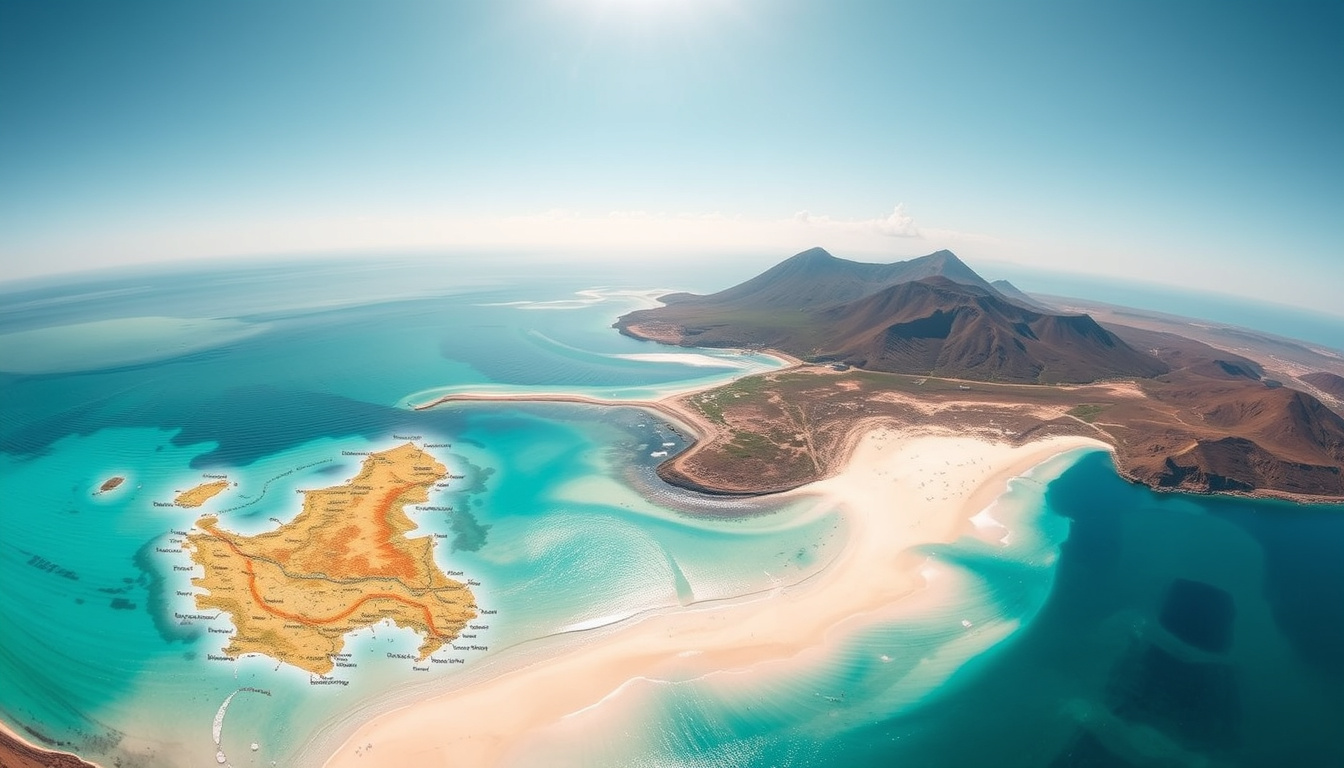
You’ve seen the postcards — volcanic peaks, turquoise water, and that dusting of European charm. But where exactly is Cape Verde, and is it the kind of place you’d actually want to go? This guide pins down the archipelago’s location off West Africa, walks through safety, flights, and culture, and compares it with the Canary Islands so you can decide if it’s your next holiday spot.
Population: approximately 560,000 ·
Capital: Praia (on Santiago) ·
Official language: Portuguese ·
Currency: Cape Verdean escudo (CVE) ·
Flight time from Ireland: around 6 to 7 hours ·
Time zone: UTC-1
Quick snapshot
- Archipelago of 10 main islands off West Africa (Wikipedia)
- Capital: Praia on Santiago island (Britannica)
- Area: 4,033 km² (Britannica)
- Population ~560,000 (Britannica)
- Official language: Portuguese (Wikipedia)
- Musical traditions: morna, coladeira (Wikipedia)
- Currency: Cape Verdean escudo (CVE) (BBC)
- Time zone: UTC-1 (timeanddate.com)
- Visa-free for most Western tourists up to 30 days (UK Government travel advice)
- Moderate crime; watch for petty theft (U.S. Department of State)
- Avoid isolated beaches at night (UK Government travel advice)
- Tap water not safe to drink (CDC)
Eight facts, organised to give you the essentials at a glance.
| Field | Value |
|---|---|
| Official name | Republic of Cabo Verde |
| Capital | Praia |
| Population | approximately 560,000 |
| Area | 4,033 km² |
| Official language | Portuguese |
| Currency | Cape Verdean escudo (CVE) |
| Time zone | UTC-1 |
| Drives on the | Right |
What country did Cape Verde belong to?
Where is Cape Verde located?
- The archipelago sits about 600 km off the west coast of Africa, opposite Senegal (Britannica (encyclopaedic authority)).
- It consists of 10 main islands, all volcanic in origin (Wikipedia).
- Its nearest neighbours are still about 650 km away (Encircle Africa (African travel resource)).
Who owns Cape Verde?
- Cape Verde is an independent republic. It gained full independence from Portugal on 5 July 1975 (U.S. State Department).
- No foreign power owns the islands — it is a sovereign, multiparty democracy with free elections since the early 1990s (BBC (UK public broadcaster)).
- Portuguese is still the official language, reflecting its colonial past (Britannica (encyclopaedic authority)).
What this means: Cape Verde is an African nation with European cultural DNA — that mix influences everything from language to tourism marketing.
Is it safe to go to Cape Verde now?
What should I be careful of in Cape Verde?
- Petty crime such as pickpocketing is common in tourist areas, marketplaces, festivals, and public gatherings, according to the U.S. Department of State.
- The UK Foreign Office advises against carrying large amounts of cash and warns that isolated beaches are best avoided at night (UK Government travel advice).
- Avoid hillside stairways connecting neighbourhoods, even during the day, particularly in Praia (U.S. Department of State).
- Street lighting in some areas is poor — be extra vigilant at night (U.S. Department of State).
- Described by Encircle Africa (African travel resource) as “one of the safest destinations in Africa,” but general caution is still needed.
Can you drink alcohol in Cape Verde?
- Alcohol is legal and widely available in bars, restaurants, and shops (UK Government travel advice).
- Drinking age is 18, and local spirits like grogue (sugarcane spirit) are common.
- Public drunkenness is frowned upon but not illegal — stay respectful.
The trade-off: Cape Verde is safe by West African standards, but that does not mean zero risk — petty crime and poor lighting in certain areas require the same street smarts you would use in any European city.
How do I get to Cape Verde from Ireland?
How long is the flight from Ireland to Cape Verde?
- Flight duration is approximately 6 to 7 hours (Skyscanner (flight comparison tool)).
- Most flights from Ireland connect through Lisbon, Portugal (TAP Air Portugal (national airline)).
Are there direct flights from Ireland to Cape Verde?
- Seasonal charter flights operate from Dublin to Sal Island during winter months (November–April) (Sunway (Irish travel agency)).
- Main international airports on the Cape Verde side: Amílcar Cabral International Airport (Sal) and Aristides Pereira International Airport (Boa Vista) (ASA (Cape Verde airports authority)).
Cape Verde is less accessible than the Canary Islands because it has fewer direct flight options from Europe. If you want a non-stop from Dublin, you have to book a charter package, not a standard scheduled flight.
The implication: Getting to Cape Verde requires more planning than a flight to the Canaries, but the extra effort pays off in a less commercialised experience.
Is Cape Verde good for a holiday?
What language is spoken in Cape Verde?
- Portuguese is the official language (used in government, media, and education) (Britannica).
- Cape Verdean Creole (Kriolu) is the everyday spoken language (Wikipedia).
- English is understood in tourist areas but not widely spoken on the streets.
Is Cape Verde a rich or poor country?
- Cape Verde is classified by the UN as a developing country with a growing tourism sector (World Bank (development institution)).
- It has a GDP per capita of approximately $4,200 (2023, nominal) (World Bank (development institution)).
- Tourism now accounts for about 25% of GDP (World Bank (development institution)).
What currency is used in Cape Verde?
- The Cape Verdean escudo (CVE) is the official currency (BBC (UK public broadcaster)).
- Euros are accepted in some tourist spots, but exchange rates may be unfavourable (Lonely Planet (travel guide publisher)).
- Credit cards are accepted in hotels and resorts but cash is king in local markets and small towns.
Popular holiday activities include beach resorts, water sports (windsurfing, kitesurfing), hiking (Fogo volcano), cultural festivals, and island hopping (Lonely Planet (travel guide publisher)).
What this means: Cape Verde offers a genuine escape — less commercialised than the Canaries, with a distinct culture, but you trade convenience for authenticity.
Cape Verde vs Canary Islands: What are the differences?
Both are volcanic archipelagos in the Atlantic, but the differences matter more than the similarities. Four key contrasts, one pattern: distance dictates everything.
| Factor | Cape Verde | Canary Islands |
|---|---|---|
| Location | Off West Africa (~600 km from Senegal) (Britannica) | Off northwest Africa (~100 km from Morocco) (Britannica) |
| Political status | Independent republic since 1975 (U.S. State Department) | Autonomous community of Spain (Britannica) |
| Climate (winter highs) | ~25°C (Lagoon Resort (travel comparison blog)) | ~22°C (Lagoon Resort (travel comparison blog)) |
| Climate (summer highs) | ~30°C (Lagoon Resort (travel comparison blog)) | ~28°C (Lagoon Resort (travel comparison blog)) |
| Flight time from Ireland | 6-7 hours (Skyscanner) | 4-5 hours (Skyscanner) |
| Number of inhabited islands | 9 (Lagoon Resort (travel comparison blog)) | 7 (Lagoon Resort (travel comparison blog)) |
| Tourism development | Less developed, more off-the-beaten-path (Lonely Planet) | Highly developed mass tourism (Lonely Planet) |
| Cost of living for tourists | Moderate; imported goods are expensive (Numbeo (cost-of-living database)) | Similar to mainland Spain, generally lower than Cape Verde (Numbeo) |
The pattern: Cape Verde is warmer, wilder, and farther. The Canary Islands are quicker to reach, more developed, and cheaper in real terms. For an Irish traveller, the decision often comes down to whether you want resort convenience (Canaries) or something more adventurous (Cape Verde). For a deeper look at accommodations, see our guide on Gran Canaria resort options.
An Irish family on a one-week break might save 3 hours round-trip flight time and up to 30% on accommodation by picking the Canaries. But if you value consistent heat, fewer crowds, and a genuinely different culture, Cape Verde wins — you just need to budget for longer flights and pricier imported goods.
How to plan your trip: step by step
Step 1: Choose your island
- Sal — best for beaches, resorts, and water sports. It is the most tourist-friendly island (Lonely Planet).
- Boa Vista — quieter, with long sandy beaches and dunes (Lonely Planet).
- Santiago — cultural hub, capital Praia, and hiking in the interior (Lonely Planet).
- Fogo — active volcano, wine region, dramatic landscapes (Lonely Planet).
Step 2: Book flights and accommodation
- Check seasonal charters from Dublin to Sal (November–April).
- For scheduled flights, fly Dublin–Lisbon–Sal or Dublin–Lisbon–Praia with TAP Air Portugal (TAP Air Portugal (national airline)).
- Book accommodation early — good hotels on Sal and Boa Vista fill up fast during peak season (Booking.com).
Step 3: Sort out paperwork and health
- Irish passport holders do not need a visa for stays up to 30 days (UK Government travel advice).
- Check routine vaccinations: hepatitis A, typhoid, tetanus, and yellow fever if you are coming from an endemic area (CDC (U.S. public health authority)).
- Tap water is not safe to drink — stick to bottled water.
- Travel insurance with medical cover is strongly recommended (UK Government travel advice).
Step 4: Pack smart
- Light clothing, but bring a jacket for evenings (especially from December to March).
- Sun protection, insect repellent (mosquitoes can carry dengue), and a universal travel adapter (type C/F, 220V) (Power Plugs & Sockets).
- Cash in escudos or euros — cards not accepted everywhere.
Step 5: On the ground
- Domestic flights and ferries connect the islands — book inter-island travel in advance (Best Cape Verde (travel resource)).
- Local taxis are common; agree on fare before starting.
- Emergency numbers: 132 (police), 130 (medical), 131 (fire) (U.S. Department of State).
The implication: Planning a Cape Verde trip requires more foresight than a trip to Spain or Portugal — flights are fewer, islands are spread out, and some basics (like safe tap water) cannot be assumed.
“Petty crime is common in tourist areas. You should avoid carrying large amounts of cash and keep valuables in a safe place.”
— UK Foreign Office travel advice (UK Government)
“Cape Verde was uninhabited until Portuguese explorers discovered the islands in the 15th century, establishing a colonial outpost that shaped the islands’ culture and economy for five centuries.”
— Wikipedia (Wikipedia)
Cape Verde is a safer, quieter alternative to the Canary Islands for the risk-aware traveller. Its colonial history shapes its tourism appeal — you get African warmth and Portuguese infrastructure, which means you trade convenience for authenticity. For the Irish holidaymaker, the trade-off is straightforward: fly longer and pay a little more for a genuinely different experience, or stay closer to home for the familiar resort formula.
Frequently asked questions
What is the best time of year to visit Cape Verde?
The dry season (November to June) offers the most reliable weather — warm, sunny, and low humidity. July to October is the rainy season, with higher temperatures and occasional showers (Meteoblue (climate data provider)).
Do I need a visa to travel to Cape Verde from Ireland?
No, Irish passport holders can stay visa-free for up to 30 days. Your passport must be valid for at least six months beyond your planned departure date (UK Government travel advice).
Is tap water safe to drink in Cape Verde?
No. The CDC advises that tap water is not safe to drink. Stick to bottled or filtered water (CDC).
What electrical plugs are used in Cape Verde?
Type C and Type F sockets, standard 220V at 50Hz. A universal travel adapter is recommended (Power Plugs & Sockets).
Are credit cards widely accepted in Cape Verde?
In major hotels and resorts, yes. But in local restaurants, markets, and taxis, cash is king. ATMs are available in cities like Praia and Mindelo (Lonely Planet).
What vaccinations do I need before traveling to Cape Verde?
Routine vaccines (hepatitis A, typhoid, tetanus) are recommended. Yellow fever vaccine is required if arriving from an endemic country. Check with your GP or a travel clinic at least 4-6 weeks before departure (CDC).
Can I use euros instead of escudos in Cape Verde?
Euros are accepted in some tourist-focused businesses, but you will get a weaker exchange rate. It is cheaper to use the local currency (escudo) or withdraw from ATMs (Lonely Planet).
Is there reliable internet in Cape Verde?
In major towns and tourist resorts, yes — most hotels offer Wi-Fi. In rural areas and smaller islands, connections can be slow and patchy (Ookla Speedtest Global Index).
For Irish travellers weighing up where to go for winter sun, the choice between Cape Verde and the Canary Islands is clear: pick the Canaries for convenience and lower cost; pick Cape Verde if you want consistent warmth, fewer crowds, and a deeper cultural experience. Cape Verde will cost you more in flights and a little more in daily spending, but the trade-off is an Atlantic archipelago that feels genuinely unlike anything closer to home.

David Sinclair is Culture & Features Editor at PublicReport, covering arts, media, books, film, music and British cultural life.