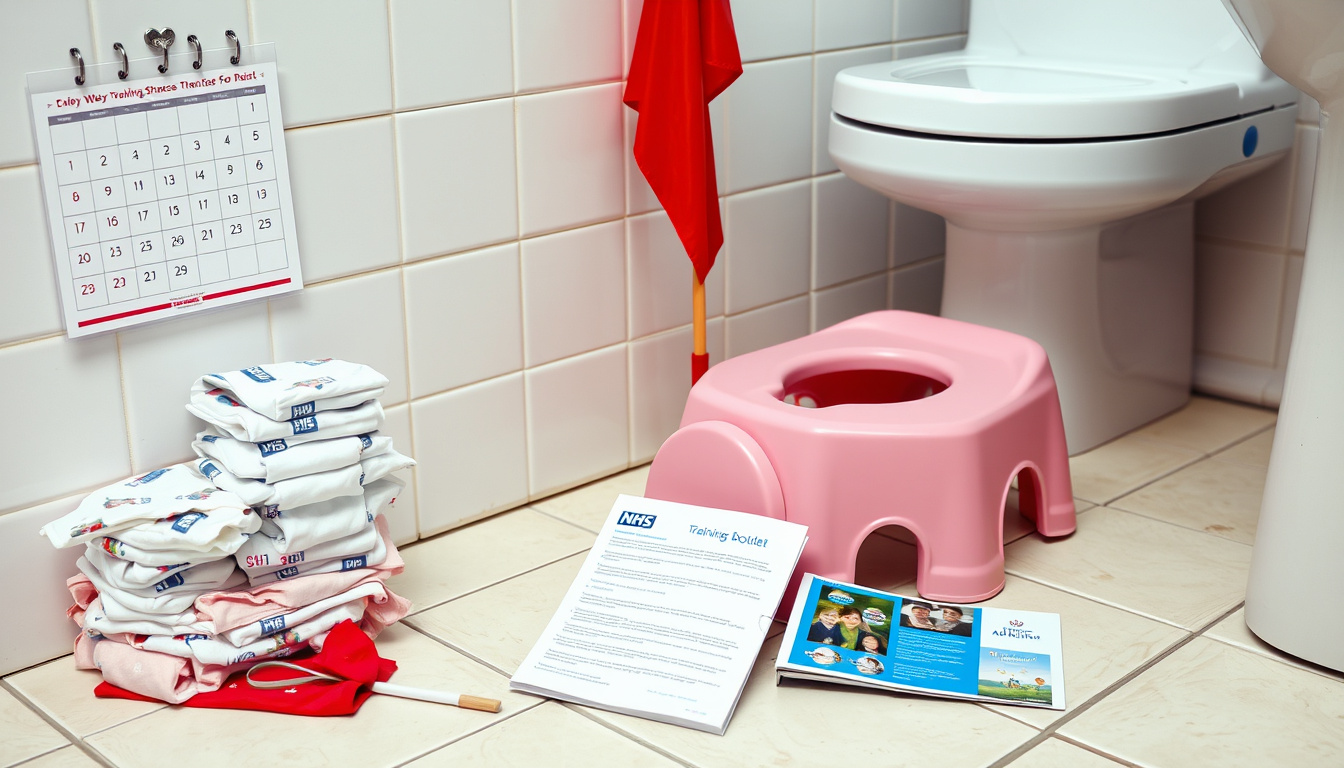
Every parent hears the same question around the second birthday, but the honest NHS-backed answer points to readiness, not the calendar. This guide sets the evidence-led NHS path against the popular three-day method, and flags the red flags that genuinely warrant a GP visit.
Common UK start window: around 2 to 2.5 years · Expert readiness checklist: 5 signs · Popular intensive method: 3 days · Night dryness: usually later than daytime dryness
Quick snapshot
- A child is likely ready when they can sit on a potty, get back up, and stay dry for about two hours (Derbyshire Family Health Service).
- NHS Best Start in Life puts the practical window at 18 months to 2.5 years (NHS Best Start in Life).
- The 10, 10, 10 rule has no medical definition in the UK guidance reviewed for this article.
- The reviewed evidence does not compare the 3-day method with gradual readiness training, so “fastest” has no official NHS evidence base here.
- Physical readiness is commonly in place from around age 2 (Leicestershire Partnership NHS Trust).
- Daytime control usually lands before night control (University Hospitals Birmingham NHS Foundation Trust).
- If the gap between wettings is under an hour, potty training may fail or be very hard work (Wirral Community Health and Care NHS Foundation Trust).
- If pain, blood, or persistent constipation appear, stop training and ask a GP or health visitor (Cambridgeshire & Peterborough NHS children’s health team).
Seven rows, one pattern: every NHS trust anchors potty training in physical and communication readiness, not a birthday.
| Factor | What the guidance says |
|---|---|
| Common UK start window | Around 2 to 2.5 years, based on early-years childcare guidance (Little Stars Day Care) |
| Expert readiness checklist | Five signs led by interest, telling you when they need to go, and staying dry (Berkshire Healthcare NHS Foundation Trust) |
| Official guidance | NHS Best Start in Life toilet training advice (NHS Best Start in Life) |
| Night dryness | Often later than daytime dryness; the morning-dry nappy is the green light (Wirral Community Health and Care NHS Foundation Trust) |
| Dry-gap signal | Stays dry for 1–2 hours or longer (Cambridgeshire & Peterborough NHS children’s health team) |
| Potty skills | Sits on a potty, gets back up, and tries to remove their nappy (Derbyshire Family Health Service) |
| Regional cues | Some trusts add fidgeting, going quiet, or straining (NHS Lothian health visiting team) |
What age is best to potty train?
The short answer: when the child is ready, not when the calendar says so. The NHS Best Start in Life programme says almost all children can be potty trained between 18 months and two-and-a-half years old, and that readiness signs matter more than a fixed age. Different NHS trusts phrase the milestone slightly differently, but the message is the same: watch the child, not the calendar.
Is age 3 too late to potty train?
- No NHS trust in the reviewed guidance sets a cut-off age for starting.
- The five-sign checklist applies at 3 exactly as it does at 2 — interest, communication, and staying dry matter more than the birthday (Berkshire Healthcare NHS Foundation Trust).
- Starting later can be quicker, because motor skills, bladder capacity, and communication are more developed.
So no — age 3 is not too late. It sits inside the normal window, and many children who start at 3 finish faster than they would have at 2.
What this means: the best age is the one where your child can sit, signal, and hold urine long enough. For most families that lands between 18 months and 2.5 years; for others, closer to 3.
Is it normal for a 2 year old not to be potty trained?
Yes — completely normal. Readiness checklists exist because children develop at different speeds. Leicestershire Partnership NHS Trust sets physical readiness around age 2, so a child who has not reached it at their second birthday is common, not concerning.
Why some 2-year-olds are not ready yet
- Bladder capacity: the common bar is a dry gap of about two hours between wees or poos (Derbyshire Family Health Service).
- Motor skills: sitting on a potty for a few minutes and pulling pants up and down need to be in place (University Hospitals Birmingham NHS Foundation Trust).
- Communication: the child needs to tell you when they need to go, or at least when they are wet or dirty (NHS Lothian health visiting team).
With those conditions missing, “not potty trained at 2” is a developmental variation, not a red flag by itself. The red flags are physical, and they are covered later in this article.
The pattern: a late-starting 2-year-old is normal variation, not a parenting failure. Starting before the hourly dry gap appears is the more common — and more fixable — mistake.
What is the fastest way to potty train a toddler?
For families who want speed, the structured answer is an intensive method: a short, focused block with nappies off, the potty close by, and very frequent sits. The 3-day method is the best-known version, and it is popular because it compresses the work into a long weekend.
It is also a parent-marketed framework, not a medical protocol. The NHS trusts reviewed here do not describe it; they describe readiness, routine, and patience.
What is the 3 day potty training trick?
- Block out three full days at home.
- Ditch the daytime nappy and keep the potty within reach.
- Sit the child on the potty at frequent, predictable points — not only when they ask.
- Expect day 1 and day 2 to be messy; the method banks on repetition before the habit clicks.
The catch, in NHS terms: readiness still applies. If the dry gap is under an hour, the warning from the snapshot holds — the sprint becomes a very hard three days.
What is the 10, 10, 10 rule for potty training?
The 10, 10, 10 rule has no medical definition in the UK guidance reviewed for this article. It circulates between parents as scheduling shorthand; the NHS frame is readiness and routine, not a 10-day countdown.
If you come across the 10, 10, 10 rule online, treat it as one family’s scheduling system rather than a health standard. The NHS version of a potty schedule is simpler: wait for readiness, put the potty in the daily routine, and keep the sits regular.
What’s the hardest day of potty training?
- Day 1 and day 2 of intensive methods carry the heaviest accident load.
- Refusals peak in the same window, because the novelty wears off before the habit forms.
- Day 3 is where the routine usually starts to click for children who were ready at the start.
The practical move: schedule the hard days on purpose, and keep the evenings calm.
The trade-off: a fast method compresses the mess into a long weekend, but it multiplies the strain if the child’s body is not ready. Fast is a parenting choice, not a clinical one.
What age should kids be dry overnight?
Later than most parents hope. Daytime training usually comes first, and night dryness runs on a separate clock. The most consistent NHS green light is the morning-dry test: Wirral Community Health and Care NHS Foundation Trust says a child may be ready for night training when their nappy is dry or only slightly damp on waking for several mornings in a row.
Can a 2 year old go all night without peeing?
- Many cannot, and that is developmentally normal — University Hospitals Birmingham NHS Foundation Trust lists dry during the day and at night as a milestone that can arrive by age 3, not at age 2.
- Expecting a 2-year-old to stay dry overnight sets the bar higher than most NHS milestones do.
Should I put my 3 year old back in nappies at night?
- Going back to night nappies is not a failure; it protects sleep and keeps training stress low.
- Stay in nappies or pull-ups at night until the morning-dry signal has been consistent for several mornings.
- If a child was dry for weeks and then starts waking wet again, treat it as a phase to mention to a health visitor, not a discipline problem.
Night training is a waiting game. The morning-dry nappy is the only green light that matters; before it appears, night pull-ups are protecting sleep, not failing training.
Why this matters: night dryness is physiology, not discipline. Pushing it early tends to fail; waiting for the morning-dry nappy gives the child’s body the deciding vote.
What is a red flag for potty training?
Most potty-training delays are normal variation. The red-flag list is shorter and more physical. The Cambridgeshire & Peterborough NHS children’s health team is typical of the continence guidance reviewed here: the checks that matter involve pain, pee, poo, and unexplained regression.
Physical symptoms that need medical advice
- Pain or crying when weeing.
- Blood in urine or stool.
- Persistent constipation or very hard poos.
- Regression: a child who was reliably dry and then starts wetting again for no clear reason.
- No readiness signs at all by around age 4 — at that point, a health visitor or GP conversation is the sensible next step.
These are not “try harder” moments. If any of them appear, pause the training and let a professional rule out underlying causes first.
A red flag is not a reason to train harder. It is the one situation where the fastest route to dryness is a pause and a professional check.
The pattern: if it hurts, bleeds, or reverses without reason, stop training and ask. The break is the safest fix.
What are the NHS guidelines for toilet training?
Nationally, the NHS Best Start in Life programme sets the tone, and local health trusts fill in the practical detail. The wording varies by region, but the skeleton is the same: readiness first, routine second, praise throughout.
NHS readiness checklist
- Shows interest in the potty or toilet.
- Tells you when they need to go.
- Stays dry for a reasonable stretch or after a nap.
- Prefers to fill their nappy in private.
- Asks to be changed soon after filling their nappy.
That five-sign checklist comes from Berkshire Healthcare NHS Foundation Trust, and other trusts add their own cues — NHS Lothian’s health visiting team includes fidgeting, going quiet, or straining as signs a wee or poo is on its way.
How to handle accidents
- Expect accidents — NHS Best Start in Life treats them as part of the process, not a failure.
- Praise the attempt, not just the result.
- Avoid shame or punishment — it slows training down.
- Keep the routine going; consistency beats perfection.
The NHS line is deliberately simple: praise the tries, ignore the misses, and keep the potty routine rolling.
What this means: the NHS framework is deliberately unglamorous. That is the opposite engine from the 3-day method, and blending the two usually produces more accidents, not fewer.
3-day potty training: the upsides and downsides
The 3-day method works for some families. The honest label is “parenting choice”, not “medical recommendation”. Here is the balance sheet.
Upsides
- Compresses the work into one focused block instead of weeks of low-grade nagging.
- Removes the nappy as a crutch, so the child gets immediate feedback.
- Gives a clear start date, which suits structured households.
Downsides
- Demands intense adult presence for three full days.
- If the dry gap is under an hour, the under-hour warning applies and the block may fail.
- It skips the NHS readiness pathway, so a not-ready child gets a harder start.
- Night dryness usually continues anyway; the method trains the day, not the night.
The catch: the 3-day method is only fast when readiness is already in place. If the five signs are missing, the fastest method is also the fastest way to create a power struggle.
A step-by-step potty training plan that follows the evidence
A five-step sequence that follows the NHS-ready pattern:
- Check readiness first. The practical baseline: a dry gap of about two hours, the ability to sit on a potty and get back up, and some way of telling you a wee or poo is coming.
- Put the potty in daily life. Let the child get used to sitting on it, getting back up, and pulling pants down before any pressure starts.
- Build a routine. Potty sits at predictable points in the day, so the habit forms without a power struggle.
- Handle accidents calmly. Praise attempts, avoid punishment, and keep the routine moving. Accidents are data, not a verdict on your parenting.
- Move to pants, then watch the night separately. Daytime pants come first; night training waits for the morning-dry nappy signal.
The trade-off: this plan is slower than a 3-day sprint, but it follows the physical signals that predict success — and it keeps night dryness out of the daytime battle.
Potty training timeline: what to expect at each stage
Five phases, one pattern: observation comes first, routine second, and overnight dryness runs on its own clock.
| Stage | What happens |
|---|---|
| 18–30 months | Watch for readiness: noticing a wee or poo, sitting on a potty and getting back up, and staying dry for 1–2 hours (Cambridgeshire & Peterborough NHS children’s health team). |
| 2 to 2.5 years | Most parents in early-years childcare guidance begin here (Little Stars Day Care). |
| Days 1–3 | Intensive methods use nappy-free time and frequent potty sits — a parent-marketed framework, not an NHS protocol. |
| Week 2–4 | Build the routine, praise attempts, and handle accidents calmly, following the NHS Best Start in Life advice from the key facts table above. |
| Months 3–6 | Watch daytime progress and night dryness separately; night control often lags (University Hospitals Birmingham NHS Foundation Trust). |
The implication: most “late” potty training is just a child following this timeline a bit behind the average — still inside the NHS window.
Potty training: what’s confirmed and what’s still unclear
The NHS sources give a clear yes on some questions and silence on others.
- Readiness signs are consistent across UK NHS trusts: interest, communication, motor skills, and a dry gap of about two hours (Derbyshire Family Health Service; Berkshire Healthcare NHS Foundation Trust).
- Physical readiness is commonly described from around age 2 (Leicestershire Partnership NHS Trust guidance).
- Night dryness is a separate, later milestone; the morning-dry nappy is the standard green light (Wirral Community Health and Care NHS Foundation Trust).
- No NHS trust in the reviewed guidance treats age 3 as too late to start.
- The 10, 10, 10 rule has no medical definition in the UK guidance reviewed here.
- No single perfect potty-training age exists; children vary more than any calendar.
- The reviewed guidance does not compare the 3-day method with gradual readiness training, so “fastest” has no NHS evidence base.
- The readiness checklist is standard NHS practice, but the research validation behind it was not part of the reviewed guidance.
- NHS trusts phrase the signs slightly differently, so parents comparing pages will see regional variation.
The pattern: the NHS system is strong on what readiness looks like and what to do about it, lighter on proving which method is fastest. Treat speed claims as marketing until a health body weighs in.
What experts and childcare providers say
Three voices frame the practical debate: a national health programme, a potty-training specialist, and an early-years provider.
Almost all children can be potty trained between 18 months and two-and-a-half years old.
NHS Best Start in Life
Look for the five key signs of readiness first: interest in the potty, staying dry for longer stretches, telling you when a wee or poo is coming, hiding to fill their nappy, and asking to be changed. Training before those signs appear turns a short process into a long one.
Amanda Jenner, potty training expert, Bright Horizons
Most parents begin potty training between 2 and 2.5 years, and a focused two-week block at home, with the potty always available, is a realistic way to start.
Little Stars Day Care, early-years guidance
The pattern: all three voices start with readiness and routine; none of them treats speed as the prize. That alone separates the NHS path from the 3-day marketing.
The takeaway
Potty training is a physical milestone before it is a parenting contest. Follow the NHS sequence — the five-sign readiness check, a predictable routine, praise for attempts, and calm handling of accidents — and treat night dryness as a separate clock. When the morning nappy is consistently dry, night training can begin; until then, night pull-ups are the low-stress default. For a UK parent, the decision is clear: trust the readiness checklist and the NHS window, or accept that a 3-day sprint is a lifestyle choice, not a medical one — with accidents and night pull-ups as the expected price either way.
health.clevelandclinic.org, services.nhslothian.scot, cpft.nhs.uk, suttonhealthandcare.nhs.uk
Frequently asked questions
How do I know if my child is ready for potty training?
Work through the five-sign checklist: interest in the potty, telling you when they need to go, staying dry for a reasonable stretch, hiding to fill their nappy, and asking to be changed. Add the physical bar from the NHS trusts — a dry gap of about two hours between wees.
How long does potty training usually take?
There is no fixed number. Intensive methods promise three concentrated days; early-years guidance often plans on a two-week home block; a readiness-led approach can take several weeks. Children who start later often finish faster because the underlying skills are stronger.
What should I do if my child refuses to use the potty?
Back off, keep the potty visible, and return to the routine a few days later. Pressure tends to harden resistance. The NHS advice is consistent: praise the attempts, skip the punishment, and let readiness set the pace.
Should I use rewards or praise during potty training?
Praise is the NHS-benchmarked tool. If you add a small reward, keep it immediate and tied to the attempt, not just the result. What matters is that the child connects the potty with approval rather than anxiety.
How do I handle potty training regression?
Treat a relapse as information, not defiance. Return to the routine, keep night nappies until the morning-dry signal is consistent, and mention the regression at the next health-visitor check — especially if it comes with pain or constipation.
Are pull-ups a good idea during potty training?
Pull-ups are fine, especially at night, where the NHS trusts’ advice is to keep them until the morning-dry signal appears. During the day, the key is consistency — whatever pants you choose, keep the routine the same.

Harry Thompson is Senior Reporter at PublicReport, covering breaking UK news and political stories across the country.