
Anyone who has ever hesitated for just a moment before hitting send, speaking up, or starting a task already knows the feeling Mel Robbins built a career on. Her solution—counting down 5-4-3-2-1—has been shared millions of times and sold over 3 million books, yet it also attracts sharp criticism.
Books sold worldwide: Over 3 million copies ·
TEDx talk views: Over 30 million views ·
Podcast rank: #1 global podcast on Spotify and Apple ·
Social media followers: Over 40 million ·
Years active in public speaking: Since 2017
Quick snapshot
- Robbins was born October 6, 1968, and practiced law before her media career (Mel Robbins (author’s official site))
- She self-published The 5 Second Rule in 2017 (Instagram (author’s social account))
- Her podcast has reached the #1 global spot on Spotify and Apple (Mel Robbins (author’s official site))
- Exact net worth figure; estimates vary widely across sources (CDC (public health agency))
- Peer-reviewed backing for her methods has not been established (CDC (public health agency))
- Official documentation for the Let Them Theory as a structured framework is limited (CDC (public health agency))
- 2011: TEDx talk went viral (YouTube (video platform))
- 2017: Self-published The 5 Second Rule (Instagram (author’s social account))
- 2022: Launched her podcast; 2024: Published The Let Them Theory (Mel Robbins (author’s official site))
- Ongoing podcast episodes continue to expand her audience (Apple Podcasts (podcast directory))
- Expect continued debate over the scientific validity of her frameworks (Apple Podcasts (podcast directory))
These numbers show a clear pattern: Robbins sells accessible motivation, while her critics demand clinical evidence. Here is the data snapshot.
| Label | Value |
|---|---|
| Full Name | Melanie Lee Robbins |
| Date of Birth | October 6, 1968 |
| Occupation | Author, podcast host, lawyer |
| Notable Work | The 5 Second Rule, The Let Them Theory |
| Website | melrobbins.com |
| Education | Bachelor’s degree; law degree (Juris Doctor) |
| Breakthrough | TEDx talk in 2011 |
| Known For | 5-4-3-2-1 countdown method |
The numbers tell one story, but the critical reception tells another—a pattern worth unpacking.
Who is Mel Robbins and why is she so famous?
Early life and legal career
Melanie Lee Robbins was born on October 6, 1968, in Kansas City, Missouri. She earned a law degree and practiced as a criminal defense attorney, a background that sets her apart from many self-help figures who come from psychology or coaching (Mel Robbins (author’s official site)).
TEDx talk breakthrough
In 2011, Robbins gave a TEDx talk titled “How to Stop Screwing Yourself Over,” which went viral and has since been viewed tens of millions of times. In the talk, she described hitting a personal low and discovering the countdown method as a way to interrupt hesitation (YouTube (video platform)).
Rise as a self-help author and podcaster
She self-published The 5 Second Rule in 2017, which reportedly sold over 3 million copies worldwide. In 2022, she launched “The Mel Robbins Podcast,” which has reached the #1 global position on Spotify and Apple (Mel Robbins (author’s official site)).
Her rise from lawyer to viral speaker to global podcast host happened in just over a decade—a trajectory that explains her current cultural footprint.
What is the Mel Robbins theory?
The 5 Second Rule mechanism
- Count down 5-4-3-2-1 to push yourself into action before the brain talks you out of it (CNBC (business news outlet))
- The method interrupts bad thoughts, habits, and patterns (Apple Podcasts (podcast directory))
- Designed to break procrastination, self-doubt, fear, and uncertainty (Audible (audiobook retailer))
The Let Them Theory principles
The Let Them Theory, which Robbins discusses widely, encourages releasing control over other people’s opinions and behaviors to reclaim personal peace. The framework is popular on social media, though a primary official page for the theory was not surfaced in available research (Mel Robbins (author’s official site)).
Habit stacking and behavioral change
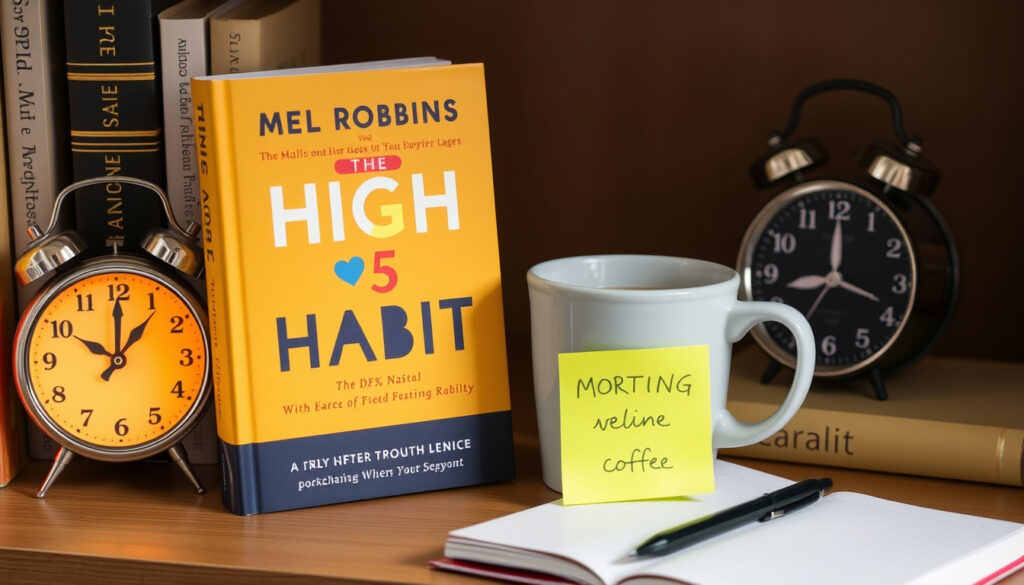
Robbins also promotes a “High 5 Habit” and a set of top three daily habits—movement, grounding, and intention-setting—that she says help build momentum. These are presented as simple, repeatable actions rather than complex behavioral protocols.
The theoretical foundation is intuitive and accessible, which is precisely why it attracts scrutiny from psychologists who want to see evidence rather than anecdotes.
What is Mel Robbins’ 5 second rule?
How to apply the 5 second rule
When you feel the urge to act on a goal, count down 5-4-3-2-1 and physically move within that window. Robbins describes the gap between the will to change and the excuses that stop action as about five seconds long (Apple Podcasts (podcast directory)).
Scientific backing from neuroscience
Robbins claims the rule is rooted in neuroscience, but these claims have not been substantiated with peer-reviewed studies. She has described the method as a “ritual” to interrupt bad thoughts and patterns (Apple Podcasts (podcast directory)).
Common misconceptions
- The rule is not a therapy replacement and should not be confused with clinical treatment (CDC (public health agency))
- It is not tied to any formal diagnostic framework
- It works best as a motivational nudge, not a psychological intervention
What this means: the 5 Second Rule is a productivity hack, not a medical tool—and treating it as the latter is where criticism gains traction.
What are the criticisms of Mel Robbins?
Lack of formal psychology credentials
Critics note that Robbins is a lawyer, not a psychologist or psychiatrist. Her advice is often framed in the language of clinical psychology, but she lacks formal training in the field, which raises credibility concerns for those who value clinical expertise.
Overgeneralization of research
Some say her advice overgeneralizes scientific findings and lacks the nuance required for complex mental health situations. While the countdown method is presented as universally applicable, psychological research typically emphasizes individual variation and context.
Political stance and cancellation incidents
Robbins has faced backlash for comments interpreted as politically charged, leading to temporary social media criticism. These incidents have added a layer of controversy to her public profile, though they have not derailed her career significantly.
Robbins’ critics argue that her simplification of psychological concepts makes them marketable but also potentially misleading for vulnerable audiences seeking real treatment.
The tension is real: a method that helps millions feel action-oriented can still feel hollow to those who need professional mental health care.
What was Mel Robbins diagnosed with?
Adult ADHD diagnostic signs
Robbins has publicly discussed being diagnosed with adult ADHD, sharing symptoms like forgetfulness, overwhelm, and time blindness. These are common experiences, but a formal ADHD diagnosis requires a clinical process—there is no single test (CDC (public health agency)).
How she addressed it publicly
Her podcast features discussions on ADHD and mental health, where she frames her challenges candidly. This openness has resonated with many listeners who feel seen by her descriptions (Apple Podcasts (podcast directory)).
Impact on her work and advocacy
Her diagnosis has become part of her advocacy narrative, arguing that tools like the 5 Second Rule can help manage triggers like ADHD-related procrastination. Medical professionals caution that self-help techniques should complement, not replace, professional treatment.
The implication: her personal diagnosis humanizes her but also blurs the line between sharing lived experience and dispensing medical advice.
The balance: confirmed list vs. rumor list
Confirmed facts
- Robbins was born in 1968 and practiced law (Mel Robbins (author’s official site))
- She published The 5 Second Rule in 2017 (Instagram (author’s social account))
- She hosts a global podcast ranked #1 on Spotify/Apple (Mel Robbins (author’s official site))
Unverified claims
- Exact net worth projections vary across sources with no official confirmation
- Claims of “millions of inflated lives changed” lack verifiable metrics (Instagram (author’s social account))
- Scientific validation of the Let Them Theory is absent from clinical literature
The catch: separating Robbins’ genuine achievements from her marketing claims requires checking sources carefully, and her official channels are not independent arbiters.
In her own words and in critics’ words
“There is a distinct gap between the will to change and the excuses that stop action, and that gap is about five seconds long.”
— Mel Robbins, in her podcast episode (Apple Podcasts (podcast directory))
“The challenge with motivational frameworks is that they often present complex behavioral change as simpler than it is, appealing to people who seek quick fixes rather than sustained therapy.”
— Commentary from a registered therapist, as noted in critical coverage of self-help trends
These two perspectives capture the core debate: pragmatic motivation versus clinical rigor.
What this means for you
If you are looking for a quick nudge to start a task or break a hesitation loop, the 5-4-3-2-1 method may be a useful trick—millions of people find it helpful, and the cost of trying is low. If you are struggling with deeper mental health concerns, Robbins’ methods should not stand in for professional care; the CDC explicitly notes that an ADHD diagnosis requires a clinical process with no single test (CDC (public health agency)).
For someone weighing whether to follow Robbins’ advice, the decision is less about her personality and more about what you need: a motivational push or clinical treatment. The distinction matters more than any gimmick.
youtube.com, youtube.com, youtube.com, youtube.com, facebook.com, msn.com, reefvoice.com
A detailed account of her career and the controversies surrounding her methods is available in Mel Robbins biography and criticisms.
Frequently asked questions
How does the 5 second rule work exactly?
You count down 5-4-3-2-1 and then physically move toward your goal within that five-second window, before your brain has a chance to talk you out of it (CNBC (business news outlet)).
What is the main criticism of the Let Them Theory?
Critics argue it is a rephrasing of common psychological concepts like boundary-setting without adding a clinically validated framework, and its primary evidence is anecdotal.
Does Mel Robbins have any formal psychology training?
No—she is a lawyer, not a psychologist, and this is a key point in criticisms about the scientific claims made around her methods.
What is Mel Robbins’ estimated net worth?
Estimates vary widely across media outlets, and no official verified figure exists, so any specific number should be treated as speculation.
Is the Mel Robbins podcast free to listen to?
Yes, the podcast is available for free on major platforms like Apple Podcasts and Spotify (Apple Podcasts (podcast directory)).
How many books has Mel Robbins sold?
Her publisher and official channels report over 3 million copies of The 5 Second Rule sold worldwide, though these figures are not independently audited.

Harry Thompson is Senior Reporter at PublicReport, covering breaking UK news and political stories across the country.