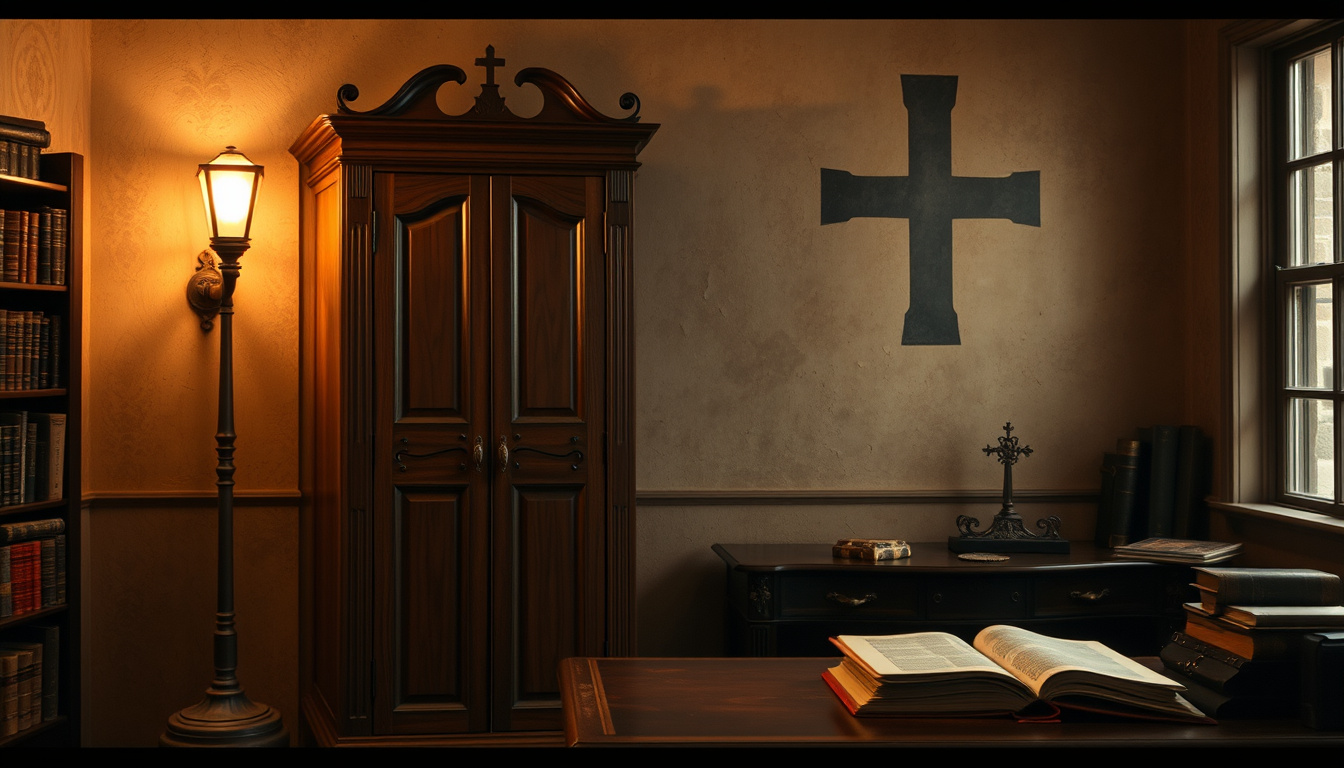
Most people know him as the man who created Narnia, that magical wardrobe, and Aslan the lion. But C.S. Lewis was also a trenchant Christian apologist, a former atheist, and a scholar whose personal life stirred as much debate as his theology.
Born: 29 November 1898 ·
Died: 22 November 1963 ·
Notable works: The Chronicles of Narnia, Mere Christianity, The Screwtape Letters ·
Occupations: Author, literary scholar, Anglican lay theologian ·
Number of marriages: 2
Quick snapshot
- Born in Belfast, Ireland in 1898 (Encyclopaedia Britannica)
- Fought in WWI, wounded at the Somme (Encyclopaedia Britannica)
- Converted from atheism to Christianity in 1931 (SparkNotes)
- Oxford don and member of the Inklings (Encyclopaedia Britannica)
- The Chronicles of Narnia (7-book series, 1950–1956) (Encyclopaedia Britannica)
- Mere Christianity (1952) (Christian History Institute)
- The Screwtape Letters (1942) (Encyclopaedia Britannica)
- Surprised by Joy (1955) (Encyclopaedia Britannica)
- Christian apologist emphasizing reason and imagination (Encyclopaedia Britannica)
- Defended Jesus’s divinity with the “Liar, Lunatic, or Lord” argument (Encyclopaedia Britannica)
- Influenced modern Christian thought through Mere Christianity (Encyclopaedia Britannica)
- Narnia remains a children’s classic with deep allegorical layers (Encyclopaedia Britannica)
- Relations with Tolkien shaped literary circles (Encyclopaedia Britannica)
- His views on homosexuality remain a point of scholarly debate (Encyclopaedia Britannica)
Seven key facts about Lewis’s life reveal a pattern: a man who transformed dramatically, from soldier and atheist to celebrated author and Christian thinker.
The facts below trace Lewis’s journey from Belfast to Oxford, from doubt to faith, and from private scholar to public intellectual.
| Label | Value |
|---|---|
| Full name | Clive Staples Lewis |
| Born | 29 November 1898, Belfast, Ireland (Encyclopaedia Britannica) |
| Died | 22 November 1963, Oxford, England (Encyclopaedia Britannica) |
| Cause of death | Renal failure (kidney disease) (Encyclopaedia Britannica) |
| Spouse(s) | Joy Davidman (m. 1956–1960) (Encyclopaedia Britannica) |
| Children | None (Encyclopaedia Britannica) |
| Notable works | The Chronicles of Narnia, Mere Christianity, The Screwtape Letters, The Space Trilogy (Encyclopaedia Britannica) |
What was C.S. Lewis best known for?
C.S. Lewis is best known as the author of The Chronicles of Narnia, a seven-book series that begins with The Lion, the Witch and the Wardrobe (published 1950, according to the Christian History Institute). He is also widely recognized for his works of Christian apologetics, including Mere Christianity (1952) and The Screwtape Letters, as documented by Encyclopaedia Britannica.
Beyond his writing, Lewis was a professor of English literature at both Oxford and Cambridge universities, as noted by Encyclopaedia Britannica. His influence extends far beyond academia into modern Christian thought.
What is C.S. Lewis’s famous quote?
One of Lewis’s most cited passages comes from his sermon The Weight of Glory (1941):
“It is a serious thing to live in a society of possible gods and goddesses.”
C.S. Lewis, The Weight of Glory, 1941
Another widely shared line from Mere Christianity reads: “I believe in Christianity as I believe that the sun has risen: not only because I see it, but because by it I see everything else.” This quote, hosted by Encyclopaedia Britannica, encapsulates his conviction that faith illuminates all of life.
What are the most famous books by C.S. Lewis?
- The Chronicles of Narnia (7 books, 1950–1956) — his most popular work (Encyclopaedia Britannica)
- Mere Christianity (1952) — a foundational Christian apologetics text (Christian History Institute)
- The Screwtape Letters (1942) — fictional letters from a senior demon to a junior tempter (Encyclopaedia Britannica)
- Surprised by Joy (1955) — his spiritual autobiography (Encyclopaedia Britannica)
Lewis wrote about 40 books in total, according to Encyclopaedia Britannica. For readers discovering him today, Narnia offers an entry point, but his apologetics works remain the core of his influence on modern Christianity.
What did CS Lewis say about Jesus being God?
Lewis’s most famous argument for the divinity of Jesus is the “Liar, Lunatic, or Lord” trilemma, which he laid out in Mere Christianity. This framework, documented by Encyclopaedia Britannica, forces a stark choice: Jesus was either a liar, a lunatic, or actually the Son of God.
“I am trying here to prevent anyone saying the really foolish thing that people often say about Him: ‘I’m ready to accept Jesus as a great moral teacher, but I don’t accept His claim to be God.’ That is the one thing we must not say. A man who was merely a man and said the sort of things Jesus said would not be a great moral teacher. He would either be a lunatic—on a level with the man who says he is a poached egg—or else he would be the Devil of Hell. You must make your choice. Either this man was, and is, the Son of God, or else a madman or something worse.”
C.S. Lewis, Mere Christianity (1952)
What was C.S. Lewis’s argument for the divinity of Jesus?
Lewis argued that Jesus could not merely be a “great moral teacher” if He claimed to be God — that would be logically incoherent. The trilemma, as recorded by Encyclopaedia Britannica, presents only three possibilities: liar, lunatic, or Lord.
How did C.S. Lewis defend the idea of Jesus as God?
- He rejected the “Great Moral Teacher” option as illogical (Encyclopaedia Britannica)
- His reasoning appears in Mere Christianity and other works (Encyclopaedia Britannica)
- He emphasized that Jesus’s own claims force a decision (Encyclopaedia Britannica)
Lewis’s trilemma has become one of the most widely cited arguments for Christian apologetics. For believers, it offers a crisp intellectual defense; for skeptics, it demands a clear response. The catch is that it simplifies a complex theological question into a three-option logic puzzle, which some scholars find reductive.
The pattern: Lewis’s argument forces readers to confront a binary choice that many prefer to avoid.
What is the deeper meaning behind Narnia?
The Chronicles of Narnia are rich in Christian symbolism, as noted by Encyclopaedia Britannica. The series reflects themes of redemption, faith, and moral choices through allegorical storytelling.
What are the Christian allegories in Narnia?
- Aslan sacrifices himself for Edmund, mirroring Christ’s crucifixion (Encyclopaedia Britannica)
- The White Witch represents evil and temptation (Encyclopaedia Britannica)
- Resurrection and redemption are central themes (Encyclopaedia Britannica)
How does Aslan represent Jesus in The Chronicles of Narnia?
Aslan, the great lion, is a Christlike figure. In The Lion, the Witch and the Wardrobe, he voluntarily dies to save Edmund, a traitor, and then resurrects — a direct parallel to the Gospel narrative, as described by Encyclopaedia Britannica.
Lewis insisted Narnia was not a strict allegory but a “supposal” — a story asking what Christ might look like in a different world. This distinction allowed him to weave theological ideas into fantasy without preaching, making the books accessible to readers of all faiths.
The implication: readers who miss the theology still get a compelling adventure, while those who see it gain additional layers of meaning.
How many marriages did CS Lewis have?
Lewis was married twice to the same woman, Joy Davidman, under different legal circumstances. He met her in 1950 through correspondence, while she was still married to William Gresham, according to Encyclopaedia Britannica.
Who was C.S. Lewis married to?
- Joy Davidman, a Jewish American writer, former Communist, and convert to Christianity (Logos)
- They entered a civil marriage in April 1956 to secure her legal right to remain in England (Encyclopaedia Britannica)
- A religious ceremony followed in March 1957 (Encyclopaedia Britannica)
What was C.S. Lewis’s relationship with Joy Davidman?
Joy Davidman was diagnosed with advanced cancer shortly after their marriage. The disease temporarily went into remission but returned, and she died on 13 July 1960, according to the Christian History Institute. Lewis had no children from either marriage, as confirmed by Encyclopaedia Britannica.
The relationship was fictionalized in the film Shadowlands, which dramatized Lewis’s late-life love story.
For Lewis, marrying Joy Davidman brought personal joy but also alienation from some friends, including Tolkien, who disapproved of the marriage due to his Catholic views on divorce. The cost of love was a fractured relationship within the Inklings circle.
The pattern: Lewis’s personal life echoes his theological themes of sacrifice and redemption.
Why did C.S. Lewis and J.R.R. Tolkien fall out?
The friendship between Lewis and Tolkien, two founding members of the Inklings literary group, eventually cooled due to several disagreements. Key factors include:
- Tolkien disliked Lewis’s Narnia series for its mixed mythology, blending Christian allegory with pagan elements (Encyclopaedia Britannica)
- Lewis’s marriage to Joy Davidman alienated Tolkien due to his Catholic views on divorce (Encyclopaedia Britannica)
- Academic and theological differences grew over time (Encyclopaedia Britannica)
What did Tolkien say when Lewis died?
Tolkien expressed regret and affection after Lewis’s death. In a letter to his daughter Priscilla, he wrote: “We were all very fond of him and he will be deeply missed,” as recorded by Encyclopaedia Britannica.
Were C.S. Lewis and Tolkien friends after the falling out?
The exact nature and timeline of the falling out is debated among scholars. While their friendship weakened, Tolkien’s letter after Lewis’s death suggests lingering affection, not bitter enmity. The relationship, as documented by Encyclopaedia Britannica, remained complex to the end.
The implication: even deep creative partnerships can fracture, but final messages suggest lasting respect.
What did C.S. Lewis say about homosexuality?
Lewis held traditional Christian views on sexuality, viewing homosexual acts as sinful within his broader ethical framework. However, he wrote little directly on the topic, and most evidence of his stance comes from private letters rather than published works, according to Encyclopaedia Britannica.
What was C.S. Lewis’s view on same-sex relationships?
- He emphasized chastity for all unmarried people, regardless of orientation (Encyclopaedia Britannica)
- His ethical framework was rooted in traditional Anglican teaching (Encyclopaedia Britannica)
- He did not engage in extended public debate on the subject (Encyclopaedia Britannica)
Did C.S. Lewis write about homosexuality?
C.S. Lewis’s exact stance on homosexuality is debated because he wrote so little directly on the subject. His overall ethical framework, as described by Encyclopaedia Britannica, emphasized chastity for all unmarried people but did not specifically address same-sex relationships in detail.
Readers seeking Lewis’s views on homosexuality face a scarcity of direct source material. The debate relies heavily on interpreting his general principles rather than explicit statements — a reality that fuels ongoing disagreement among scholars and fans.
The pattern: Lewis’s silence on this topic leaves room for divergent interpretations, making certainty elusive.
Confirmed facts
- C.S. Lewis was born on 29 November 1898 and died on 22 November 1963 (Encyclopaedia Britannica)
- He authored The Chronicles of Narnia and Mere Christianity (Encyclopaedia Britannica)
- He married Joy Davidman in 1956 and had no children (Encyclopaedia Britannica)
- He was a member of the Inklings group with J.R.R. Tolkien (Encyclopaedia Britannica)
What’s unclear
- The exact nature and timeline of the falling out with Tolkien is debated among scholars (Encyclopaedia Britannica)
- C.S. Lewis’s exact stance on homosexuality is debated, as he wrote little directly on the subject (Encyclopaedia Britannica)
Timeline signal
- 29 November 1898: Born in Belfast, Ireland (Encyclopaedia Britannica)
- 1917–1918: Served in WWI, wounded at the Battle of the Somme (Encyclopaedia Britannica)
- 1925–1954: Fellow and tutor at Magdalen College, Oxford (Encyclopaedia Britannica)
- 1931: Converted to Christianity after discussions with Tolkien (SparkNotes)
- 1941–1944: Broadcast radio talks later published as Mere Christianity (Encyclopaedia Britannica)
- 1950–1956: Published the seven Chronicles of Narnia books (Christian History Institute)
- April 1956: Married Joy Davidman in a civil ceremony (Encyclopaedia Britannica)
- March 1957: Religious marriage ceremony with Joy Davidman (Encyclopaedia Britannica)
- 13 July 1960: Death of Joy Davidman from cancer (Christian History Institute)
- 22 November 1963: Died at home in Oxford; buried in Holy Trinity Church, Headington (Encyclopaedia Britannica)
The timeline reveals a man who lived through two world wars, underwent a profound personal conversion, and produced a remarkable body of work in just over two decades. The pattern: Lewis’s most creative period coincided with his late middle age, after his faith was already well established.
en.wikipedia.org, cslewisinstitute.org, whosoever.org, scribd.com, philosophynow.org, cslewis.org, apilgriminnarnia.com, cslewisinstitute.org, japantodaynews.com
A comprehensive resource on C.S. Lewiss biography and books offers further insight into his conversion and theological impact.
Frequently asked questions
Where did C.S. Lewis study?
Lewis studied at University College, Oxford, where he read classics and literature. He later became a fellow at Magdalen College, Oxford, and a professor at Cambridge University, as documented by Encyclopaedia Britannica.
What awards did C.S. Lewis win?
Lewis received the Carnegie Medal for The Last Battle (1956), the final Narnia book, as noted by the Christian History Institute. He also declined a knighthood and other honors during his lifetime.
Was C.S. Lewis married to Joy Davidman?
Yes. Lewis married Joy Davidman in a civil ceremony in April 1956, followed by a religious marriage in March 1957. She died of cancer in 1960, according to Encyclopaedia Britannica.
What is the first book of The Chronicles of Narnia?
The first published book is The Lion, the Witch and the Wardrobe (1950), though the chronological order of the series begins with The Magician’s Nephew. Publication order, as tracked by the Christian History Institute, remains the standard.
How did C.S. Lewis become a Christian?
Lewis converted from atheism to Christianity in 1931 after discussions with J.R.R. Tolkien and reading Christian writers such as G.K. Chesterton and George MacDonald, as reported by SparkNotes.
Did C.S. Lewis write under any pseudonyms?
Yes. Lewis occasionally published under the name “N.W. Clerk” for scholarly works, but he is overwhelmingly known by his full name, Clive Staples Lewis, as documented by Encyclopaedia Britannica.
What is C.S. Lewis’s full name?
His full name is Clive Staples Lewis. Friends and family called him “Jack,” a nickname he adopted as a child, according to Encyclopaedia Britannica.
Why is C.S. Lewis considered an important Christian apologist?
Lewis is considered important because his works like Mere Christianity made complex theological arguments accessible to a broad audience. His “Liar, Lunatic, or Lord” trilemma remains a cornerstone of modern apologetics, as noted by Encyclopaedia Britannica.
C.S. Lewis left a legacy that continues to shape both literature and faith. For readers exploring his work, the choice is not just between Narnia and apologetics — it is between understanding the man behind both. The implication: Lewis’s life reminds us that intellectual conviction and creative imagination need not be opposites.
For the modern reader curious about faith and fiction, Lewis’s story offers a clear lesson: the most compelling arguments are often wrapped in the most compelling stories. For the skeptic, the challenge of the trilemma remains as sharp today as it was in 1952. Lewis forces his readers to make a choice, not just about Jesus, but about the kind of life worth living.

Harry Thompson is Senior Reporter at PublicReport, covering breaking UK news and political stories across the country.