There’s a moment every parent knows: your child has outgrown the toddler seat, and suddenly you’re staring at a wall of high-back and backless boosters, wondering if the rules changed while you weren’t looking. In Ireland, the law is refreshingly clear-cut once you know the numbers—150 cm and 36 kg are the magic thresholds—but the journey to that point is paved with good intentions and common mistakes.
Key Facts at a Glance
- Height: Under 150 cm must use a child seat or booster seat — RSA (state road safety authority)
- Weight: Under 36 kg must use a child seat or booster seat — HSE (national health authority)
- High-back boosters: Recommended between 100 cm and 150 cm — RSA FAQ
- Backless boosters: Recommended only for older children meeting certain criteria — RSA child seats page
- Under 3: Must be restrained in the correct child seat—no exceptions — An Garda Síochána rules PDF
- Front passenger seat: Never use a rearward-facing seat with an active airbag — RSA child safety page
- Booster seat: Usually from 4 years old, but height and weight matter more — Tusla child safety booklet
- Backless booster min weight: 15–18 kg (per seat label) — RSA FAQ
Booster seat law: Under 150 cm / 36 kg · RSA high-back: 100–150 cm · RSA backless: Older children only · Garda rule (under 3): Mandatory child seat
The Health Service Executive (HSE) puts it plainly: by law, a child must use the correct child seat or booster seat when travelling if they are under 150 cm in height or weigh less than 36 kg. That’s the entire legal framework boiled down to two numbers—no ambiguity about age, just height and weight. For most children, this means a booster seat is required until around 11 or 12 years old, which surprises many parents who assume the requirement ends at primary school. The HSE (national health authority for child safety guidance) states this rule applies to every journey, no matter how short. What’s striking is how often parents assume their 5-year-old is “big enough” for a booster when the law and the child’s own skeletal development say otherwise.
| Requirement | Legal Standard |
|---|---|
| Legal limit (must use booster) | Under 150 cm OR under 36 kg |
| Typical age range for boosters | 4–12 years (depends on height/weight) |
| Backless booster minimum weight | 15–18 kg (per seat label) |
| High-back booster recommended | 100–150 cm (RSA guidance) |
| Minimum booster height (typical) | Around 125 cm for many backless models |
The pattern: the 150 cm rule is a “must” threshold, not a “can stop” suggestion. Even if your child is 149 cm and 40 kg, they still need a booster seat—the thresholds are “or,” not “and.” This subtlety trips up many parents who think weight alone settles it.
The Law in Ireland: Exact Height and Weight Cutoffs
Irish law is refreshingly specific about child car restraints, but the nuance is in how the rules interact with your car, your child’s size, and even the type of seat you’re using. The core requirement comes from both the Road Safety Authority (RSA) (the state body responsible for road safety in Ireland) and the An Garda Síochána (the national police service, in their official Rules of the Road PDF).
The Citizens Information (the State’s official public information service) clarifies that the child restraint requirement applies while travelling in a car or goods vehicle other than a taxi. This is a crucial point for parents who occasionally use taxis or ride-sharing services.
What is the purpose of a booster seat?
A booster seat raises the child so the vehicle’s seatbelt fits correctly across the stronger parts of the body. Without it, the lap belt rides up over the abdomen and the shoulder belt cuts across the neck — both positions that cause internal injuries and spinal damage in a crash.
How does a booster seat position the seatbelt correctly?
The HSE (Ireland’s health service executive) explains that a booster raises the child so the lap belt lies across the upper thighs, not the stomach, and the shoulder belt crosses the centre of the chest and collarbone. This positioning spreads crash forces over the skeletal frame instead of soft organs.
Why is proper seatbelt fit critical for child safety?
The Tusla child safety booklet (the Child and Family Agency’s official guide) emphasizes that without a booster, the seatbelt can cause severe internal injuries — liver, spleen, and bowel damage — in a crash. The shoulder belt across the neck can fracture the collarbone or cause head injuries as the child’s body slides forward.
The RSA’s minimum for high-back boosters is 100 cm, but keeping a child in a five-point harness until they physically can’t fit reduces injury risk by up to 60% compared to switching to a booster too early.
What age should your child go in a booster seat in Ireland?
The law doesn’t use age — it uses height and weight. Most children move into a booster seat around 4 years old, but the deciding factor is whether the child has outgrown their forward-facing harness seat and meets the booster’s minimum height and weight.
What are the legal height and weight requirements in Ireland?
Irish law requires a booster seat for any child under 150 cm in height OR under 36 kg in weight. The Citizens Information (official state information portal) confirms this applies to all private cars and goods vehicles except taxis.
When can a child stop using a booster seat in Ireland?
A child can stop using a booster seat only when they reach 150 cm tall AND weigh at least 36 kg. The RSA (state road safety authority) notes this typically happens between 11 and 12 years of age, but every child develops at a different pace. The seatbelt must still pass the five-step fit test: knees bent at the seat edge, lap belt across thighs, shoulder belt across collarbone, and the child can sit still for the entire journey.
HSE, RSA, and Garda: Three Authorities, One Message
Three separate bodies each play a role, and their guidance, while consistent, carries different weight for enforcement and safety. Understanding who says what helps you navigate conflicting advice from well-meaning grandparents or online forums.
- The HSE (health authority) frames the rule in terms of child development and injury prevention, stating the 150 cm / 36 kg thresholds as the legal basis.
- The RSA (road safety authority) goes further, recommending high-back booster seats for children between 100 cm and 150 cm, noting these help position the seat belt correctly across an older child’s body while providing head and back support.
- An Garda Síochána (police) enforces the law, and their rules document explicitly states children under 3 must not travel unless in the correct child seat—a stricter baseline than the general booster rules.
The Tusla child safety booklet (the Child and Family Agency’s official guide) adds a critical developmental nuance: children should use a booster seat until the adult seat belt fits correctly without assistance, which is usually when they reach 150 cm and 36 kg. Until then, the seat belt rests on the abdomen and neck, risking serious internal injury in a crash. The booklet emphasizes that age, height, and weight should be used together, not interchangeably.
The catch is enforcement and understanding: the Gardaí can stop and check anytime, and the onus is on the driver to prove the seat is correct. But the deeper issue is that many parents switch to a booster too early—a mistake the RSA (Ireland’s road safety authority) warns can reduce crash protection by up to 60% for children who should still be in a five-point harness.
High-Back vs. Backless Booster Seats: What the Cues Mean
The choice between high-back and backless isn’t just about comfort—it’s about what the seat’s label says vs. what the law requires. The RSA’s position on backless boosters is often misunderstood.
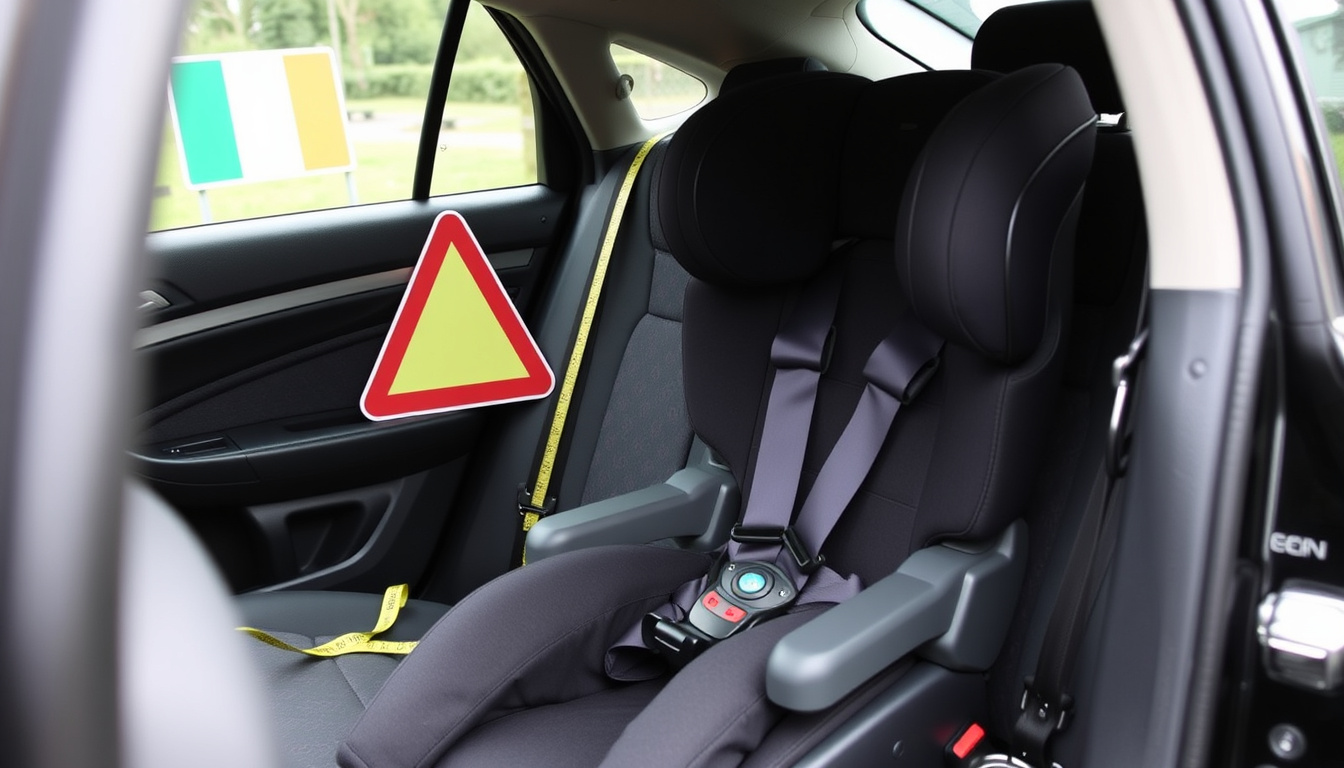
- High-back boosters: Use a top tether and provide head and side protection. Recommended by the RSA for children from 100 cm to 150 cm, primarily because they guide the seat belt correctly across the shoulder and chest.
- Backless boosters: Suitable only for older children who meet the seat’s own height/weight minimums (often 125 cm or 22 kg), and only when the car has a head restraint behind the child’s head.
The RSA (state road safety authority) is unambiguous: backless boosters should be the exception, not the default. The reason is physics—a high-back booster positions the belt across the stronger collarbone and pelvis, while a backless model relies entirely on the car’s seat design. For parents, this means reading the seat’s label and manual, not just the age range on the box.
The trade-off is simple: high-back boosters are safer for most children up to 150 cm, but they’re bulkier and can be harder to move between cars. Backless boosters are portable and cheap, but the RSA effectively brands them as “last resort” for older kids.
Common Mistakes That Undermine Safety
Even well-meaning parents make errors that dramatically reduce a booster seat’s effectiveness. The most frequent mistakes are consistent across the HSE and RSA guidance, and they all stem from the same root: moving up a stage too quickly.
- Moving to booster too early: The HSE (Ireland’s health service executive) notes that a booster seat is only safe when the child can sit still with the belt across the pelvic bone and shoulder, which typically requires maturity and the size to stay put.
- Seatbelt not snug across hips: The lap belt must sit high on the thighs, not across the stomach. Loose belts during a crash cause “submarining” and internal injuries.
- Shoulder belt behind the child’s back or under the arm: The Tusla booklet (state child welfare agency’s guidance) explicitly calls this out as a rule-breaker. It turns the shoulder belt into a lap-only belt and increases head-injury risk.
- Not using the top tether on high-back boosters: The RSA states the top tether is integral to injury prevention—it limits forward head movement in a crash. Skipping it is like not wearing a seatbelt.
The RSA warns that skipping the top tether on a high-back booster allows the child’s head to move up to 30 cm forward in a crash — the difference between walking away and a serious head injury.
The Progression Timeline: From Harness to Seatbelt
Navigating the stages from rear-facing infant seat to adult seatbelt feels like an endless series of transitions, but each step has clear triggers based on height and weight, not just age. Here’s how the typical progression works in Ireland.
- Rear-facing (birth to ~15 months): Legally required until at least 15 months and 9 kg, but extended rear-facing is safer.
- Forward-facing harness (from ~9 kg): The RSA recommends keeping children in a five-point harness until they reach the seat’s maximum, often around 18 kg.
- High-back booster (from ~100 cm / 15 kg): The RSA explicitly recommends this type for children between 100 cm and 150 cm. Many parents skip this stage entirely, a mistake.
- Backless booster (older children only): Only when the child exceeds the seat’s stated weight/height, which is typically 22 kg / 125 cm for newer models.
- Adult seatbelt: The legal exit is 150 cm and 36 kg—the HSE emphasizes this is a minimum, not a recommendation to switch.
The practical takeaway: Every booster seat sold in the EU (including Ireland) must have a label with the height and weight range. Ignore the age on the box—it’s the manufacturer guessing, not the law. The law only cares about whether the belt fits correctly.
Related reading: Double Decker Bus: Price, Seat Count, Bathrooms, and History
odo.ie, rsa.ie, rsa.ie, rsa.ie, halfords.ie, visualfoodie.com, uprti.com, carzone.ie, rsa.ie, auto-doc.ie, rsa.ie, rsa.ie, auto-doc.ie, aig.ie, thesun.ie, civicpost.co.uk, nidirect.gov.uk, legislation.gov.uk, eur-lex.europa.eu, eur-lex.europa.eu, eur-lex.europa.eu, eur-lex.europa.eu, eur-lex.europa.eu
Frequently Asked Questions
What is the legal height and weight for a booster seat in Ireland?
The law requires a child to use a booster seat if they are under 150 cm in height or weigh less than 36 kg. The RSA recommends high-back boosters from 100 cm to 150 cm. Backless boosters are only for older children, typically above 125 cm or 22 kg, and only if the car has a head restraint.
Can a 4 year old use a booster seat in any car?
Yes, but only if the child has reached the booster seat’s minimum height and weight requirements, which is usually around 100 cm and 15 kg. However, the RSA recommends a high-back booster for children under 125 cm, and many four-year-olds are still too short for even a backless booster to function safely.
Is it legal to use a backless booster seat in Ireland?
Yes, but with conditions. The RSA says backless boosters are only suitable for older children whose ears are higher than the seat back or head restraint, and who meet the seat’s specific weight minimum, usually 22 kg. The law defers to the seat’s label, but safety experts strongly prefer high-back models.
When can a child legally sit in the front passenger seat in Ireland?
There is no height or weight rule for the front seat in Irish law, but the RSA and Garda guidance state that a rearward-facing child car seat must never be used with an active front airbag. In practice, it’s safest to keep children under 150 cm in the back seat because the front airbag can cause severe injuries.
What if my child is 149 cm and 35 kg—are they legal in a booster?
Yes, they are legally required to use a booster. The law states “under 150 cm OR under 36 kg,” meaning if they fall below either threshold, a booster is mandatory. Moving them to an adult belt at 149 cm is an offence, even if they seem big.
Are boosters required in taxis in Ireland?
No—the requirement for a child restraint does not apply in a taxi. However, the Citizens Information (official state information portal) notes this is a legal exemption, not a safety recommendation. If you have a booster seat, you should still use it.
What age is a booster seat required until?
In Ireland, the law is based purely on height and weight, not age. In practice, children need boosters until they are 10–12 years old because most children don’t hit 150 cm or 36 kg before then. The Tusla booklet (state child welfare agency’s official guidance) says a child is ready for an adult belt only when the lap belt rests on the thighs and the shoulder belt crosses the collarbone, not the neck.
Can I use a second-hand booster seat?
The RSA advises against it unless you can verify the seat’s history. A booster that’s been in a crash, has missing parts, or is past its expiry date (usually 6 years from manufacture) offers reduced protection. The label on the seat will show the expiry.

Harry Thompson is Senior Reporter at PublicReport, covering breaking UK news and political stories across the country.