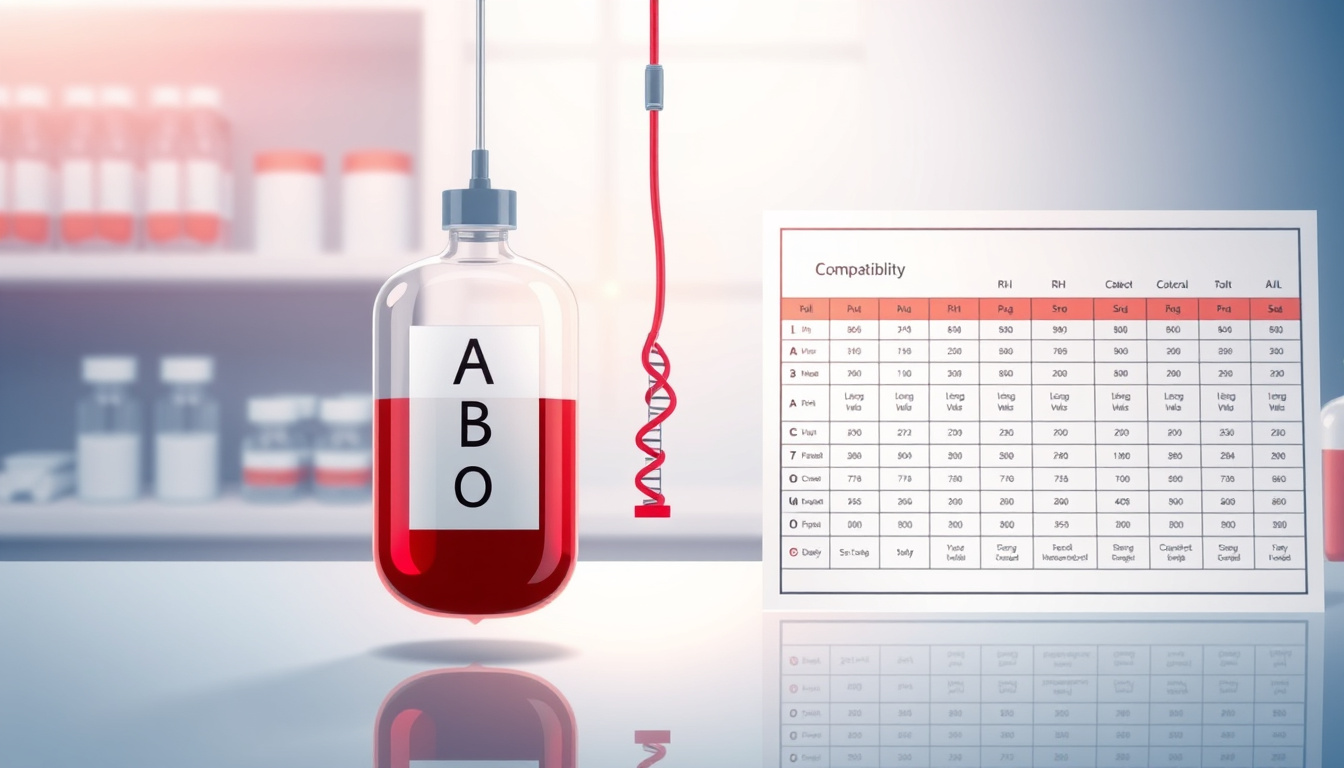
Your blood type is one of the first things medical staff want to know in an emergency – and for good reason. It determines who can safely give you blood and whose blood you can receive, and it’s written in your DNA.
Main blood types: 8 (ABO + Rh positive/negative) ·
Most common worldwide: O+ (≈37%) ·
Rarest blood type: AB- (<1%) ·
Universal donor: O- (≈7%) ·
Most common in Ireland: O+ (47%)
Quick snapshot
- Four main groups: A, B, AB, O (NHS (UK health authority))
- Based on antigens on red blood cells (Lifeblood (Australian blood service))
- Antibodies in plasma determine compatibility (NHS)
- Presence (+) or absence (-) of RhD antigen (NHS)
- Rh-negative can receive only Rh-negative blood (NHS)
- Important in pregnancy (Rh incompatibility) (NHS)
- O- is universal donor for red cells (Northern Ireland Blood Transfusion Service (regional health service))
- AB+ is universal recipient (NiBTS)
- Matching blood type prevents immune reactions (Northern Ireland Blood Transfusion Service (regional health service))
The eight blood types and their key characteristics break down as follows, based on data from health authorities.
| Attribute | Value | Source |
|---|---|---|
| ABO groups | A, B, AB, O | NHS (UK health authority) |
| Rh factor types | Positive (+), Negative (-) | NHS (UK health authority) |
| Total blood types | 8 (4 ABO × 2 Rh) | NHS (UK health authority) |
| Most common globally | O+ (≈37%) | NHS Blood Donation (UK donor service) |
| Rarest globally | AB- (<1%) | NHS Blood Donation (UK donor service) |
| Universal donor (red cells) | O- | NiBTS (regional health service) |
| Universal recipient (red cells) | AB+ | NiBTS |
| Most common in Ireland | O+ (47%) | Irish Blood Transfusion Service (national blood service) |
What blood type is rarest?
AB negative is the rarest of the eight main blood types, found in less than 1% of the population according to the NHS Blood Donation (UK donor service). The Irish Blood Transfusion Service reports the same pattern in Ireland, where AB- also accounts for just 1% of donors.
What are the 3 rarest blood types?
- AB- – rarest, below 1% globally (NHS Blood Donation)
- B- – around 3% of donors (same source)
- A- – roughly 8% of the donor pool (NHS Blood Donation)
Rare doesn’t mean “best.” While AB- is rare, its holders can only receive AB- blood. For everyday transfusions, O+ (common) is far more flexible.
Which is better, O+ or AB+?
The short answer: it depends on whether you’re giving or receiving. Northern Ireland Blood Transfusion Service (regional health service) explains that group O red cells can be given to any patient, making O- the universal donor, but O+ can only donate to Rh-positive recipients. AB+ patients, on the other hand, can receive red cells of any group – they are universal recipients.
Why is O+ blood so special?
- O+ is the most requested blood type for transfusions because it is the most common (NHS Blood Donation)
- O+ can be given to any Rh-positive patient, covering about 85% of people
- It’s a workhorse donor type – not universal, but in high demand
Do you get your blood type from mom or dad?
Yes – you inherit one allele from each parent. The NHS confirms that blood group is determined by genes inherited from both parents. The Lifeblood (Australian blood service) details that the ABO gene sits on chromosome 9, with A and B alleles dominant over O.
Can two siblings have the same blood type?
- Yes – siblings can share a blood type if they inherit the same combination of alleles
- Two O parents can only have O children (Lifeblood inheritance table)
- An A and B parent can have children with any of the four ABO types (Lifeblood)
- Two AB parents can have A, B, or AB children – never O (Lifeblood)
Paternity disputes or medical records sometimes rely on blood-type logic. But it’s not foolproof – DNA testing is far more precise.
What two blood types don’t mix?
Incompatible blood types trigger a dangerous immune reaction called agglutination. NHS explains that type A blood contains anti-B antibodies, so giving type B blood to a type A patient causes a transfusion reaction. The same applies in reverse. Rh factor adds another layer: Rh-negative patients receiving Rh-positive blood can develop antibodies that complicate future transfusions or pregnancies.
- ABO incompatibility – A cannot receive B; B cannot receive A; O can only receive O
- Rh mismatch – Rh-negative can only receive Rh-negative to avoid sensitisation
- During pregnancy, an Rh-negative mother carrying an Rh-positive baby may need anti-D immunoglobulin to prevent haemolytic disease (NHS)
What blood type are most Irish?
According to the Irish Blood Transfusion Service (national blood service), O positive is the most common blood type in Ireland, accounting for 47% of the population. A positive follows at about 28%, while AB negative is the least common at 1%.
- O+ : 47% (Irish Blood Transfusion Service)
- A+ : ~28%
- B+ : ~8%
- AB- : 1% (Irish Blood Transfusion Service)
What was Jesus’s blood type?
This question often surfaces online, tied to claims about the Shroud of Turin or Eucharistic miracles. No scientific evidence confirms the blood type of any historical figure from that era. Some theories suggest type AB, but they remain speculative and are not supported by verifiable data (NHS Blood Donation notes that blood typing requires a fresh sample). The discussion is cultural curiosity, not medical fact.
- No ancient DNA of Jesus exists to test
- Claims based on relics are not scientifically accepted
- Blood type cannot be determined from historical accounts
Comparison: O+ vs AB+
Two key blood types, one pattern: O+ is the most common donor workhorse, while AB+ is the universal recipient with the rarest profile.
| Attribute | O+ | AB+ |
|---|---|---|
| Global prevalence | ~37% | ~2% |
| Can donate to | O+, A+, B+, AB+ (all Rh+) | AB+ only (NiBTS) |
| Can receive from | O+ and O- (NHS Blood Donation) | All blood types (universal recipient) |
| Typical demand | Very high (most common) | Lower (rarer, fewer patients) |
The implication: O+ donors power the bulk of routine hospital transfusions, while AB+ recipients benefit from unmatched flexibility when they need blood.
Blood type compatibility matrix
Eight blood types, two axes – here’s how they pair for red blood cell transfusion.
| Donor ↓ → Recipient → | A+ | A- | B+ | B- | AB+ | AB- | O+ | O- |
|---|---|---|---|---|---|---|---|---|
| A+ | ✓ | ✓ | ||||||
| A- | ✓ | ✓ | ✓ | ✓ | ||||
| B+ | ✓ | ✓ | ||||||
| B- | ✓ | ✓ | ✓ | ✓ | ||||
| AB+ | ✓ | |||||||
| AB- | ✓ | ✓ | ||||||
| O+ | ✓ | ✓ | ✓ | ✓ | ||||
| O- | ✓ | ✓ | ✓ | ✓ | ✓ | ✓ | ✓ | ✓ |
Note: This table shows red blood cell compatibility only. Plasma and platelet rules differ.
Upsides and downsides of knowing your blood type
Upsides
- Critical for emergency transfusions
- Helps plan safe pregnancy care (Rh factor)
- Enables targeted blood donation
Downsides
- Rare types (AB-) limit donor/receiver options
- Knowing your type doesn’t change health outcomes otherwise
- Misinformation (e.g., blood type diets) can cause confusion
Confirmed facts vs what’s unclear
Confirmed facts
- ABO and Rh blood group systems are medically standard (NHS)
- O- is the universal donor for red blood cells (NiBTS)
- AB+ is the universal recipient (NiBTS)
- Blood type is inherited from both parents (Lifeblood)
What’s unclear
- Exact blood type of historical figures (e.g., Jesus) – no verifiable evidence
- Precise rarity percentages in every global population subgroup
Perspectives from blood services
“Every two seconds someone in the U.S. needs blood.”
“O-negative blood can be given to anyone – it’s used in emergencies when blood type is unknown.”
– NHS Blood Donation
Blood donation supply chains depend on a steady mix of all types, but O- stands out as the emergency lifeline. For routine surgeries, matching the patient’s exact type is preferred.
For Irish readers, the takeaway is practical: if you have O+ blood, you belong to the largest donor group in the country – and your regular donations are what keep the health service running. For those with rare types like AB-, your blood is irreplaceable when it’s needed. The choice to donate or simply know your type is clear: check your blood group, and if you’re able, roll up your sleeve.
giveblood.ie, medicover-genetics.com, en.wikipedia.org, youtube.com, facebook.com, thetech.org, pmc.ncbi.nlm.nih.gov, bulletinvietnam.org
For a comprehensive overview of how these groups are defined and inherited, see blood types explained in detail.
Frequently asked questions
What blood type is the universal donor?
O- is the universal donor for red blood cells because it lacks A, B, and Rh antigens, making it safe for any recipient (NiBTS).
What blood type is the universal recipient?
AB+ is the universal recipient – people with AB+ can receive red blood cells from any ABO and Rh type (NiBTS).
Can your blood type change?
Generally no – it’s fixed from birth. Rare exceptions include bone marrow transplants or certain cancers, but it’s extremely unusual (NHS).
What is the Rh factor and why does it matter?
The Rh factor is a protein on red blood cells. Rh-positive means you have it; Rh-negative means you don’t. It matters during transfusion and pregnancy to avoid immune reactions (NHS).
How is blood type determined?
Through a simple blood test. A lab mixes your blood with antibodies against A, B, and Rh antigens to see which ones react (NHS).
What blood types are compatible for pregnancy?
Any combination is fine if both parents are Rh-positive or both Rh-negative. If an Rh-negative mother carries an Rh-positive baby, she may need anti-D injections to prevent complications (NHS).
Which blood type is most common in Europe?
O+ is the most common across Europe, though prevalence ranges from 35-45% depending on the country. In Ireland it’s 47% (Irish Blood Transfusion Service).
Is there a link between blood type and personality?
No scientific evidence supports personality traits associated with blood type. The idea is popular in some cultures but is considered pseudoscience (NHS).

Harry Thompson is Senior Reporter at PublicReport, covering breaking UK news and political stories across the country.