
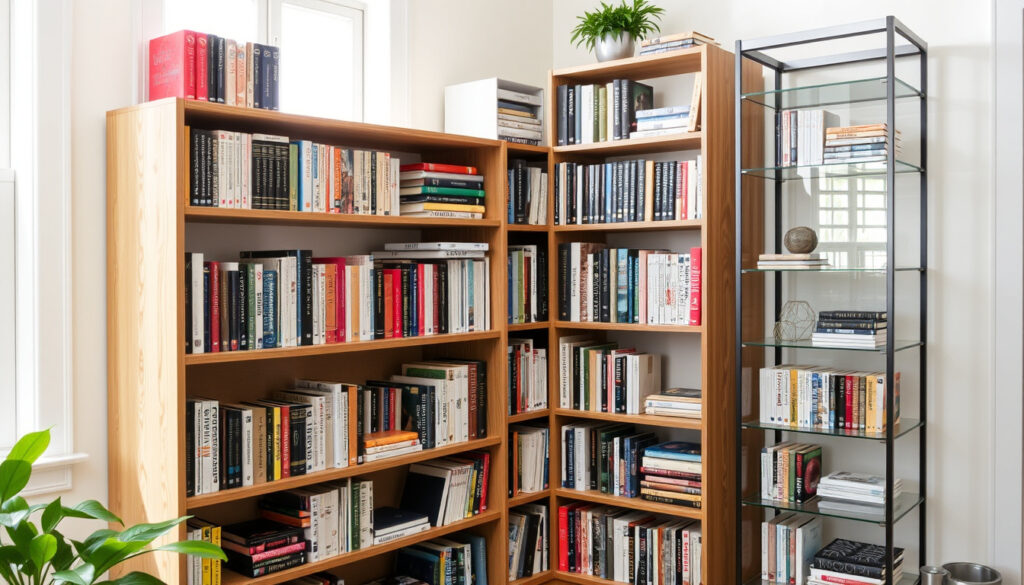
Anyone who has tried to find a single book in a double-stacked pile knows the real problem was never the books — it was the shelf. A standard bookshelf runs only about 12 inches deep, according to Room Reveal (bookshelf buying guide), yet most shoppers choose by color before checking whether their largest art books will even fit. The difference between a shelf that lasts a decade and one that bows in a year usually comes down to depth, span, and anchoring.
Average height: 72 inches (183 cm) ·
Common shelf depth: 12 inches (30 cm) ·
Typical price range: $50 – $500 ·
Most popular material: Engineered wood ·
Standard number of shelves: 3 to 6
Quick snapshot
- Bookshelves are built in wood, metal, and glass (The Spruce (home furnishing review site)).
- Standard shelf depth is about 12 inches (30 cm) (Room Reveal (bookshelf buying guide)).
- Most mass-market units are made of engineered wood (The Spruce (home furnishing review site)).
- Tall bookcases must be anchored to a wall (FEMA (federal safety guidance)).
- Which brand lasts longest depends on usage conditions, not the nameplate.
- Weight capacities vary widely by design, span, and material.
- The right shelf span depends on load and board thickness.
- The published per-shelf weight rating before loading (Room Reveal (bookshelf buying guide)).
- Shelf span vs. material thickness (WoodCalcs (bookshelf span calculator)).
- Wall studs and an anchor kit for tall units (FEMA (federal safety guidance)).
- Measure your largest books before choosing a unit.
- Match material to the load the shelf will actually carry.
- Anchor the bookcase before filling it.
Seven numbers settle most bookshelf decisions before aesthetics enter the picture; here is the range a buyer actually sees in standard units.
| Specification | Typical value |
|---|---|
| Average shelf depth | About 12 inches (30 cm); 13+ for oversized books (Room Reveal (bookshelf buying guide)) |
| Common overall heights | 30–84 inches (76–213 cm) |
| Typical materials | Wood, metal, glass, engineered wood (The Spruce (home furnishing review site)) |
| Price range for standard units | $50 – $500 |
| Typical per-shelf load rating | 20–40 lb (9–18 kg); confirm the published rating (Room Reveal (bookshelf buying guide)) |
| Shelf clearance by format | Paperback 200–230 mm; hardback 260–300 mm; large-format 320–380 mm (WoodCalcs (bookshelf span calculator)) |
| Safe unsupported span by material | 18 mm plywood: under ~750 mm; 18 mm MDF: under ~600 mm; 25 mm hardwood: about 1,000 mm (WoodCalcs (bookshelf span calculator)) |
What are the best wall-mounted bookshelves?
Wall-mounted units are the default answer for small rooms because they turn unused vertical wall space into storage. The catch: the wall becomes the load-bearing structure, so a shelf that is not anchored into framing is only as strong as the drywall around the screw.
How to mount a bookshelf on drywall?
- Locate the wall studs and drive the main screws into them.
- Use rated hollow-wall anchors for any secondary fixings.
- Confirm the unit’s published per-shelf weight rating before loading it (Room Reveal (bookshelf buying guide)).
The principle applies to any tall or wall-attached bookcase: FEMA’s anchoring guidance says tall bookcases should be secured to the wall structure, not simply set on the floor (FEMA (federal safety guidance)).
A wall-mounted shelf rated for 30 pounds is only as strong as its anchor. If the bracket lands in drywall instead of a stud, that rating stops meaning much.
What weight can a wall-mounted shelf hold?
- Per-shelf ratings are the number to trust, not the unit’s total capacity.
- Longer spans reduce the safe load because the shelf material bends.
- Metal frames deliver strength with a lighter visual footprint (Room Reveal (bookshelf buying guide)).
If a manufacturer does not print a per-shelf weight rating, treat that as a red flag; the rating is the minimum due-diligence check before stacking hardbacks on a floating board.
The trade-off: wall units trade a drywall repair risk for a cleaner floor plan — an even swap only when the buyer anchors into the right material.
What are the best bookshelves for kids?
For a child’s room, “best” means something different: the unit has to survive climbing, keep its center of gravity low, and put books within a child’s reach.
What safety features should a kids’ bookshelf have?
- Rounded or eased edges to soften falls.
- A wide, low base that resists tipping during play.
- Wall anchoring on every tall unit — no exceptions.
FEMA’s guidance is unambiguous on the last point: tall bookcases should be anchored to the wall because children pulling on shelves is a known tip-over hazard (FEMA (federal safety guidance)). For the unit itself, Room Reveal’s guide notes that cube or grid shelving is particularly suitable for children’s rooms and playrooms because bins and boxes keep toys as organized as books (Room Reveal (bookshelf buying guide)). Design matters too: themed units with animals or bright colors are the popular nursery choice, but the rounded edges and anchored frame underneath are what do the safety work.
A loaded tall bookcase outweighs a small child several times over. Anchored, it is furniture; unanchored, it becomes a topple risk in the room where kids spend the most unsupervised time.
Are low-height bookshelves better for children?
- Low shelves put books at eye level so children can choose their own reading.
- A low unit keeps the center of gravity close to the floor.
- Freestanding low bookcases stay storage-dense and often include adjustable shelves (Room Reveal (bookshelf buying guide)).
Why this matters: a low, anchored unit with rounded edges stops being a climbing hazard and becomes an invitation to read — the actual job of a kids’ bookshelf.
What is a corner bookshelf and when should I use one?
Corner bookshelves solve a geometry problem: most rooms have at least one 90-degree corner that standard rectangular furniture cannot use without wasting floor space.
What are the dimensions of a standard corner bookshelf?
- Triangular and L-shaped designs are the two dominant formats.
- Triangular units fit flush into the corner but reduce usable depth near the back.
- L-shaped units keep straight, full-depth shelves on both sides of the corner.
Because the format dictates depth, measure the widest book you own before choosing. Standard shelves of about 12 inches suit most books, while oversized art and coffee-table volumes need 13 inches or more, according to Room Reveal’s buying guide (Room Reveal (bookshelf buying guide)).
A corner unit plus a reading chair can turn an empty angle into a usable nook without blocking traffic — but only if the shelf depth fits the books you plan to keep there.
Can corner shelves be used in offices?
- Yes — corner units fit office corners and reading nooks without crowding walkways.
- Open etagere frames make small or formal rooms feel less visually crowded (Room Reveal (bookshelf buying guide)).
- Modular corner units adapt as an office collection grows.
The pattern: corner shelves trade shelf span for floor space. They are ideal for small apartments and reading nooks, but they are not the right home for dozens of large-format books.
What are the best small bookshelves for tight spaces?
In a dorm room, hallway, or compact office, the real question is how much floor you are willing to give up — and whether the shelf can do its job without taking up a quarter of the room.
How narrow can a small bookshelf be?
- Most small bookshelves measure under 30 inches wide.
- Wall-mounted and leaning formats reclaim floor space entirely.
- Leaning and ladder shelves look light but carry less than conventional bookcases (Room Reveal (bookshelf buying guide)).
For renters, modular or stackable shelving makes the most sense: it breaks into pieces that fit a car and expands as the collection does. Room Reveal’s guide flags modular units as the practical choice for people who move frequently (Room Reveal (bookshelf buying guide)).
What is the difference between a cube shelf and a standard shelf?
- A cube shelf is a grid of square compartments, often with bins that slide in and out.
- A standard shelf runs horizontal rows across the unit.
- Cube formats are flexible for books, toys, and boxes, and suit playrooms and offices (Room Reveal (bookshelf buying guide)).
The trade-off: cube storage wins on flexibility and visual order; standard shelves win on linear book capacity. In a tight space, that one decision shapes everything else.
What are the benefits of an oak bookshelf?
Oak is the material for buyers who treat a bookshelf as a one-time purchase rather than a temporary fix.
Is oak more durable than pine?
- Oak is a hardwood, denser than pine and more resistant to dents and scratches.
- Solid wood is generally more durable than MDF or particleboard, but it is heavier and more expensive (The Spruce (home furnishing review site)).
- Engineered wood is more affordable but more vulnerable to sagging and edge damage under heavy loads (The Spruce (home furnishing review site)).
The engineering numbers support the choice: WoodCalcs’ calculator lists about 1,000 mm as an acceptable unsupported span for 25 mm solid hardwood, while 18 mm MDF can sag noticeably beyond roughly 600 mm when loaded with heavy books (WoodCalcs (bookshelf span calculator)).
How to care for an oak bookshelf?
- Wipe regularly with a dry cloth and address spills before they sit.
- Reapply furniture wax or oil when the finish starts to look dry.
- Spread heavy books evenly to avoid long unsupported spans.
The trade-off: oak costs more and weighs more at checkout, but its span capacity means fewer center dividers, cleaner lines, and a shelf that still looks right after the books move out.
How the main bookshelf types compare
Five formats, one pattern: every type trades something — floor space, capacity, or visual weight — to earn its place in the room. The type guidance below draws on Room Reveal’s format-by-format comparison and The Spruce’s material testing (Room Reveal (bookshelf buying guide); The Spruce (home furnishing review site)).
| Type | Best for | Main trade-off | Typical materials |
|---|---|---|---|
| Wall-mounted | Small rooms, floating designs | The wall becomes the load-bearing structure | Metal, glass, engineered wood |
| Corner | 90-degree corners, reading nooks | Triangular formats reduce usable depth | Wood, engineered wood |
| Kids | Nurseries, playrooms | Safety features matter more than raw capacity | Engineered wood, wood |
| Small | Dorms, hallways, offices | Width under 30 inches limits volume | Engineered wood, metal |
| Oak | Long-term or heirloom use | Higher weight and price | Solid oak |
The implication: each format solves one room problem and creates one constraint. Wall units need studs, corner units cut depth, small units cut volume, kids’ units put safety first, and oak asks for a bigger budget — so matching the trade-off to your room beats matching the style to your decor.
Bookshelf specifications at a glance
Seven numbers separate a shelf that sags from one that holds: the table below compiles the dimensional and load guidance from WoodCalcs’ span calculator and Room Reveal’s buying guide into one checklist (WoodCalcs (bookshelf span calculator); Room Reveal (bookshelf buying guide)).
| Specification | Typical value |
|---|---|
| Shelf depth | 10–12 inches; 13+ for oversized art books |
| Overall height | 30–84 inches (76–213 cm) |
| Vertical clearance, paperback | 200–230 mm |
| Vertical clearance, hardback | 260–300 mm |
| Vertical clearance, large-format | 320–380 mm |
| Per-shelf load rating | 20–40 lb (9–18 kg); confirm the published rating |
| Unsupported span, 18 mm plywood | Under about 750 mm; up to ~800 mm with a hardwood edge band |
| Unsupported span, 18 mm MDF | Under about 600 mm for heavy books |
| Unsupported span, 25 mm solid hardwood | About 1,000 mm |
What this means: two bookcases can look identical and perform completely differently — the span between supports, not the brand name, decides whether the shelf stays flat.
Bookshelf pros and cons
The right purchase is a trade-off, not a search for perfection. Here is the balanced case before you look at price tags.
Upsides
- Storage formats for every room, from wall units to cabinet-based bookcases.
- Solid wood options hold up for decades when spans and loads are matched (The Spruce (home furnishing review site)).
- Wall-mounted and corner formats unlock floor space that otherwise sits empty.
- Entry prices are low: standard units run roughly $50–$500.
Downsides
- Engineered wood can sag or break under heavy loads (The Spruce (home furnishing review site)).
- Long unsupported spans bow over time (Room Reveal (bookshelf buying guide)).
- Tall units need wall anchoring to prevent tip-overs (FEMA (federal safety guidance)).
- Solid hardwood is heavier and more expensive than engineered alternatives.
The catch: a cheap engineered-wood unit is perfectly fine for paperbacks on short spans; the same unit loaded with heavy hardbacks across a wide span is a sagging problem waiting for a repair bill.
How to choose and install a bookshelf safely
Six checks, in order, separate a shelf that lasts from one that bows, racks, or tips.
- Measure your largest books. Paperbacks sit in 200–230 mm of clearance, hardbacks in 260–300 mm, and oversized art books need 320–380 mm (WoodCalcs (bookshelf span calculator)).
- Measure the room footprint. A standard shelf depth of about 12 inches fits most books; art and coffee-table volumes want 13 inches or more (Room Reveal (bookshelf buying guide)).
- Match the span to the material. Keep 18 mm engineered-wood spans under 600–750 mm; 25 mm hardwood can carry about 1,000 mm unsupported (WoodCalcs (bookshelf span calculator)).
- Check the per-shelf weight rating. If the manufacturer publishes one, treat it as the limit, not a suggestion (Room Reveal (bookshelf buying guide)).
- Anchor the unit to the wall. FEMA’s bookcase guidance requires securing tall units to the wall structure to prevent tip-overs (FEMA (federal safety guidance)).
- Prefer a back panel or dividers. A fixed back adds rigidity and reduces racking; backless units may require diagonal bracing or stronger joinery (WoodCalcs (bookshelf span calculator)).
The takeaway: buyers who run these checks before opening the box never discover sagging shelves after the books are on them — they discover the problem on the spec sheet first.
What’s confirmed — and what still depends on the room
Some bookshelf facts are settled; others shift with load, material, and habits. Here is the honest split.
Confirmed facts
- Bookshelves are built in wood, metal, and glass (The Spruce (home furnishing review site)).
- Most mass-market units are made of engineered wood (The Spruce (home furnishing review site)).
- Tall bookcases should be anchored to the wall (FEMA (federal safety guidance)).
What’s unclear
- Which brand lasts longest depends on humidity, loading habits, and how often the unit is moved.
- Actual per-shelf capacity varies widely by design, span, and material — the published rating is the only reliable number (Room Reveal (bookshelf buying guide)).
- Sag thresholds shift with wood grade, moisture content, and load distribution, so calculator figures are planning guides rather than guarantees (WoodCalcs (bookshelf span calculator)).
- Glass-shelf weight limits are rarely published clearly enough to compare across brands.
- A standard shelf depth of about 12 inches fits most books — but oversized volumes may need 13+ inches (Room Reveal (bookshelf buying guide)).
- Long unsupported spans bow over time — the risk increases with span length and load weight (Room Reveal (bookshelf buying guide)).
The honest read: the confirmed list covers materials and safety; the unclear list covers everything that depends on how a specific household loads the shelf. That is why the spec table matters more than the brand sticker.
What the experts keep saying
Three themes repeat across the buying guides and safety documents researched for this article.
“Freestanding bookcases are the storage-dense option, but every format has a compromise: ladder shelves look light yet carry less, and modular units only make sense if you might move.”
Room Reveal, bookshelf buying guide — type-by-type comparison
“The span is the specification that decides whether a shelf sags. Eighteen-millimeter MDF holds up to roughly 600 mm under heavy books, while 25 mm solid hardwood reaches about 1,000 mm.”
WoodCalcs, bookshelf span calculator — span and material guidance
“Tall bookcases should be secured to the wall structure. Anchoring is the difference between a storage piece and a tip-over hazard in a home with children.”
FEMA, furniture anchoring guidance — How to Anchor Bookcases
The convergence: the design guides argue about style, but they agree on structure — match the span to the material, check the rating, and anchor the unit.
The takeaway
The bookshelf market is wide, but the physics is narrow: depth determines what fits, span determines what stays flat, and anchoring determines what stays upright. Buyers who come out ahead measure their largest books before comparing wood tones, because a shelf that sags or tips fails no matter how good it looks in the showroom. For a first-time buyer in a small apartment, the choice is clear: buy a unit whose span matches its material, anchor it to the wall studs, and let the books — not the marketing — decide the load.
basc.pnnl.gov, belleze.com, clutterscience.com, thewearify.com
Frequently asked questions
How do I clean a wooden bookshelf?
Wipe the surface weekly with a dry microfiber cloth. For sticky spots, use a slightly damp cloth and dry immediately; avoid soaking the wood or letting water sit on the finish.
Can I paint my existing bookshelf?
Yes. Sand the surface lightly, wipe off the dust, apply a primer suited to wood or MDF, then finish with two coats of paint. This works for both solid wood and engineered boards.
What is the weight limit of a standard glass shelf?
There is no single standard; glass thickness, tempering, span, and support all change the answer. Check the manufacturer’s published per-shelf rating before loading, and treat an absent rating as a warning.
How to prevent books from falling off an open shelf?
Use bookends, keep taller volumes at the ends of each row, or choose a unit with a low front lip. Cabinet-front bookcases are the stronger option for homes with toddlers.
Are glass shelves safe in a child’s room?
Most kids’ bookshelf recommendations favor solid wood or engineered wood with rounded edges over glass. If a unit does include glass, confirm it is tempered and anchor the whole piece to the wall.
What is the best way to arrange books aesthetically?
Group by height or color, mix vertical and horizontal stacks, and leave a few open spaces for small objects. The goal is rhythm, not a full shelf.
What size bookshelf fits a standard 8-foot wall?
An 8-foot wall offers 96 inches of height. Standard bookshelves run from 30 to 84 inches, so an 84-inch unit fits comfortably while leaving space at the top for decor.
Related reading

Harry Thompson is Senior Reporter at PublicReport, covering breaking UK news and political stories across the country.