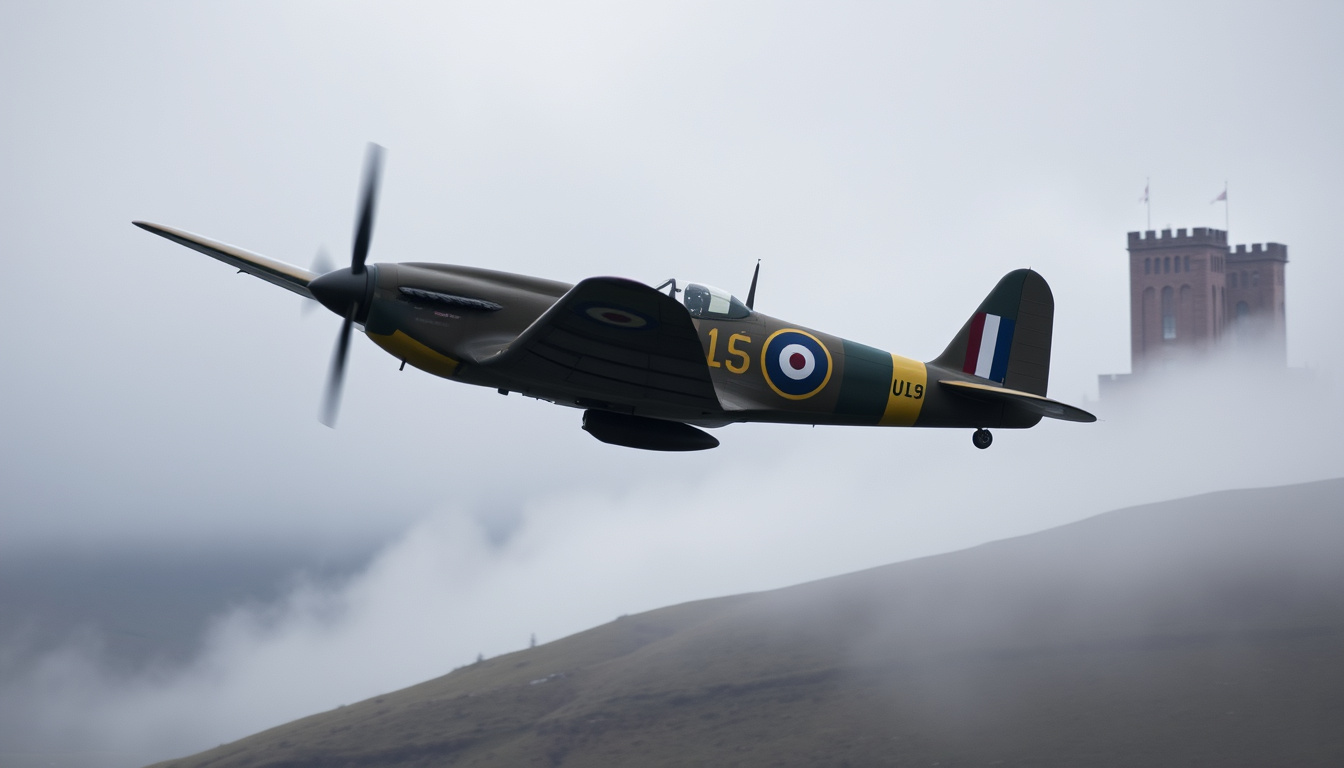
Few moments of the Second World War are stranger than the night Hitler’s deputy climbed into a fighter plane and flew to Britain without telling anyone. Rudolf Hess’s flight on 10 May 1941 ended in a crash-landing near Eaglesham and, ultimately, a life sentence at Nuremberg and about 40 years inside Spandau Prison in Berlin.
Born: 26 April 1894, Alexandria, Egypt ·
Died: 17 August 1987, West Berlin, West Germany (suicide by hanging) ·
Role in Nazi Party: Deputy Führer until 1941 ·
Flight to Scotland: 10 May 1941, crashed near Eaglesham ·
Trial and Sentence: Nuremberg, 1946 – life imprisonment ·
Imprisonment: Spandau Prison, 1946–1987
Quick snapshot
- Hess was Hitler’s deputy Führer when he flew to Scotland in May 1941 (Smithsonian Magazine (history publication)).
- The flight was an unauthorized peace mission that ended in a crash-landing (BBC News (UK public broadcaster)).
- He was sentenced to life imprisonment at Nuremberg (United States Holocaust Memorial Museum (research institution)).
- His true motive for the flight — peace bid, delusion, or a plot — was never settled in court (Britannica (reference publisher)).
- Whether his Nuremberg amnesia was genuine; he later said it was simulated (Britannica (reference publisher)).
- Whether his 1987 death was an unassisted suicide: officially ruled so (Britannica (reference publisher)), but doubts persist.
- 26 April 1894 — born in Alexandria, Egypt (Britannica (reference publisher)).
- 10 May 1941 — flew to Scotland and was captured (BBC News). (Britannica (reference publisher))
- 1 October 1946 — sentenced to life at Nuremberg (USHMM (research institution)).
- 17 August 1987 — found dead at Spandau (Britannica (reference publisher)).
- TIME (news magazine) called Hess the last surviving member of Nazi Germany’s high command at his death (TIME (news magazine)).
- The suicide note and autopsy report remain the final documented pieces of the affair (Los Angeles Times (US newspaper)).
- For researchers, the open question is still why Hess flew (Britannica (reference publisher)).
Seven facts anchor the Hess story, from his birth in Alexandria to his death in an Allied-run prison in West Berlin.
| Label | Value |
|---|---|
| Full name | Rudolf Walter Richard Hess |
| Born | 26 April 1894, Alexandria, Egypt |
| Died | 17 August 1987, West Berlin, West Germany |
| Cause of death | Suicide by hanging |
| Known for | Deputy Führer of Nazi Germany, flight to Scotland |
| Trial | Nuremberg, 1946 – life imprisonment |
| Prison | Spandau Prison, 1946–1987 |
This article separates documented events from unresolved questions. On the two most contested points — the motive for the 1941 flight and the 1987 death — the text says what the official record states and names the gaps.
What was Rudolf Hess famous for?
Hess was not a marginal figure in the Nazi Party. He was Hitler’s deputy Führer, the man formally second in the party hierarchy until his flight in 1941 (BBC News).
Role as deputy to Hitler
- Hess joined the party in its early years, helped draft parts of Mein Kampf, and had a role in organizing the Nuremberg rallies (Britannica).
- By 1933 he had been appointed Deputy Führer, and in 1939 he was designated Hitler’s successor after Hermann Göring (Smithsonian Magazine).
The post gave Hess real administrative authority over the party machine — but little command over the military. The position matters for understanding 1941: he could speak for the party, yet he had no standing to negotiate for the German state.
Key contributions to Nazi ideology
- He worked with Hitler on Mein Kampf while both were imprisoned after the 1923 Beer Hall Putsch.
- The Nuremberg rallies, central to Nazi spectacle, were among his organizational responsibilities.
The pattern: Hess was an insider from the beginning, not a late joiner looking for influence. When he flew to Scotland, he carried the party’s institutional memory with him — which is what made his flight so difficult to explain as a simple lapse.
What was Hitler’s reaction to Rudolf Hess?
Hitler’s response came within hours, and it was absolute.
Hitler’s public denial
- The flight was denounced by Hitler (BBC News).
- He declared Hess insane and expelled him from the party, presenting the flight as the act of a deranged deputy rather than a political maneuver.
- Orders were given to shoot Hess on sight if he returned to Germany.
The public message was blunt: Hess had acted alone, in madness, and nobody in the leadership was implicated. There was no official interest in what Hess had intended to tell the British — only the need to close the file in public.
Official explanation of Hess’s mental state
- The regime’s line was that Hess had been mentally unstable for some time — an explanation that conveniently absolved the party of any involvement.
- The flight was framed as a personal breakdown sparked by mental illness, not as a political act with any legitimacy.
The implication: Hitler’s handling of Hess was damage control, not investigation. By declaring the man insane, the regime avoided the hard questions — about Hess’s motives, about his knowledge, and about what he might say in British custody.
What happened to Rudolf Hess in Scotland?
The flight itself was audacious; the arrival was almost absurd.
Landing and capture
- Hess secretly flew a German fighter plane to Scotland and bailed out near the Duke of Hamilton’s home (United States Holocaust Memorial Museum).
- He was immediately taken prisoner and interrogated, telling his captors that he had come to negotiate peace with Britain.
The British took no chances with a senior Nazi in their midst. Hess was held as a prisoner of war — the beginning of 46 years in Allied custody (Smithsonian Magazine).
Meeting with the Duke of Hamilton
- Hess’s stated goal was to reach the Duke of Hamilton, the British aristocrat he believed would support a peace initiative.
- The meeting produced nothing: no armistice, no negotiation — only an intelligence interview.
The diplomatic opening never came. Hess had bet everything on a conversation that changed nothing strategically — and sealed his own fate.
Why did Hess fly to Scotland?
- The flight was widely described as an unauthorized peace mission (BBC News).
- The record shows no mandate from Hitler or the German government; Hess acted on his own.
The question is not whether the mission was authorized — it clearly was not — but whether Hess believed he could pull it off, or whether he was already beyond rational calculation.
The trade-off: if Hess was sane, the flight was one of the most reckless acts in modern political history. If he was not, the whole exercise was a symptom — and the regime’s public story was right, though for the wrong reasons.
The implication: regardless of Hess’s intent, the British intelligence apparatus gained a senior Nazi source who could confirm operational details of the German war machine from the inside.
Where did Rudolf Hess crash his plane?
The crash site has a small place in the story because it is one of the few physical traces of the flight.
Crash site near Eaglesham, Scotland
- Hess’s aircraft crash-landed in Scotland during the 1941 flight (BBC News).
- The plane came down in a field near Eaglesham, and Hess suffered a broken ankle when he bailed out.
A broken ankle and a crumpled fighter were hardly the entrance Hess had planned for his one-man peace mission. The scene was less “special envoy” and more “crashed pilot” — and British officials treated him accordingly.
Condition of the aircraft
- The aircraft was a German fighter, identified in the record as a Messerschmitt Bf 110.
- Hess abandoned the plane by parachute; the machine came down separately from the man.
For the investigators, the plane mattered less than its range. This was not a short hop: somebody had planned a crossing that could only end in Britain or the sea.
The pattern: the details of the crash confirm the audacity of the attempt while exposing its amateurish end. The mission had ambition; its execution collapsed on a Scottish hillside.
Why was Rudolf Hess not sentenced to death?
Of the major Nazi leaders tried at Nuremberg, Hess was the one who escaped the gallows — without being acquitted.
Verdict at the Nuremberg Trials
- Hess was tried at the Nuremberg trials in 1946 (Britannica).
- He was convicted of crimes against peace but cleared of war crimes and crimes against humanity (BBC News).
- He received a life sentence rather than death.
The verdict was a compromise: the tribunal accepted that Hess had helped plan aggressive war, but it was not persuaded that he had personally driven atrocities or the Holocaust. That distinction was the difference between a life sentence and the noose.
Mental state assessment
- Hess claimed amnesia during the trial; he later told the court he had simulated the condition (Britannica).
- His erratic behavior in court complicated the judges’ assessment of his responsibility.
The tribunal had to decide whether it was sentencing a man who understood the proceedings or a patient who barely knew where he was. In the end, the life sentence reflected the doubt.
The legal distinction that spared Hess was not technical trivia: a conviction for war crimes or crimes against humanity would have carried the death penalty. The narrow verdict is the reason Spandau even existed.
The implication: Hess was kept alive by the narrowest legal margin. The same court that sent other Nazi leaders to death drew a line between the planners of aggressive war and the operators of its crimes — and Hess landed on the survivable side.
The catch: the legal line that saved Hess also locked him into a lifetime of isolation that no other Nazi leader endured.
Why did Hess hang himself?
The last mystery is the manner of his death — and the questions that survived it.
Circumstances of his suicide in Spandau
- Hess died in 1987 while imprisoned at Spandau, and the death was officially ruled a suicide (Britannica).
- A Special Investigation Branch report of the Royal Military Police concluded that he hanged himself with an electric cord in a summer house on the Spandau grounds.
- The Allied report published after his death said he wrote a suicide note beforehand (Los Angeles Times).
- Autopsy findings identified asphyxiation as the primary cause of death (Los Angeles Times).
The mechanics are precise: a cord, a summer house, a note. What the reports cannot explain is why a 93-year-old man, after decades of family campaigns and world leaders’ pleas for his release, chose to die inside a prison the Allied powers refused to close.
Did he have help?
- At 93, Hess was the only inmate in a prison built for hundreds — a fact that makes the idea of a solo suicide harder, not easier, to credit (TIME).
- Alternative theories about official involvement have circulated since 1987; none has displaced the official finding.
The paradox: the more guards, regulations and official eyes surrounded Hess, the more his death looked as though it required an explanation. The official inquiry said he planned it himself, and the note he left reportedly said the same.
Every future account of Hess’s death has to confront the same gap: the official mechanism is documented, the official motive is a single note. The distance between those two things is where the theories live.
The pattern: after 46 years of custody, the only act Hess fully controlled was his own death. Whether that control was real or staged is the question that keeps the case open.
The implication: the debate over Hess’s death will persist as long as the official account rests on a single note and a cord in a locked summer house.
Key dates in Hess’s life
The dates below trace a path from Alexandria to the heart of the Nazi state to a single cell in Allied-run Berlin.
| Date | Event | Source |
|---|---|---|
| Born in Alexandria, Egypt. | Britannica | |
| 1914–1918 | Served in World War I as a pilot; wounded. | Britannica |
| 1920–1923 | Joined the Nazi Party (member no. 16); took part in the Beer Hall Putsch. | Britannica |
| Appointed Deputy Führer. | Smithsonian Magazine | |
| Designated Hitler’s successor after Hermann Göring. | Britannica | |
| Flew solo to Scotland; crash-landed near Eaglesham. | USHMM | |
| 1941–1945 | Held in British custody as a prisoner of war. | Smithsonian Magazine |
| Sentenced to life imprisonment at the Nuremberg trials. | USHMM | |
| 1947–1966 | Imprisoned at Spandau with other convicted war criminals. | TIME |
| Became the sole prisoner of Spandau. | TIME | |
| Found dead at Spandau; death ruled a suicide. | USHMM | |
| After death | A Special Investigation Branch report concluded he hanged himself with an electric cord in a summer house. | Britannica |
The pattern: every stage of Hess’s biography is documented, yet the transitions between the stages are where the mystery lives. The dates are solid; the motivations are not.
What’s confirmed, what’s still contested
Confirmed facts
- Hess flew to Scotland on 10 May 1941 and was taken prisoner (United States Holocaust Memorial Museum).
- At Nuremberg he was convicted of crimes against peace and sentenced to life imprisonment (BBC News).
- He died at Spandau in 1987, and the death was ruled a suicide (Britannica).
What’s unclear
- His true motive for the flight — peace bid, delusion, or a plot — was never established in court.
- Whether his Nuremberg amnesia was genuine; he later told the court it was simulated (Britannica).
- Whether his suicide was assisted by authorities. The official report said it was not; alternative theories persist.
- At his death, TIME described him as the last surviving member of Nazi Germany’s high command (TIME).
The takeaway: the confirmed list is longer than the contested list, but the contested items are the ones that still drive books, documentaries and arguments.
Four voices from the record
These fragments show how the flight, the trial and the death entered the historical record.
Hess made a solo flight to Scotland in May 1941 — an unauthorized peace mission that ended in a crash-landing.
— BBC News (UK public broadcaster)
He secretly flew a German fighter plane to Scotland and bailed out near the Duke of Hamilton’s home.
— United States Holocaust Memorial Museum (research institution)
At his death, he was the last surviving member of Nazi Germany’s high command.
— TIME (news magazine)
The Allied report said he wrote a suicide note before his death, and the autopsy identified asphyxiation as the primary cause.
— Los Angeles Times (US newspaper)
The pattern: the closer the record gets to Hess’s inner life, the quieter the sources become. The documentation is loud on events and almost silent on motives.
Forty years in prison gave Hess a strange kind of afterlife: he outlived the regime he served, the court that sentenced him, and nearly everyone who had known him. The documents are closed; the prison is gone; the questions are not. For historians and biographers, the choice is now clear — keep treating the 1941 flight as a puzzle with a solution somewhere in the archives, or accept that Hess, like the note he left behind, took the part that mattered most to the grave.
Related reading
- Hess’s flight to Scotland — BBC News (UK public broadcaster)
- Hess’s life imprisonment at Spandau — Britannica (reference publisher)
Related reading: Hess’s life imprisonment at Spandau · Hess’s flight to Scotland
en.wikipedia.org, nytimes.com, scotsman.com, pressandjournal.co.uk, worldhistory.org, ebsco.com
Frequently asked questions
Did Rudolf Hess regret his actions as a Nazi?
No documented statement of remorse from Hess is part of the Nuremberg record. The note reported after his death reportedly said he accepted death willingly — a personal statement, not a political one.
Was Rudolf Hess fluent in English?
Hess was born and educated in British-administered Alexandria, where English was part of daily life. By 1941 he was able to explain his mission to his captors.
What happened to Rudolf Hess’s son?
Hess’s son became the public face of the family campaign for his release, and after 1987 he questioned the official suicide finding — one reason the case remains contested.
What happened to Rudolf Hess’s wife after the war?
Hess’s wife survived the war and joined the family campaign for his release. She remained publicly committed to him through the Spandau decades.
Did Rudolf Hess ever see his family again?
Yes. His family remained in contact during his imprisonment, and their campaign for his release was a recurring feature of the Spandau years.
How long was Rudolf Hess in prison?
From his capture on 10 May 1941 to his death on 17 August 1987, Hess spent 46 years in Allied custody. The Spandau portion alone was about 40 years (BBC News).
What was Rudolf Hess’s role in the Nazi Party?
He was Hitler’s deputy Führer until 1941 — the second-ranking party official — and he had earlier helped draft parts of Mein Kampf (Smithsonian Magazine).

Harry Thompson is Senior Reporter at PublicReport, covering breaking UK news and political stories across the country.