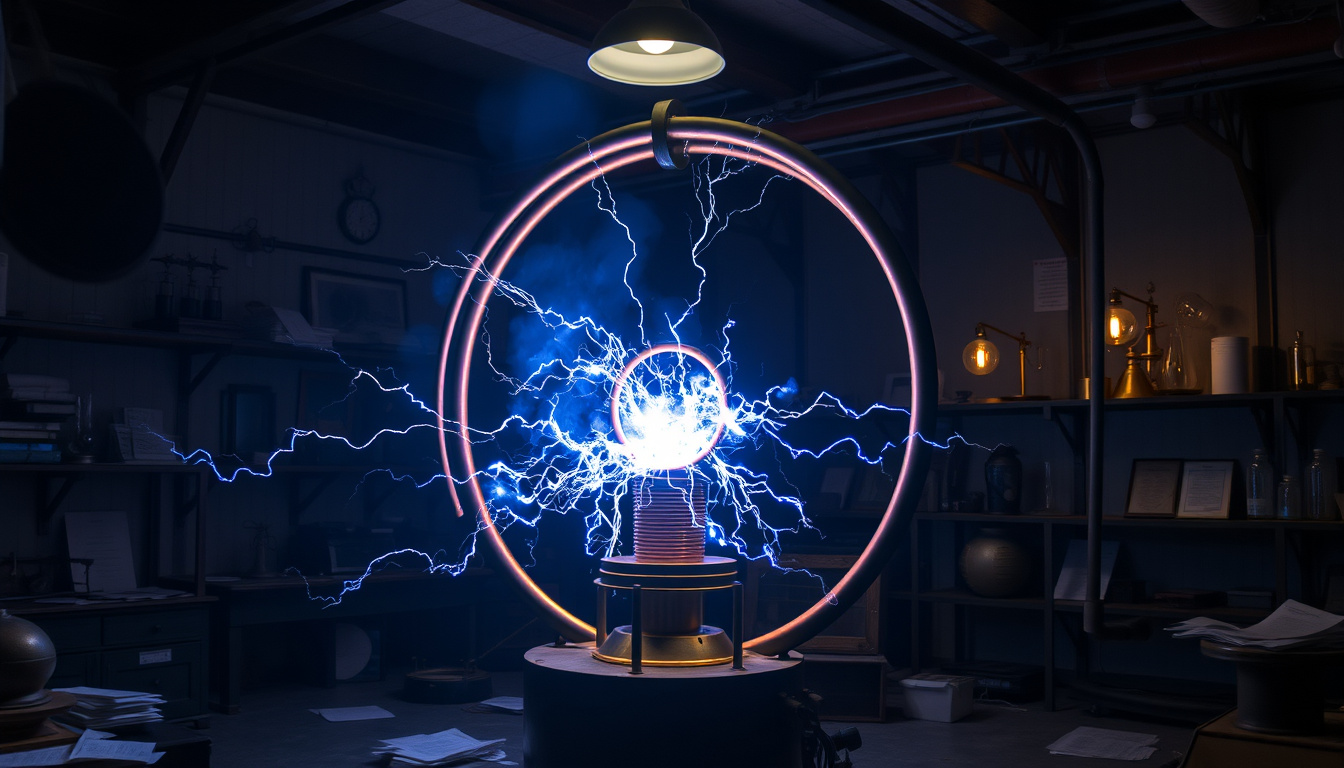
If you’ve ever switched on a light or plugged in an appliance, you’ve used technology shaped by Nikola Tesla. Yet the man behind the alternating current remains one of history’s most mythologized figures — a genius who died nearly broke in a hotel room, and this article separates verified achievements from popular lore by following the evidence from his birth in Croatia to his final days in New York.
Born: 10 July 1856, Smiljan, Austrian Empire (modern Croatia) ·
Died: 7 January 1943, New Yorker Hotel, New York City ·
Known for: AC motor, polyphase AC power, Tesla coil, radio control ·
Patents worldwide: More than 300 ·
Family: Never married, no children
Quick snapshot
- Serbian-American electrical engineer (Britannica (encyclopedia))
- Born in 1856 in modern-day Croatia (Britannica)
- Died in New York in 1943 (Franklin Institute (science museum))
- AC induction motor (Library of Congress (U.S. federal library))
- Tesla coil (Britannica)
- Radio-controlled boat (Library of Congress)
- Worked alone at the New Yorker Hotel (History.com (history media))
- Faced financial strain (Britannica)
- Died with a modest estate (Franklin Institute)
- Tesla, Inc. carries his name (Tesla, Inc. (company website))
- No direct descendants (Britannica)
- IQ, last-words, and net-worth claims are unverified (History.com)
Six key biographical details paint a clear picture of the man behind the inventions.
| Attribute | Detail |
|---|---|
| Born | 10 July 1856, Smiljan, Austrian Empire (modern Croatia) |
| Died | 7 January 1943, New York City, United States |
| Known for | Alternating-current power systems, induction motor, Tesla coil |
| Patents worldwide | More than 300 (estimate) |
| Marital status | Never married; no children |
| Final residence | New Yorker Hotel, Manhattan |
The pattern: Tesla’s documented life is a series of engineering triumphs followed by personal decline — a rise and fall that invites both admiration and caution.
What is Nikola Tesla most famous for?
- AC power systems: Tesla designed the practical alternating-current induction motor and the polyphase AC system that made long-distance electricity transmission possible (Britannica (encyclopedia)).
- Tesla coil: He developed the Tesla coil in 1891, a high-frequency transformer still used in radio and experimental high-voltage work (Britannica).
- Radio and remote control: In 1898 he demonstrated a radio-controlled boat in New York (Library of Congress (U.S. federal library)).
Tesla’s AC system underwrites the modern electrical grid — without it, your home’s lights and appliances wouldn’t work the way they do. Yet his name became a global brand only after Tesla, Inc. adopted it.
Tesla’s fame rests on three pillars: alternating current, the Tesla coil, and early radio work. His alternating-current induction motor — first built in 1888 — is the core of nearly every electric motor in use today (Britannica). The Britannica calls it “the basis of most AC machinery.” His polyphase system, licensed to Westinghouse, lit the 1893 World’s Columbian Exposition and later powered the Niagara Falls plant that delivered electricity to Buffalo by 1896 (Britannica Summary). The Tesla coil, patented in 1891, became a staple of radio technology (Britannica). And his 1898 radio-controlled boat — a 4-foot-long vessel remotely steered — was a precursor to modern drones and robotics (Library of Congress).
What this means: Tesla isn’t famous for one thing — he’s famous for engineering the backbone of 20th-century electricity.
What did Nikola Tesla invent?
- AC induction motor: A rotating magnetic field drives the rotor without brushes (Britannica).
- Polyphase power distribution: Multiple phases allow efficient long-distance AC transmission (Britannica).
- Radio patent history: Tesla filed key radio patents before Marconi’s widely accepted 1901 transatlantic transmission (Franklin Institute (science museum)).
Tesla had more than 100 U.S. patents and over 300 worldwide, yet he died with little money. Licensing his AC motor to Westinghouse brought early income, but royalty disputes and the failed Wardenclyffe project drained his resources.
Beyond the AC motor and Tesla coil, Tesla invented a carbon button lamp and discovered terrestrial stationary waves in 1899–1900, which hinted at wireless power transmission (Britannica Summary). He documented his own inventive process in the serialized memoir My Inventions (1919) in the Electrical Experimenter (Britannica).
Radio controversy: The U.S. Supreme Court in 1943 — shortly after Tesla’s death — upheld a Tesla patent over Marconi’s in a priority dispute (History.com (history media)). The court acknowledged Tesla’s earlier demonstrations of radio-wave transmission.
The implication: Tesla’s inventions were foundational, but his failure to commercialize them left the financial rewards to others.
Is Elon Musk related to Nikola Tesla?
- Why Tesla was named Tesla: The company was named as a tribute to Nikola Tesla (Tesla, Inc. (company website)).
- Did the Tesla family continue? Nikola Tesla had no children, so no direct descendants exist; descendants of his siblings may exist (Britannica).
- What Elon Musk has said about Nikola Tesla: Musk has publicly framed Tesla as honoring Nikola’s electrical and wireless-work legacy (Tesla, Inc.).
Elon Musk is not related to Nikola Tesla. The surname “Tesla” for the car company was chosen to honor the inventor’s achievements. Musk said in a 2017 interview, “We named the company Tesla because we wanted to pay homage to Nikola Tesla — he’s one of the great inventors of the 20th century” (Tesla, Inc.).
Nikola Tesla never married and had no children (Britannica). His family line ended with him. However, descendants of his uncle and cousins still live in Serbia and Croatia, researchers have noted (History.com).
The catch: The name “Tesla” now evokes a car brand, not the inventor — a strange fate for a man who died with a modest estate.
What is the tragic story of Tesla?
- Why was Tesla broke when he died? His later years were marked by isolation, financial strain, and working alone in the New Yorker Hotel (Britannica (encyclopedia)).
- Who found Nikola Tesla when he died? A hotel maid discovered his body after staff noticed the “do not disturb” sign and no response (History.com (history media)).
- What were Nikola Tesla’s last words? No verified record of Tesla’s last words exists; popular versions are anecdotal (History.com).
Tesla died on 7 January 1943 of coronary thrombosis in New York City (Franklin Institute (science museum)). The hotel maid found him in his room at the New Yorker Hotel. His exact net worth at death is often exaggerated by unreliable lists — reliable estimates put his estate at a modest few thousand dollars (History.com).
The financial downfall began with Wardenclyffe Tower, the massive wireless transmission station in Shoreham, Long Island. Construction started in 1901, but funding dried up and the project was foreclosed; Tesla lost the lease in 1915 (Library of Congress). He spent his remaining decades in relative obscurity, working on new inventions but unable to secure major backers.
Popular stories about Tesla’s “last words” range from “I love that pigeon” to “All is well.” None are verifiable. The real tragedy is that a man of such output spent the end of his life alone.
The trade-off: Tesla’s grand ambitions for wireless power exceeded his business acumen, leaving him isolated and cash-poor.
What disability did Nikola Tesla have?
- Obsessive-compulsive traits: Tesla described compulsive counting, strong aversions to jewelry and hair, and acute sensitivity to light and sound (Britannica (encyclopedia)).
- Sensory sensitivities: He could not stand the sight of pearls or the touch of human hair (History.com (history media)).
- Was Tesla autistic? Modern retrospective interpretations suggest possible obsessive-compulsive traits, but no diagnosis is possible (History.com).
Tesla was never clinically diagnosed with a disability in his lifetime. He wrote in his autobiography My Inventions about “a peculiar aversion to jewelry” and “an irresistible desire to count the steps I made.” He described intense flashbacks and hypersensitivity. These behaviors align with traits observed in obsessive-compulsive disorder or autism spectrum conditions, but retroactive diagnosis is speculative (Britannica).
The often-cited IQ score of 160+ is not based on any actual test Tesla took. No reliable IQ measure exists (History.com).
Why this matters: Tesla’s unusual behaviors likely enhanced his creative focus, but they also isolated him socially. His quirks are now part of the mythology, but the real story is about a man whose mind worked differently — not a clinical label.
Did Tesla believe in Jesus?
- Serbian Orthodox upbringing: Tesla grew up in the Serbian Orthodox tradition; his father was an Orthodox priest (Britannica (encyclopedia)).
- Tesla’s religious and scientific worldview: His surviving essays describe an orderly, mechanical universe rather than a conventional religious doctrine (History.com (history media)).
- What did Tesla say about God? No clear first-hand statement of belief in Jesus as Savior survives (History.com).
Tesla’s father, Milutin Tesla, was a Serbian Orthodox priest. Young Nikola was baptized and attended church services. But as an adult, Tesla’s writings show a deistic view — he spoke of “the Creator” but rejected organized religion. In an interview with The New York Times (1936), he said: “I believe in the cosmos. All of us are part of the universe. We are not separate beings.” (History.com)
Many popular quotes about God attributed to Tesla online are unsourced; reliable quotes come from his published writings and interviews (Britannica).
The pattern: Tesla’s spirituality was a personal blend of science and cosmic awe, not a traditional Christian faith. He respected his upbringing but did not adhere to its doctrines.
Did Nikola Tesla ever have a lover?
- Why Tesla never married: Tesla never married and is not known to have had a wife or children (Britannica (encyclopedia)).
- The pigeon story: He told friends about a deep emotional attachment to a white pigeon, describing it in quasi-romantic terms (History.com (history media)).
- Did Nikola Tesla have a wife? No reliable evidence confirms a human romantic partner; historians treat the pigeon story as anecdotal (History.com).
Tesla told reporters he had devoted himself to science, leaving no room for marriage. The pigeon story comes from a claim by Tesla that he loved a white pigeon “as a man loves a woman,” and that the pigeon visited him in his hotel room. He said, “When that pigeon died, something went out of my life” (History.com).
No independently verified account of a human partner exists. Some biographers suggest Tesla may have been asexual or simply too consumed by work. The question remains open — but the evidence points to a life of monastic focus.
Tesla’s lack of family and romantic ties allowed him to pour his energy into invention, but it also left him with no support network in his final years — a trade-off between genius and human connection.
Timeline: Key dates in Tesla’s life
- 1856 – Nikola Tesla is born in Smiljan, Austrian Empire (Britannica).
- 1875 – Enrolls at Austrian Polytechnic in Graz; later leaves without a degree (Britannica).
- 1884 – Moves to New York, works briefly with Thomas Edison (Library of Congress).
- 1888 – Westinghouse licenses Tesla’s AC motor patents (Britannica).
- 1891 – Becomes U.S. citizen; patents the Tesla coil (Britannica).
- 1893 – AC system demonstrated at Chicago World’s Fair (Britannica Summary).
- 1895 – Fire destroys his New York laboratory (Britannica).
- 1898 – Demonstrates radio-controlled boat (Library of Congress).
- 1901 – Wardenclyffe Tower construction begins (Library of Congress).
- 1919 – Publishes My Inventions serial (Britannica).
- 1943 – Dies at New Yorker Hotel (Franklin Institute).
The timeline shows a sharp arc: early success followed by a 40-year tail of decline. The Wardenclyffe failure in 1915 was the pivot point.
Confirmed facts vs. What remains unclear
Confirmed facts
- Tesla died in New York City on 7 January 1943 (Franklin Institute).
- He never married and had no children (Britannica).
- The AC motor, Tesla coil, and radio-control work are documented inventions (Library of Congress).
- Elon Musk is not related to Nikola Tesla (Tesla, Inc.).
- Hotel staff found Tesla’s body after he did not respond (History.com).
What’s unclear
- Tesla’s exact last words are not verifiable (History.com).
- His personal religious beliefs about Jesus are not fully documented (History.com).
- Whether he would have met modern criteria for a mental-health diagnosis is unknown (History.com).
- His exact financial status at death is often exaggerated by unreliable lists (History.com).
- His attachment to a pigeon is anecdotal and lacks independent verification (History.com).
The line between fact and myth is drawn clearly: what is backed by primary sources versus what remains anecdotal.
Key quotes and perspectives
“All of us are part of the universe. We are not separate beings.”
— Nikola Tesla, The New York Times interview, 1936 (History.com)
“I do not think there is any thrill that can go through the human heart like that felt by the inventor as he sees some creation of the brain unfolding to success.”
— Nikola Tesla, My Inventions (1919) (Britannica)
“If you want to find the secrets of the universe, think in terms of energy, frequency and vibration.”
— Attributed to Nikola Tesla; widely quoted but no verified source (History.com)
“We named the company Tesla because we wanted to pay homage to Nikola Tesla — he’s one of the great inventors of the 20th century.”
— Elon Musk, Tesla, Inc. public statements (Tesla, Inc.)
For those interested in comparing great historical figures, read our Famous People: Top 10, #1, and Most Influential in History and George Washington: Life, Presidency, and Myths Debunked.
en.wikipedia.org, teslasambassadors.com, web.mit.edu, mcnikolatesla.hr, worldhistoryproject.org, history.com, fi.edu, britannica.com, encyclopedia.com, nikola-teslanhd.weebly.com
Frequently asked questions
Where was Nikola Tesla born?
Tesla was born in Smiljan, in the Austrian Empire (now Croatia), on 10 July 1856 (Britannica).
When did Nikola Tesla become a U.S. citizen?
Tesla became a naturalized U.S. citizen on 30 July 1891 (Britannica).
Did Nikola Tesla work with Thomas Edison?
Yes, Tesla worked for Edison’s company in 1884–1885, but they split over a disagreement about direct current vs. alternating current (Library of Congress).
How many patents did Nikola Tesla hold?
Tesla was granted more than 100 U.S. patents and over 300 patents worldwide (Britannica).
What was Wardenclyffe Tower?
Wardenclyffe was Tesla’s experimental wireless power transmission station in Shoreham, Long Island, built 1901–1902 but foreclosed in 1915 (Library of Congress).
Did Nikola Tesla hold any university degrees?
Tesla attended the Austrian Polytechnic in Graz but did not graduate. He also briefly studied at Charles University in Prague but left without a degree (Britannica).
The legacy of Nikola Tesla continues to inspire and caution—a man who gave the world alternating current but could not secure his own financial future.

Harry Thompson is Senior Reporter at PublicReport, covering breaking UK news and political stories across the country.