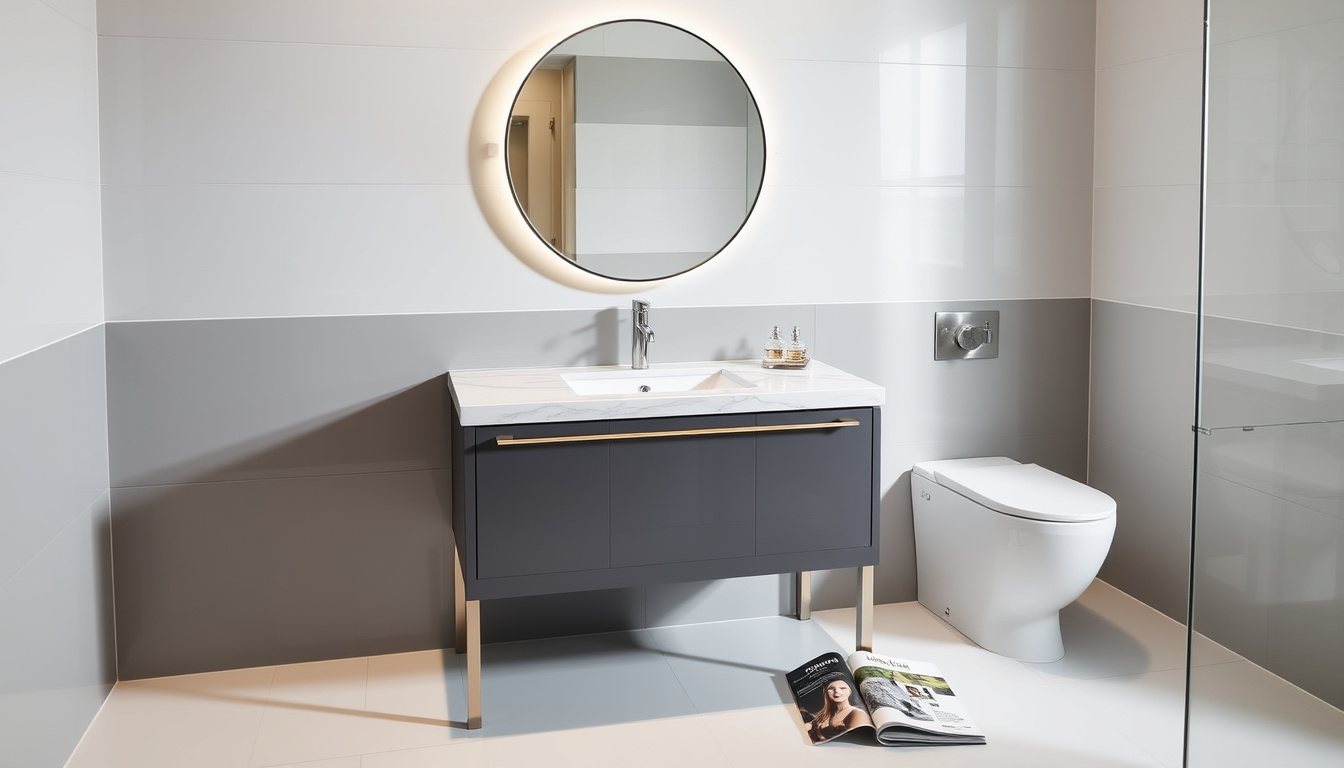
Anyone who has squeezed a basin into a compact bathroom knows the real question is never just which tap — it’s how to make the sink work harder. Irish retailers list vanity units from about €129.95 for a basic compact model to over €1,500 for designer double units, so the price gap is real and the choices are wide.
Typical width of compact vanity unit: 600mm ·
Common clearance for floating vanity from floor: 8 to 12 inches ·
Price range for entry-level vanity unit: €200 to €400 ·
Number of main vanity types: 2 (floor-standing and wall-hung/free-standing)
Quick snapshot
- Floating vanities require a solid wall or specialist fixings (McGarry Tiles (Irish bathroom and tile retailer))
- Standard vanity unit height is around 32 inches (820mm) and 600mm is the most common width (Southern Monitor (Irish bathroom market guide))
- How long the floating-vanity trend will stay dominant
- How material shortages will affect 2025 pricing
- Whether wall-hung units hold resale value better than floor-standing models
- Typical installation time for a standard floor-standing unit (1–3 hours) – data unverified
- Average lifespan of a well-maintained vanity unit (10–15 years) – data unverified
- 2025: wall-hung units lead the design direction in Irish bathrooms (Southern Monitor (Irish bathroom market guide))
- Measure the space and check the wall construction before you browse
- Compare floor-standing and wall-hung prices at Irish retailers
- Budget €250–€350 for a cloakroom, €500–€900 for a family bathroom
Key facts: vanity units at a glance
Six listed price points across four Irish retailers, one pattern worth holding onto: the widest gaps come from build quality and fittings, not from the size of the unit.
| Model or range | Listed price | Reference |
|---|---|---|
| Cloakroom vanity units | €269–€304 | Big Bathroom Shop Ireland (national bathroom retailer) |
| Sonas Otto Plus 500mm (floor-standing) | €243.50 | TJ O’Mahony (Irish builders’ merchant) |
| Sonas Otto Plus 600mm (floor-standing) | €284.15 | TJ O’Mahony (Irish builders’ merchant) |
| Acumen 500mm (floor-standing) | €865.73 | McGarry Tiles (Irish bathroom and tile retailer) |
| Modern floor-standing range | €936.15–€1,146.91 | The Bathroom Boutique (Irish bathroom specialist) |
| Tavistock Lansdown 550mm (freestanding) | €957.20–€960.10 | The Bathroom Boutique (Irish bathroom specialist) |
The pattern: you can buy a 500mm vanity for €243.50 or for €865.73 depending on brand and construction. Size matters far less than the hardware attached to the doors and the moisture resistance of the cabinet.
What is the current trend for bathroom vanities?
Rise of floating vanities
- Wall-hung (floating) units are the lead style in new bathroom designs
- Floor-standing cabinets still anchor the value end of the market
- Wall-hung models now appear at mid-range prices, not just premium showrooms
The shift is easy to spot in Irish showrooms and online ranges: the floating silhouette has become the default look for modern bathrooms. The reason is practical as much as aesthetic. A wall-hung unit leaves the floor open, and in a small bathroom that open strip of floor makes the whole room read as larger.
Floor-standing cabinets have not disappeared. They hold the value end of the market because they are cheaper to make, simpler to fit, and work in any room regardless of wall construction.
The retail data in the key facts table above shows how much cabinet you still get for your money at the traditional end of the market.
The trade-off: floating vanities win on looks and floor cleaning; floor-standing wins on cost and simplicity.
Popular materials and finishes
- Natural stone worktops lead the countertop choices in current ranges
- Matte finishes are the default; high-gloss has receded
- Neutral, warm tones anchor the colour direction
The material story matches the silhouette: natural, quiet, and low-maintenance. A natural stone top adds weight and cost, so budget ranges use ceramic or compact laminate that mimics the look. Matte finishes hide water marks better than gloss — a real advantage in a room used twice a day by everyone in the house.
What this means: you get the best performance from matte, natural surfaces that hide wear and need less upkeep.
Color and style direction
The 2025 direction is neutral, warm, and matte — the opposite of the glossy white that dominated previous cycles.
Neutral tones and minimalist designs lead the market, with soft whites, beiges, and warm greys replacing stark chrome and gloss.
The implication: pick a vanity that blends with the wall rather than contrasting — it makes the room feel larger and less dated as trends shift.
How much should a quality bathroom vanity cost?
Budget vs premium options
- Entry level: compact floor-standing units start below €300 at most Irish retailers
- Mid-market: traditional floor-standing models cluster in the €700–€960 band (key facts table above)
- Premium: designer and double units are a separate price league
The jump from entry level to mid-market is where the quality shows. Around €700–€900, the cabinet uses denser board, the drawers run on soft-close runners, and the worktop is a material that will not stain. Below €300, you are paying for a basin and a box, and the difference shows up in daily use rather than in product photos.
The €500–€900 band is where Irish buyers get most of the premium experience without the premium price. At the bottom end you buy a basin and a box; at the top end you buy hardware, materials, and a surface that still looks right a decade on.
Where the money goes
Compare what the money buys at the same size. The key facts table shows a 500mm Acumen floor-standing unit at €865.73, while TJ O’Mahony’s Sonas Otto Plus 500mm sits at €243.50. Both are compact floor-standing units with a basin. The €600 gap pays for denser board, better hinges, a more durable worktop, and design details that do not show in a thumbnail.
The pattern: the price jump is not about size — it is about how long the cabinet will last in a damp room.
Where to find cheap vanities
If you want the lowest price, focus on cloakroom-sized units — the cheapest band in the key facts table above starts at €269. But the cheapest listing is only the best deal if the hardware and moisture resistance survive Irish bathroom humidity.
Online bathroom retailers and builders’ merchants are the best hunting grounds for discounted units. The key facts table above lists the current spread: cloakroom units from €269, 500mm floor-standing units from €243.50.
The catch: cheap units save money upfront but often need replacement sooner, especially in high-use bathrooms.
What is the best vanity unit for my bathroom?
Choosing by bathroom size
- 600mm unit fits most cloakrooms; 800mm–1000mm gives extra storage when space allows
- Wall-hung units make a small room feel larger
- Depth matters as much as width — measure floor space before buying
Start with the floor plan, not the catalogue. If the bathroom is on the compact side, a 600mm wall-hung unit is usually the sweet spot: it leaves walking space and returns the floor area visually. If the room is wider, an 800mm or 1000mm unit gives you more drawer space without dominating the room.
Depth matters too. A vanity that is too deep will crowd the toilet or the door swing, even if the width looks right on paper. Measure from the wall to the front edge you can live with, then compare that against the spec sheets on retailer sites.
What this means: measure twice, buy once — the wrong depth ruins the layout faster than the wrong width.
Key features to look for
- Storage layout: drawers for everyday items, cupboard space for bulky bottles
- Hardware: soft-close runners and hinges last longer under daily use
- Wall-hung models: confirm the wall construction before you commit
The storage layout is the part people get wrong. Drawers are better than shelves for small items, and a mix of one drawer and one cupboard works in most family bathrooms. If the unit has doors only, you will end up stacking bottles in ways you regret.
Moisture resistance is the hidden spec. Bathroom cabinets face humidity every day, so look for sealed edges, quality hinges, and a solid top surface. The unit that looks identical in photos can perform very differently after a year of Irish bathroom air.
The implication: the best vanity matches your storage habits and wall type, not the showroom display.
Single vs double vanities
- Single units: ideal for small bathrooms, one sink with storage below, widths from 600mm to 900mm
- Double units: two sinks for shared use, extra storage and counter space, need a larger room
A double vanity is a luxury that only makes sense when two people genuinely share the bathroom at the same time. If that is your household, the extra counter space earns its floor area. If not, a single unit with a well-planned storage layout will serve a family better.
The trade-off: there is no single best vanity, only the best fit for the room and the people using it.
What are the key differences between a floating vanity and a standard vanity?
Installation differences
- Floating vanities require a reinforced wall for support
- Standard vanities are easier to install and more stable
- Floating vanities create an illusion of space and easier cleaning
A floating vanity trades installation simplicity for a lighter, more open bathroom. The wall does the structural work and the floor below becomes easy to clean — but the fitting has to be right the first time.
If the wall is questionable, floor-standing is the rational choice, whatever the style magazines say.
The pattern: installation time and cost reflect the wall work, not the cabinet itself.
Pros and cons of floating
Upsides
- The open floor below makes a small bathroom feel larger
- Under-sink cleaning is straightforward
- The slim profile suits modern, minimalist design
Downsides
- Requires a solid wall or specialist fixings
- Installation is less DIY-friendly than a floor-standing unit
- Entry prices run higher — the wall-hung Lucca starts at €669.00 (McGarry Tiles (Irish bathroom and tile retailer))
The list makes the trade-off explicit. A floating vanity is the better-looking, easier-to-clean choice, but it asks for more money and a more careful installation.
The catch: for a rental property or a quick refresh, the floor-standing unit is the lower-risk option.
Height and clearance
Standard clearance for a floating vanity is 8 to 12 inches from the floor — enough to clean under and visually lift the room. Floor-standing units sit directly on the floor, so no clearance needed.
What this means: if easy floor cleaning matters more than installation simplicity, floating wins.
Are bathroom vanity units worth it?
Vanity vs pedestal sink
- Pedestal sinks are cheaper but offer no storage
- Vanity units combine basin, storage, and counter space in one purchase
- Entry-level vanity units cost only a little more than a decent pedestal sink setup
The storage argument is the one that settles most debates. A pedestal sink can cost half as much as a basic vanity, but it gives you nowhere to put soap, towels, or cleaning supplies. In a small bathroom, that missing storage is the difference between a tidy room and a cluttered one.
For an Irish homeowner, the vanity is the most-used surface in the bathroom. The €200–€300 saved on a basic unit shows up every morning in sticky drawers and water spots on an undersized counter.
The pattern: the cost difference is small; the daily usability difference is large.
Long-term value and resale
A quality vanity also improves the room’s resale value. Buyers read a well-fitted, well-stored bathroom as a sign that the rest of the house has been looked after. With a typical lifespan of 10–15 years for a well-maintained unit, the cost spreads thin across a decade of daily use.
The implication: spend on quality once and avoid replacement costs later.
Cost savings from added storage
- A vanity replaces two purchases: a basin and a separate storage cabinet
- Built-in storage keeps counters clear, so surfaces stay cleaner and last longer
- Wall-hung units avoid the cost of a plinth and legs
The cost logic is simple. If you would otherwise buy a pedestal sink and a wall cabinet, a vanity unit does both jobs in one footprint — usually for less than the combined price. That makes it one of the better value purchases in a bathroom renovation.
The verdict: for almost every bathroom, a vanity unit earns its place — not because it is trendy, but because it combines basin, storage, and counter into one purchase.
Floating vs floor-standing: side-by-side comparison
Four comparison points, one trade-off: the floating vanity asks more of your wall and less of your floor.
| Comparison point | Floating / wall-hung | Floor-standing |
|---|---|---|
| Installation | Needs a solid wall or specialist fixing kit | Free-standing on the floor; simpler to fit |
| Floor cleaning | Open floor underneath, easy to clean | Hard to reach below and behind |
| Space effect | Makes a small bathroom feel larger | More visual weight, traditional look |
| Best for | Modern ensuites and compact bathrooms | Family bathrooms, rentals, quick installs |
The price gap between the two forms is the part most buyers miss. McGarry Tiles lists the 500mm wall-hung Lucca from €669.00 to €735.50 (McGarry Tiles (Irish bathroom and tile retailer)) — nearly three times the floor-standing Sonas Otto Plus at €243.50 (TJ O’Mahony). Both hold a basin and store toiletries. The premium pays for the wall-fixing system, the slimmer profile, and the open floor effect, not for extra storage space.
Floating vanities: pros and cons
If you are torn between the two forms, the short list below is the one to weigh.
Upsides
- The open floor below makes a small bathroom feel larger
- Under-sink cleaning is straightforward
- The slim profile suits modern, minimalist design
Downsides
- Requires a solid wall or specialist fixings
- Installation is less DIY-friendly than a floor-standing unit
- Entry prices run higher — the wall-hung Lucca starts at €669.00 (see the comparison above)
The list makes the trade-off explicit. A floating vanity is the better-looking, easier-to-clean choice, but it asks for more money and a more careful installation. For a rental property or a quick refresh, the floor-standing unit is the lower-risk option.
What we know and what’s still uncertain
Confirmed facts
- Floating vanities require a solid wall or specialist fixings (see the snapshot above)
- Standard vanity unit height is around 32 inches (820mm) (see the snapshot above)
- 600mm is the standard compact width across Irish ranges (see the snapshot above)
What’s unclear
- How long the floating-vanity trend will stay dominant
- How material shortages will affect Irish prices through 2025
- Whether wall-hung units hold their value better at resale
- Whether entry-level units below €300 hold up in humid Irish bathrooms over a decade
The uncertainty is worth naming because it changes the budget conversation. Buying the cheapest unit is the riskier long-term bet; buying the trendiest is the riskier stylistic one.
What the market is saying
General vanity units are priced from about €279 to €450.80.
A Tavistock Lansdown 600mm underslung vanity unit and worktop comes in at €1,327.31.
The pattern across both: the Irish market has widened, and the range of prices is now driven by hardware and finish rather than by the size of the cabinet.
The verdict
The vanity unit question comes down to one honest assessment: what can your wall take, what does the room need, and how much are you willing to spend for the open-floor look? For an Irish buyer renovating a small bathroom, the decision is clear. If the wall is solid and the budget reaches €700+, a floating vanity earns its keep with easier cleaning and a modern silhouette. If you want maximum storage per euro and a simpler installation, a floor-standing unit from €250–€350 is the value pick. Skip the wall check, and the wall-hung unit becomes a repair bill waiting to happen — and that repair erases the style premium in one go.
deluxebathrooms.ie, deluxebathrooms.ie, mcgarrytiles.ie, mcgarrytiles.ie, bathroomwarehouse.ie, mybuildingsupplies.ie
Frequently asked questions
What size vanity do I need for a small bathroom?
Measure the width of the space first. A 600mm unit is the most common compact size and fits most cloakrooms, while 800mm and 1000mm widths give extra storage when the room allows. Wall-hung units are a smart fit for tight spaces because the open floor below makes the room feel larger.
Can I install a vanity unit myself?
A floor-standing unit is a realistic DIY job — most standard units take 1 to 3 hours to fit. Wall-hung units are more involved because they need a solid wall or specialist fixings. If you are not sure the wall can support the unit, get a professional.
What is the best material for a vanity countertop?
Natural stone is the popular choice in current ranges, with matte finishes leading the way. For durability on a budget, a ceramic top over a solid wood or moisture-resistant MDF cabinet is hard to beat. Solid wood looks premium but needs more care in a damp bathroom.
How do I clean and maintain my vanity unit?
Wipe the unit down with a soft, damp cloth and dry it after use. Avoid harsh abrasive cleaners, especially on matte finishes. Check the seal around the basin periodically and reapply silicone if it shows wear — that is what keeps moisture out of the cabinet.
Do floating vanities hide the plumbing?
Most wall-hung units are designed with a fixed panel or plinth option that hides the trap and pipework, keeping the under-sink area clean. Ask the retailer how the model you are considering handles the waste pipe before you order.
Is a single or double vanity better for a family bathroom?
A double vanity is worth it when two people regularly use the bathroom at the same time. It gives you two sinks and more storage, but it takes up significantly more floor space. In a compact bathroom, a wide single unit (1000mm to 1200mm) with a large cabinet usually does the job.
What is the standard depth of a bathroom vanity?
Depth varies by model — compact cloakroom units are noticeably shallower than full-size vanities, which is why they fit tight spaces. Measure your floor space and check the spec sheet on the retailer’s page; depth is the dimension people most often forget.

Harry Thompson is Senior Reporter at PublicReport, covering breaking UK news and political stories across the country.