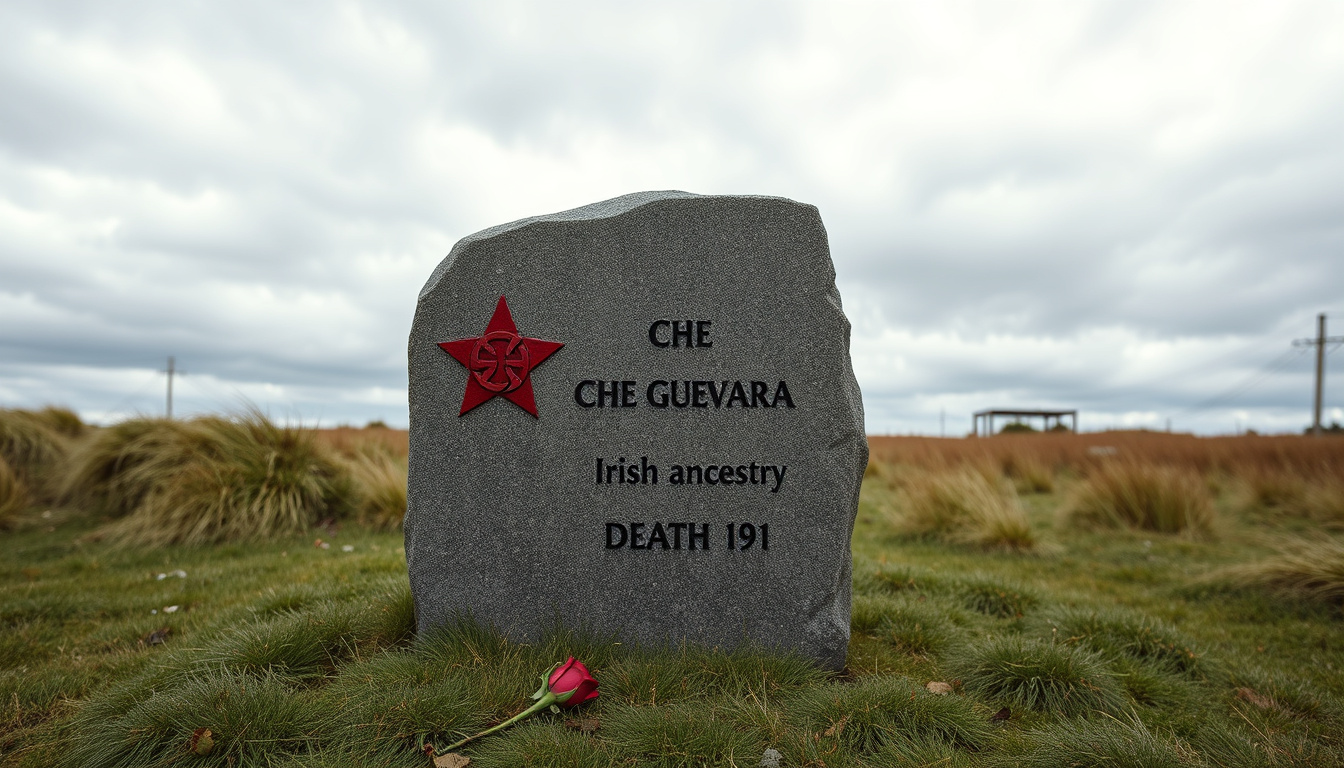
Few faces from the 20th century are as instantly recognizable as Che Guevara’s — the beret, the gaze, the star — but behind that iconic portrait lies a life that provokes as much debate as admiration. This article separates verified facts from the mythology, tracing his journey from an Argentine medical student to a revolutionary commander, and examining the legacy that still divides opinion today.
Full name: Ernesto “Che” Guevara de la Serna ·
Born: May 14, 1928, Rosario, Argentina ·
Died: October 9, 1967, La Higuera, Bolivia ·
Role in Cuban Revolution: Key commander alongside Fidel Castro ·
Famous quote: “Hasta la victoria siempre”
Quick snapshot
- Full name: Ernesto “Che” Guevara de la Serna (Encyclopaedia Britannica)
- Born in Rosario, Argentina on May 14, 1928 (Encyclopaedia Britannica (Encyclopaedia Britannica)
- Executed on October 9, 1967 in La Higuera, Bolivia (BBC History)
- Had Irish ancestry through paternal great-grandfather Patrick Lynch (The Irish Story)
- Exact level of CIA involvement in his capture and execution (National Security Archive)
- His final words — multiple versions exist (The Guardian)
- 1928: Born in Rosario, Argentina (Encyclopaedia Britannica)
- 1955: Meets Fidel Castro in Mexico City (BBC History)
- 1956-1959: Key commander in Cuban Revolution (BBC History) (Encyclopaedia Britannica)
- October 8-9, 1967: Captured and executed in Bolivia (BBC History) (Encyclopaedia Britannica)
- His image remains a global symbol of rebellion and Marxism
- Legacy deeply polarized — revered by some, condemned by others
- Scholars continue to debate his actions and writings
Six key facts, one pattern: Che Guevara’s life was compressed into a short but extraordinarily intense arc — from a middle-class Argentine childhood to a martyr’s death in Bolivia.
| Label | Value |
|---|---|
| Full name | Ernesto “Che” Guevara de la Serna |
| Born | May 14, 1928, Rosario, Argentina |
| Died | October 9, 1967, La Higuera, Bolivia |
| Cause of death | Execution by firing squad |
| Irish ancestry | Yes, via paternal great-grandfather Patrick Lynch |
| Famous quote | “Hasta la victoria siempre” |
Was Che Guevara part Irish?
Che Guevara’s paternal Irish lineage
Yes — Che Guevara had Irish ancestry through his father’s side. His paternal great-grandfather, Patrick Lynch, emigrated from Galway, Ireland to Argentina in the 18th century, according to The Irish Story (Irish history website). The World notes that Patrick Lynch was born in Galway in 1715 (The World, public radio international). His mother’s side had no Irish roots. Encyclopaedia Britannica (authoritative reference work) describes the family as “Spanish-Irish descent.”
How Irish ancestry influenced his identity
Guevara’s father, Ernesto Guevara Lynch, publicly remarked that “the blood of the Irish rebels flowed in his son’s veins,” as reported by The Irish Story. However, the same source notes that there is limited evidence that Che personally prized his Irish heritage as much as his father did. The paternal connection remains a well-documented fact, but its emotional weight in Che’s own worldview is less certain.
The Irish ancestry is genealogically confirmed, but the extent to which it shaped Che’s revolutionary identity is unclear — his father’s pride may have overstated the influence.
The implication: The Irish link is a verified genealogical fact, but its role in his personal mythology is more ambiguous than many popular accounts suggest.
Why is Che Guevara famous for?
Role in the Cuban Revolution
Guevara was a key commander in the 1956-1959 Cuban Revolution that overthrew Fulgencio Batista. Encyclopaedia Britannica describes him as a “theoretician and tactician of guerrilla warfare” and a prominent communist figure. He met Fidel Castro in Mexico City in 1955 and joined the 26th of July Movement, later landing in Cuba aboard the Granma. After the revolution, he held senior government posts including minister of industry.
Guerrilla warfare and writings
He authored Guerrilla Warfare and other texts on Marxist theory and revolutionary tactics, which The Guardian (UK newspaper) notes are still studied by insurgent groups and academics alike. His writings emphasize the role of the “foco” — a small guerrilla force that can ignite wider revolution.
Global symbol of rebellion and Marxism
Alberto Korda’s 1960 photograph of Guevara has become one of the most reproduced images in history, adorning T-shirts, posters, and murals worldwide. HISTORY (US television network) notes that the image transcends his political legacy, making him a pop culture icon. Yet this fame is inseparable from the controversies that surround his actions.
Che Guevara is famous both for his revolutionary achievements and for the iconography that outlived him — but the two are often in tension, with critics arguing that the image sanitizes a violent record.
The pattern: His fame rests on a triple foundation — military leadership, ideological writings, and an iconic photograph — each layer appealing to different audiences.
Why was Che Guevara assassinated?
Events leading to his capture in Bolivia
After leaving Cuba in 1965 to spread revolution abroad, Guevara arrived in Bolivia in 1966. PBS American Experience (US documentary series) reports that he was captured by Bolivian Rangers on October 8, 1967 at a ravine called El Yuro. HISTORY confirms the date and location.
The execution order and justification
He was executed the following day, October 9, 1967, by a Bolivian soldier named Mario Terán. BBC History (UK public broadcaster) states that the order came from the Bolivian government. The National Security Archive (George Washington University research archive) indicates that U.S. Green Beret and CIA operatives were present and aided the operation, though the exact extent of CIA involvement in the execution decision remains unclear.
“Don’t shoot – I’m Che. I’m more valuable to you alive.”
— Reportedly Guevara’s last words, according to The Guardian
The catch: The execution was a political decision by the Bolivian authorities, but the CIA’s role in the preceding hunt and capture gives the event a Cold War dimension that historians still debate.
What did Fidel Castro say when Che Guevara died?
Castro’s public address on October 18, 1967
Fidel Castro announced Guevara’s death in a televised speech on October 18, 1967. He declared three days of national mourning in Cuba and praised Guevara as a revolutionary hero and role model, calling him
“an artist of revolutionary warfare.”
The speech is widely cited in biographical accounts and is considered a key moment in cementing Guevara’s martyrdom in Cuba.
How Castro framed Guevara’s legacy
Castro framed Guevara as a selfless internationalist who gave his life for the cause of liberation, and he proclaimed that “they will be eternal symbols of the revolutionary spirit.” This framing has been central to the official Cuban narrative of Guevara ever since.
Why this matters: Castro’s speech transformed Guevara from a fallen comrade into a lasting symbol of state-sponsored revolutionary ideology, a status that still resonates in Cuba today.
Is Che Guevara considered good or bad?
Arguments for Guevara as a heroic figure
Supporters see him as a selfless champion of the poor and a fierce opponent of U.S. imperialism. BBC History notes that he left a comfortable life to fight for what he believed in. His writings on social justice and his iconic image inspire leftist movements globally.
Criticisms of his methods and legacy
Critics point to his role in the execution of political prisoners in Cuba after the revolution. The Guardian reports that he presided over the La Cabaña prison where numerous executions took place. His uncompromising approach to revolutionary justice has drawn comparisons to other authoritarian figures.
Che Guevara’s legacy is a Rorschach test: for those who prioritize anti-imperialist struggle, he is a hero; for those who weigh individual rights against collective goals, his methods are indefensible.
The pattern: The debate is not about facts — it is about values. The same evidence can be read as principled dedication or ruthless dogma.
Upsides
- Advocated for the poor and land reform
- Opposed imperialist intervention
- Inspired revolutionary movements worldwide
- Wrote influential texts on guerrilla warfare
Downsides
- Oversaw executions of political prisoners in Cuba
- Supported authoritarian one-party rule
- His image is often commercialized, divorced from his violent record
- Militaristic approach led to death and suffering
What was Che Guevara’s famous line?
“Hasta la victoria siempre”
His most famous saying is “Hasta la victoria siempre” — “Ever onward to victory.” It appears in his farewell letter to Fidel Castro and is widely used as a rallying cry by leftist groups. Encyclopaedia Britannica cites this as his signature phrase.
Other well-known quotes
Another frequently cited line is “The true revolutionary is guided by great feelings of love,” from a letter to Carlos Quijano. The line reflects Guevara’s belief that revolutionary commitment must be grounded in human compassion — a sentiment that contrasts with the violent methods he endorsed.
Hasta la victoria siempre.
— Che Guevara’s farewell to Fidel Castro, 1965
The true revolutionary is guided by great feelings of love.
— Che Guevara, “Socialism and Man in Cuba” (1965)
The trade-off: These quotes reveal a man who was both a poet and a pragmatist of violence — a tension that makes his legacy so contested.
Timeline of Che Guevara’s life
- May 14, 1928 — Born in Rosario, Argentina (Encyclopaedia Britannica)
- 1952 — Travels through Latin America, witnessing poverty and inequality (BBC History)
- 1955 — Meets Fidel Castro in Mexico City; joins the 26th of July Movement (BBC History)
- 1956-1959 — Cuban Revolution; Guevara becomes a key commander (BBC History)
- 1959-1965 — Holds government posts in Cuba (minister of industry, etc.) (Encyclopaedia Britannica)
- 1965 — Leaves Cuba to spread revolution in Africa and South America (The Irish Story)
- October 8, 1967 — Captured by Bolivian forces in La Higuera (PBS American Experience)
- October 9, 1967 — Executed by Mario Terán under Bolivian orders (BBC History)
Confirmed facts vs. lingering questions
Confirmed facts
- Che Guevara was executed by firing squad on October 9, 1967 (Encyclopaedia Britannica)
- He played a decisive role in the Cuban Revolution (BBC History)
- He had Irish ancestry through his paternal great-grandfather (The Irish Story)
- His famous quote “Hasta la victoria siempre” is authentic (Encyclopaedia Britannica)
What’s unclear
- Exact nature and extent of CIA involvement in his capture and execution (National Security Archive)
- Full details of his final words — multiple versions exist (The Guardian)
Summary
Che Guevara remains one of the most polarizing figures of the 20th century — a man who swapped a medical career for guerrilla warfare, wrote poetry about love and revolution, and died before his 40th birthday. The facts of his life are well documented, but their interpretation depends entirely on where you stand politically. Che Guevara’s legacy demands that readers weigh the evidence rather than accept the myth.
en.wikipedia.org, de.wikipedia.org, ffrf.org, news.bbc.co.uk
Frequently asked questions
What is Che Guevara’s full name?
His full name is Ernesto “Che” Guevara de la Serna, as recorded by Encyclopaedia Britannica.
Was Che Guevara Irish?
Yes, through his paternal great-grandfather Patrick Lynch, who emigrated from Galway, Ireland to Argentina. His father often remarked on this heritage. Source: The Irish Story.
How did Che Guevara die?
He was executed by firing squad on October 9, 1967 in La Higuera, Bolivia, after being captured the previous day. BBC History confirms the details.
What was Che Guevara’s famous quote?
His most famous quote is “Hasta la victoria siempre” (Ever onward to victory). He also said “The true revolutionary is guided by great feelings of love.” Encyclopaedia Britannica cites these.
What books did Che Guevara write?
He authored Guerrilla Warfare, The Motorcycle Diaries, and several essays on Marxism and revolution. The Guardian notes their enduring influence.
Was Che Guevara a good or bad person?
Opinions are sharply divided. Supporters see a selfless revolutionary; critics condemn his role in political executions. The debate is ultimately about values, not facts. BBC History provides a balanced overview.
What is the Che Guevara flag?
The “Che Guevara flag” is not an official flag but a popular image: the iconic Korda photograph of Guevara set against a red background, used by leftist groups and activists worldwide. It symbolizes rebellion and Marxism.
Related reading

Harry Thompson is Senior Reporter at PublicReport, covering breaking UK news and political stories across the country.