
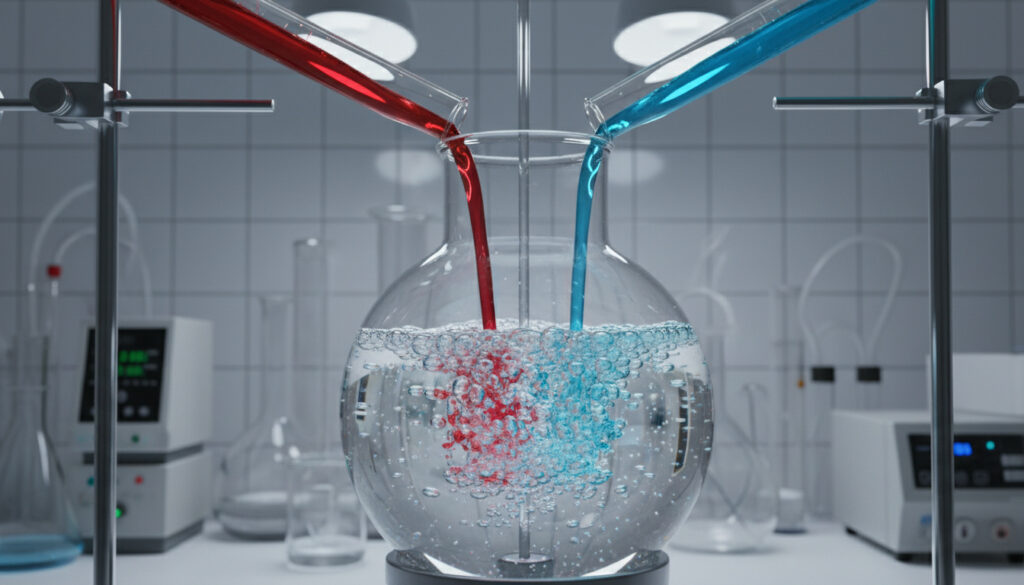
When acids and alkalis combine in aqueous solution, they undergo a chemical transformation known specifically as neutralization. This reaction generates soluble salts and water while releasing measurable heat energy, serving as a fundamental process in both educational laboratories and industrial applications worldwide.
The mechanism involves hydrogen ions from the acid interacting with hydroxide ions from the alkali, effectively canceling each other out to form neutral water molecules. This process enables the systematic preparation of specific salt compounds through controlled mixing, following the universal equation pattern acid + alkali → salt + water.
What Is the Specific Name for Reactions Forming Soluble Salts?
Neutralization
Acid + Alkali (Base)
Soluble Salt + Water
Exothermic (Heat Released)
Key characteristics define this reaction type:
- Produces exclusively salt and water when reactants fully neutralize each other
- Releases heat energy as ions bond, confirming the reaction’s spontaneous exothermic nature
- Net ionic equation simplifies universally to H⁺(aq) + OH⁻(aq) → H₂O(l) for strong pairs
- Enables laboratory preparation of pure, recrystallizable soluble salts
- Achieves pH 7 neutrality specifically with strong acid and strong base combinations
- Requires adherence to solubility rules to ensure the resulting salt dissolves completely
- Differs fundamentally from gas-forming or precipitation reaction categories
| Parameter | Specification |
|---|---|
| General Equation | Acid + Alkali → Salt + Water |
| Reaction Classification | Neutralization (Double Displacement) |
| Net Ionic Equation | H⁺(aq) + OH⁻(aq) → H₂O(l) |
| Energy Transfer | Exothermic |
| Strong Pair pH Result | Neutral (pH 7) |
| Classic Example | HCl(aq) + NaOH(aq) → NaCl(aq) + H₂O(l) |
| Solubility Outcome | Salt remains aqueous (not precipitate) |
How Do Acids and Alkalis Interact at the Molecular Level?
Ion Dissociation and Water Formation
Strong acids fully ionize in water, releasing hydrogen ions (H⁺) and corresponding anions. For example, hydrochloric acid dissociates as HCl(aq) → H⁺(aq) + Cl⁻(aq). Similarly, strong alkalis like sodium hydroxide provide hydroxide ions (OH⁻) through complete dissociation into Na⁺(aq) and OH⁻(aq), as detailed in general chemistry resources.
The defining molecular event occurs when hydrogen and hydroxide ions combine to form neutral water: H⁺(aq) + OH⁻(aq) → H₂O(l). This specific interaction, common to all Acid-alkali neutralization reactions, consumes the acidic and basic properties while generating the solvent itself.
Spectator Ions and Salt Construction
Remaining ions—typically the metal cation from the alkali and the non-metal anion from the acid—associate to form the salt compound. In the reaction between hydrobromic acid and potassium hydroxide (HBr + KOH → KBr + H₂O), the potassium and bromide ions remain as spectators until associating as potassium bromide.
Most nitrates and Group 1 salts remain soluble. Chlorides generally dissolve except with silver, lead, or mercury ions. Sulfates typically stay in solution except when combined with barium, lead, strontium, or calcium cations. Comprehensive solubility tables confirm these patterns for GCSE and undergraduate chemistry.
What Are Practical Applications and Laboratory Methods?
Preparing Soluble Salts by Titration
Chemists prepare specific salts through controlled neutralization titrations. For example, adding sulfuric acid to ammonia solution until neutrality—monitored via pH indicators—yields ammonium sulfate. Subsequent evaporation crystallizes the pure salt. This method appears in standard Royal Society of Chemistry educational protocols and represents Preparing a soluble salt by neutralisation techniques.
Medical and Industrial Implementation
Antacid tablets utilize magnesium hydroxide to neutralize excess stomach hydrochloric acid, relieving indigestion through the same reaction mechanism. Wastewater treatment facilities apply neutralization to adjust effluent pH before environmental discharge, preventing acidic or alkaline pollution.
What Variables and Misconceptions Affect Outcomes?
Weak acids and bases do not fully dissociate in solution. When writing ionic equations for weak reactants like acetic acid or ammonia, chemists retain the molecular form rather than splitting into ions. This distinction prevents equation errors in academic assessments.
Neutralization does not always yield pH 7. Mixing a strong acid with a weak base produces acidic salt solutions (pH < 7), while weak acids with strong bases create basic solutions (pH > 7). Only strong acid-strong base combinations guarantee neutral pH outcomes.
Neutralization specifically produces salt and water without gas evolution. Reactions involving carbonates that generate CO₂ or sulfides that produce H₂S gas fall under gas-forming reaction categories, not standard neutralization, as clarified in chemistry education materials.
What Is the Step-by-Step Sequence of Neutralization?
- Acid Dissociation: The acid releases hydrogen ions (H⁺) into solution; strong acids fully ionize while weak acids partially dissociate.
- Alkali Dissociation: The base provides hydroxide ions (OH⁻); Group 1 hydroxides and some alkaline earth compounds like calcium hydroxide serve as strong alkalis.
- Water Formation: Hydrogen and hydroxide ions combine to form neutral water molecules: H⁺(aq) + OH⁻(aq) → H₂O(l).
- Salt Assembly: Remaining spectator ions associate to form the salt compound, with cations from the base and anions from the acid.
- Dissolution Confirmation: The resulting salt dissolves in the aqueous medium, following established solubility guidelines to ensure clarity.
Established Facts vs. Context-Dependent Variables
Definitively Established
- The reaction name is universally neutralization
- Strong acid-strong base reactions always produce salt and water
- The process is exothermic across all valid examples
- Net ionic equation H⁺ + OH⁻ → H₂O applies to strong pairs
Variables Requiring Context
- Final pH depends on relative acid/base strength
- Partial neutralization may leave excess reactants
- Salt solubility varies based on specific ionic pairings
How Does Neutralization Fit Within Broader Chemistry?
Neutralization reactions occupy a central position in acid-base chemistry theory, representing proton transfer processes under Brønsted-Lowry definitions. Unlike oxidation-reduction reactions where electron transfer dominates, neutralization focuses exclusively on hydrogen ion and hydroxide ion annihilation to form water. For a fun science experiment, you can learn how to make slime without borax at $newsa.nl.
The reaction distinguishes itself from precipitation reactions, which deliberately form insoluble solids, and from gas-forming reactions that evolve carbon dioxide or hydrogen sulfide. This specificity makes neutralization the preferred method for laboratory demonstrations recovering soluble crystalline salts through evaporation techniques.
Authoritative Sources and Definitions
“Neutralization is the reaction of an acid and a base to form salt and water.”
— Study.com Chemistry Curriculum
Official GCSE and IGCSE chemistry specifications from examination boards including AQA and Edexcel incorporate these definitions, emphasizing the preparation of soluble salts via titration and crystallization methods. Educational resources consistently highlight the exothermic nature and ionic mechanisms described above.
Summary of Key Principles
The reaction mixing acids and alkalis to form soluble salts is definitively named neutralization. It follows the equation acid + alkali → salt + water, releases heat as hydrogen and hydroxide ions bond into H₂O, and requires attention to solubility rules and reactant strength to predict final solution properties accurately.
Frequently Asked Questions
Why is the reaction specifically called neutralization?
The term describes how acidic and alkaline properties neutralize each other, canceling out to produce a solution approaching pH 7 when strong reactants combine completely.
Does every acid-alkali mixture result in pH 7?
No. Only strong acid-strong base pairs yield neutral pH. Weak reactants create salts that hydrolyze, producing final solutions that remain acidic or basic.
How does heat factor into these reactions?
The bonding of hydrogen and hydroxide ions into water molecules releases energy, making the process exothermic and detectable through temperature measurement.
Can insoluble salts form during neutralization?
Standard neutralization targets soluble salt formation. If insoluble precipitates appear, the reaction classification shifts to precipitation rather than neutralization chemistry.
What equation should students memorize first?
H⁺(aq) + OH⁻(aq) → H₂O(l) represents the essential ionic change, while the molecular form acid + alkali → salt + water provides the practical framework.

Marcus Webb is Politics & Public Affairs Editor at PublicReport, covering Westminster, Whitehall, devolved governments, public policy and UK political affairs.